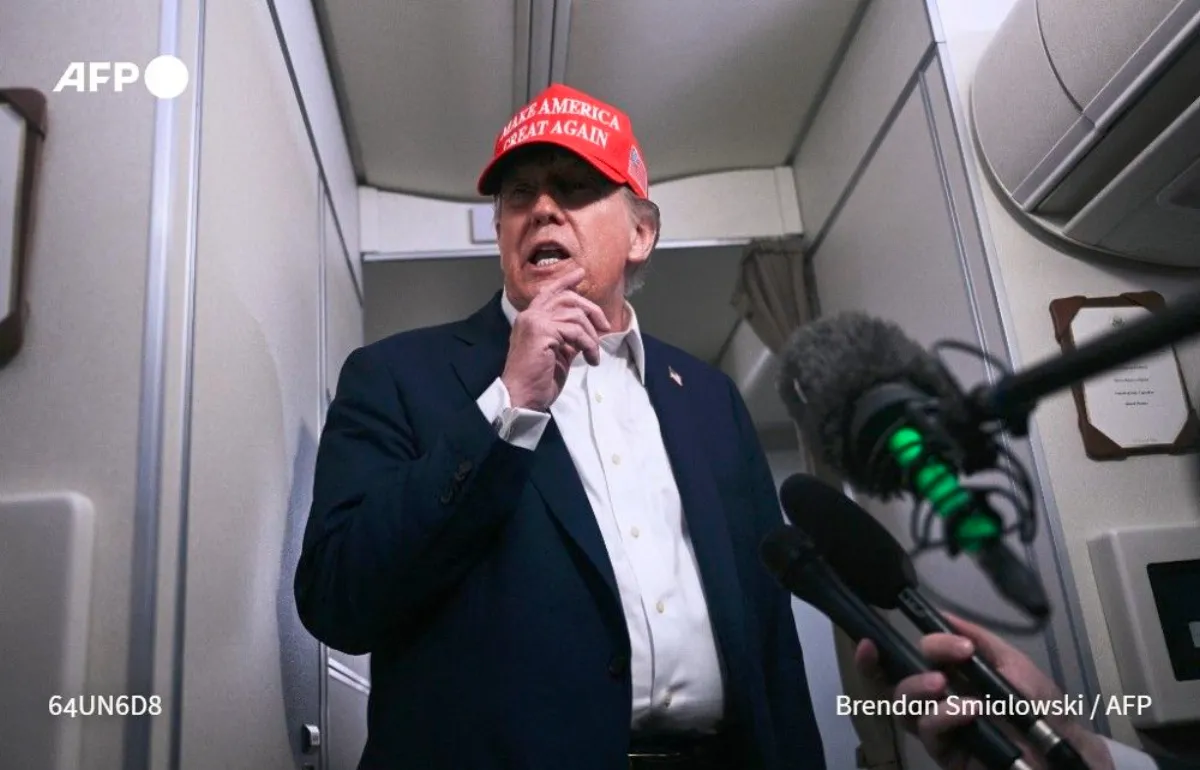
German Chancellor Olaf Scholz held crunch talks Wednesday to prevent a collapse of his fractious coalition government, hoping to focus minds on unity on the day Donald Trump was reelected to the White House.
Discord on how to revive Germany's flagging economy and carve up a tight budget has flared dangerously for weeks between Scholz's Social Democrats and his junior partners, the Greens and the Free Democrats.
A do-or-die moment could come when the three rowing parties, after a series of crisis talks to resolve the deadlock, were due to meet for coalition committee talks on Wednesday evening at the chancellery.
Finance Minister Christian Lindner of the pro-business Free Democrats has demanded sweeping economic reforms and openly flirted with the idea of bolting the unhappy alliance ahead of scheduled elections next September.
This could spark snap elections, likely around March -- or leave Scholz and the Greens trying to cling to power in a minority government.
Scholz has urged pragmatism over ideology from his two junior coalition partners and told them: "If you want to, you can reach an agreement."
On Wednesday, he pointed to the divisive US election campaign and, without directly addressing the tense coalition talks, made an appeal for German unity.
"We may have different political and social views, but we live in one country," he said. "There is more that unites us than divides us."
Vice Chancellor Robert Habeck of the Greens has warned that the US presidential election, Germany's economic woes and the Ukraine and Middle East wars make this "the worst time for the government to fail".
After Trump triumphantly declared victory, Habeck urged the warring parties in Berlin to come to their senses, telling them that now "the government must be absolutely capable of action".
Scholz and his mutinous coalition partners have drawn withering fire from conservative opposition leader Friedrich Merz of the CDU, who has demanded new elections in which polls suggest he would be the frontrunner.
"We cannot afford to argue for another year," CDU lawmaker Norbert Roettgen said after Trump's victory. "Germany is important in Europe, and if the government can't live up to that, then it must make way now."
With the German economy expected to shrink for the second year in a row, Lindner has demanded widespread measures, including corporate tax cuts, eased climate regulations and a cut in social benefits.
Most of those ideas are anathema to Scholz's SPD, Germany's traditional workers' party, and the left-leaning Greens of Habeck who is also economy minister.
In recent weeks the dispute has seen Scholz, Lindner and Habeck present contradictory economic plans and hold rival meetings with business leaders, deepening the sense of dysfunction and weakening Scholz's authority.
"While all eyes are on the US elections this week, German politics seem to have become a train crash in slow motion," Carsten Brzeski of the ING Economics think tank wrote at the start of the week.
"The German government has just entered a new stage of a slow burning political crisis that could be the last step before the eventual collapse of the governing coalition."
Scholz, Lindner and Habeck have held a series of private three-way talks, with more expected on Wednesday.
Political analyst Ursula Muench said on Tuesday that she was narrowly betting on the survival of the German government.
The US election outcome might also help set the mood music, said the head of the Academy for Political Education in the city of Tutzing.
With a Trump victory, Muench said, "there is of course a lot to be said for not also having a new government in Germany".
Scholz Scrambles To Save German Govt On Day Trump Reelected
1 year ago