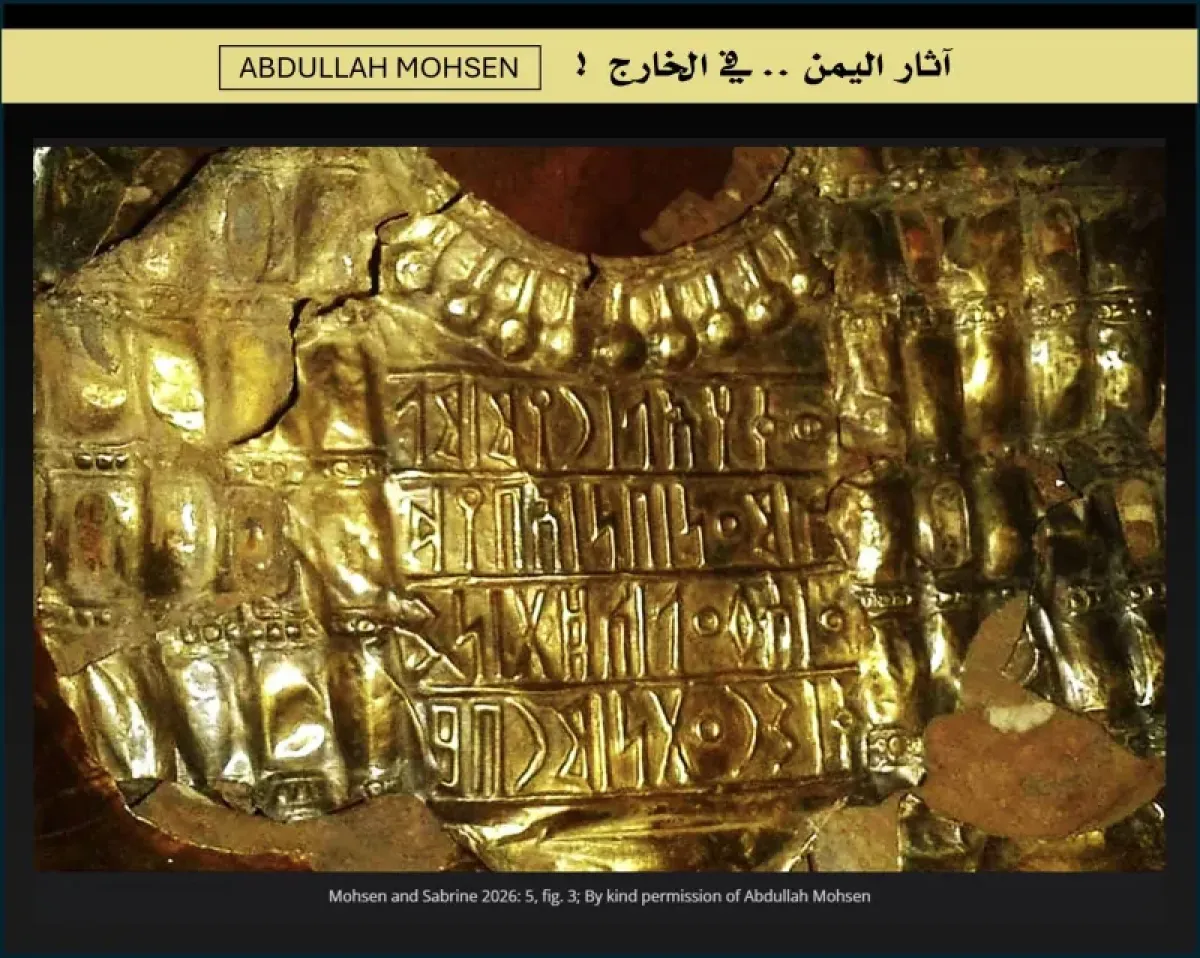
The international documentation of a golden shield attributed to the Ma'in king "Waqah'il" within the Digital Archive for the Study of Pre-Islamic Arabic Inscriptions (DASI) is a pivotal step in safeguarding looted Yemeni antiquities, preventing its illicit trade.
Abdullah Mohsen, a researcher specializing in Yemeni antiquities, stated that this documentation effectively closes the door on the shield being traded in international auctions or incorporated into private collections as a commodity. He highlighted that a significant challenge in recovering looted Yemeni artifacts is proving ownership, origin, and excavation sites, a problem that has hindered many restitution efforts globally, including in the United States and Spain.
Mohsen explained that documenting the shield in a recognized international scientific database is more than just adding a new inscription to an academic record; it represents a genuine rescue operation for a rare artifact. This provides a scientific and legal reference point crucial for future efforts to protect or reclaim the piece.
The golden shield was reportedly stolen from the archaeological site of Nashq, also known as "Al-Kharba Al-Bayda," in Al Jawf Governorate in early 2018. It surfaced months later in an Al Mashriq auction in July of the same year, initially presented as a silver shield. Its last known location was within the United Arab Emirates.
The inclusion of the artifact in the DASI archive has provided more precise and detailed information, granting it a documented scientific identity and diminishing the likelihood of its circulation in art markets or international auctions. Mohsen commended the efforts of the DASI مدونة administration, particularly Dr. Irina Rossi and Professor Mohammed Ateboush, in the scientific documentation process, viewing it as a model for international academic and research institutions contributing to the protection of cultural heritage threatened by looting and illicit trafficking.
DASI is described as one of the foremost specialized scientific projects for documenting ancient Arabic inscriptions, offering open access to thousands of archaeological texts and inscriptions from the Arabian Peninsula. It is currently managed by Italian academic institutions in collaboration with the University of Pisa and the National Research Council of Italy. Mohsen previously published information and an image of the shield in January 2022, detailing its discovery in Al Jawf before being smuggled and sold abroad. He considers its documentation in an international scientific database a significant shift, transforming the artifact from an object of unknown fate into a traceable historical witness, thereby enhancing prospects for its protection and future recovery as part of the broader effort to preserve looted Yemeni heritage.