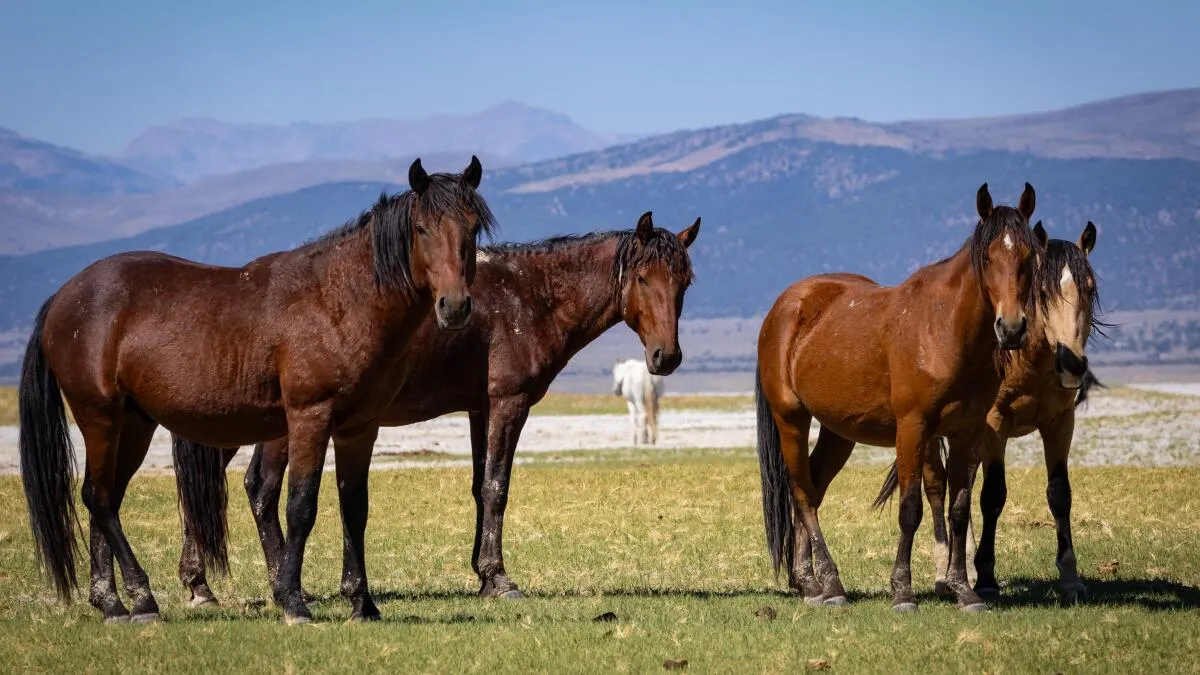
Federal officials are preparing to round up and relocate 450 wild horses in the Eastern Sierra, citing environmental damage to Mono Lake's limestone tufa formations and safety concerns for drivers. The operation, scheduled to begin July 8, has drawn praise from environmentalists but strong opposition from Native American tribes and animal welfare advocates.
The Inyo National Forest plans to initiate the roundup of the Montgomery Pass herd, which roams outside its designated territory along the California-Nevada border. The horses will be transported to a corral in Modoc National Forest for adoption readiness. Contractors will employ helicopters and vehicles to guide the horses into holding pens, a method officials deem humane, though animal welfare groups argue it can result in injury or death. A federal bill proposing a ban on helicopter use in such operations was introduced last year.
This action follows an announcement over a year ago by the U.S. Forest Service and Bureau of Land Management to remove horses that had strayed beyond their allotted lands. The horse population in the area has grown significantly, from an estimated 50 in 1971 to approximately 700 in 2024, far exceeding the land's carrying capacity. The origins of this herd are debated, with some suggesting links to historical mustang drives and others to horses lost in the High Sierra in 1871.
A lawsuit filed last August by a documentary filmmaker, a physician, and a wildlife ecologist challenged the removal plan, asserting a violation of the Wild Free-Roaming Horses and Burros Act. This law designates wild horses as "living symbols of the historic and pioneer spirit of the West." While the law prohibits harassment or killing of these animals on public land, federal agencies are permitted to remove "excess animals" to maintain ecological health. The lawsuit, which aimed to halt the roundup, was unsuccessful when a U.S. magistrate judge ruled in favor of the government in February.
Opponents of the roundup, including the plaintiffs in the lawsuit, plan to appeal and seek a court injunction. They contend that federal officials improperly redefined the horses' territory, reducing access to vital water sources. Tribal representatives from the Utu Utu Gwaitu Paiute Tribe and the Mono Lake Kootzaduka’a Tribe have drawn parallels between the horse roundup and historical displacements of their people, emphasizing the horses' cultural significance. They have proposed alternative management strategies, including operating a pack station and offering equine therapy, but feel their input has been disregarded by the Forest Service.
Conversely, some former state employees and long-time residents view the roundup as a necessary measure to restore ecological balance. They point to instances of wild horses damaging wetlands, consuming vegetation crucial for bird species, and displacing other wildlife. Concerns have also been raised about the rapid reproduction rate of wild horse populations, with some suggesting that euthanasia might be necessary if adoption and birth control measures prove insufficient. The 1971 act does permit euthanasia for management purposes, though Congressional budget appropriations have historically prevented its implementation. Some advocate for birth control methods as a more humane alternative.