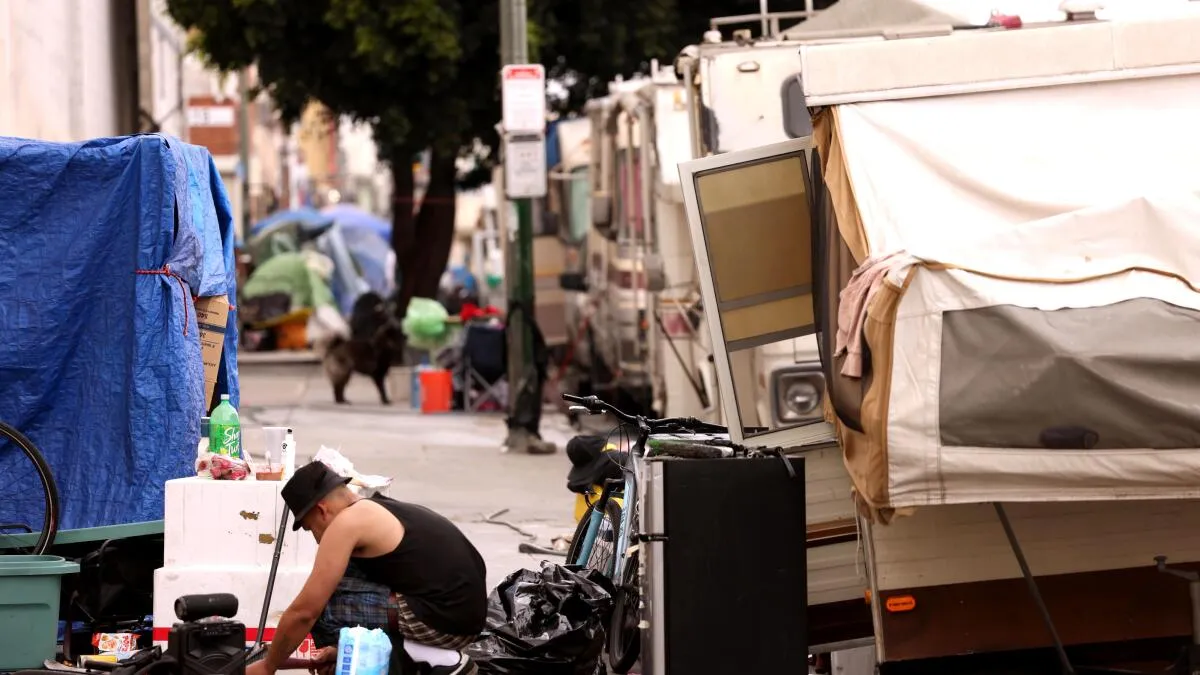
Decades of frustration and unfulfilled promises define the Skid Row community, with tents obstructing sidewalks and visible signs of hardship marking the landscape. Outreach workers navigate a challenging environment, while business owners report critical infrastructure failures, including a significant number of non-functional streetlights.
Estela Lopez, who manages a business improvement district representing local merchants, recently highlighted the severity of the situation to a city attorney candidate. Her data indicated 131 of 702 streetlights were out, 27 children were living in the area, and 72 recreational vehicles were parked there. The candidate, John McKinney, described Skid Row as a symbol of government failure, attributing the conditions to poor laws, policies, leadership, and indifference.
The persistent issues on Skid Row stem from its dual nature as a social service hub and a center for illicit activities, leading to a neighborhood in conflict with itself. While some view it as a recovery center, others see it as a reflection of societal collapse. Lopez has repeatedly raised concerns about illegal dumping, typhus, unaddressed calls to City Hall, and a constant cycle of fires, overdoses, and assaults, noting the profound personal toll of witnessing so many deaths on the streets over 24 years.
The closure of a local post office due to security concerns has been cited by Lopez as evidence of the city's inability to address criminal activity, equating it to surrender. Observations of street transactions, potential animal mistreatment, and the prevalence of drug use underscore the pervasive challenges. Merchants like Sergio Moreno, whose family has operated a check-cashing business in the area since the 1970s, express deep frustration over vandalism and blocked storefronts, and the recurring cycle of overdoses despite emergency interventions.
Street medic Dr. Susan Partovi advocates for more proactive interventions for individuals in distress, lamenting a societal complacency towards visible suffering. She notes that even when calling for assistance for individuals exhibiting severe distress, authorities do not always deem them gravely disabled. Lopez also voiced skepticism about the effectiveness of the Skid Row Care Campus, a facility offering social services and harm reduction programs, arguing it may inadvertently attract lawlessness.
Despite these challenges, progress is acknowledged by officials like Sieglinde von Deffner of the Los Angeles County Department of Homeless Services and Housing, who emphasizes the immense need and the desire for housing among the population. However, a lack of affordable housing and the complexities of long-term homelessness present significant hurdles. Professor Dennis Culhane suggests that alternative strategies beyond building new housing, such as faster SSI benefit approvals and supplemental rental assistance, could address homelessness more effectively, particularly for single adults, the disabled, and the elderly.
As the mayoral campaign intensifies, the focus shifts to whether Mayor Karen Bass and her challenger, Councilmember Nithya Raman, have concrete plans to tackle the long-standing crisis on Skid Row. While city and county responsibilities are divided, the mayor holds significant power and responsibility for addressing this humanitarian catastrophe. The community, including business owners and residents, awaits detailed proposals for solutions.