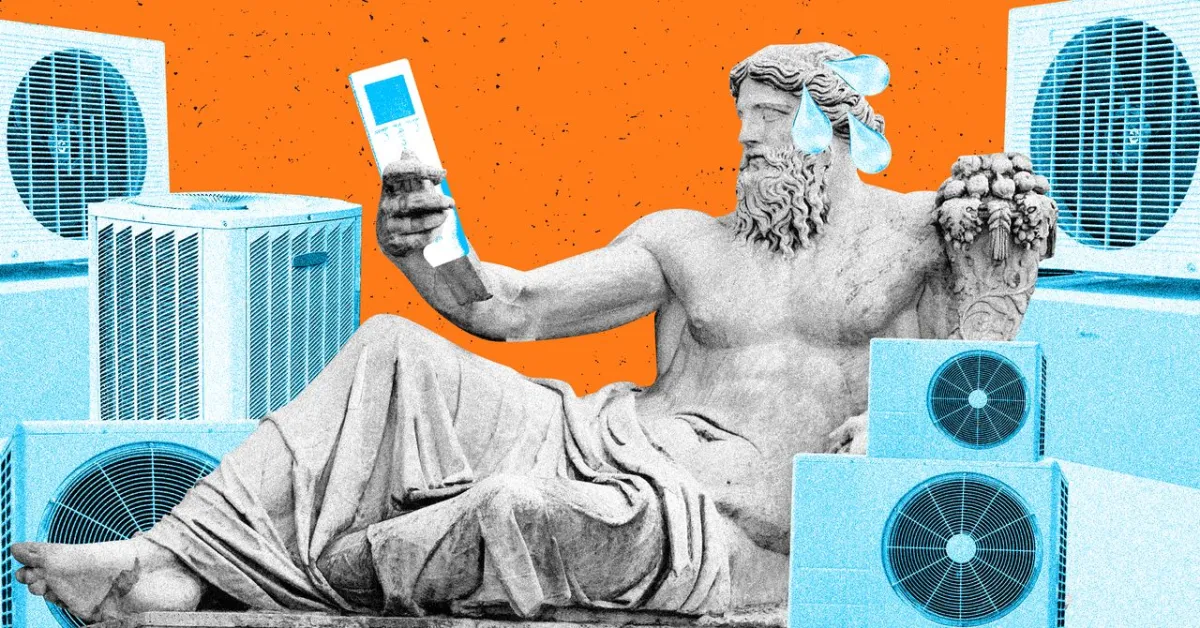
As Europe grapples with intensifying heat waves, the demand for air conditioning is soaring, prompting a debate about its future and sparking a quest for innovative cooling solutions.
Record-breaking temperatures are forcing Europeans to seek relief, with scenes of shoppers scrambling for fans and AC units becoming more common. The International Energy Agency (IEA) predicts that by 2050, two-thirds of households globally could have an air conditioner, highlighting a growing need for cooling worldwide as the planet warms.
Politicians are increasingly weighing in on the issue. While some, like France's Marine Le Pen, have pledged to expand AC access, others on the left express concerns that widespread adoption would primarily benefit the wealthy and deepen Europe's reliance on energy-intensive cooling, mirroring the situations in the US and Asia. Currently, only about 20% of Europeans have AC at home, a stark contrast to the nearly 90% in the US.
Beyond comfort, air conditioning plays a vital role in productivity, concentration, and even saving lives, particularly for vulnerable populations. Research indicates that AC prevented nearly 200,000 premature deaths among those over 65 in 2019 alone. With Europe warming faster than other continents, regions historically with mild summers are now experiencing more frequent and severe heat waves.
However, traditional AC systems present a significant environmental paradox. They account for approximately 3% of global greenhouse gas emissions, and the refrigerants used can have a global warming potential thousands of times greater than carbon dioxide. The EU is phasing out these harmful gases, but alternatives like propane and ammonia come with their own safety challenges.
This has spurred a search for refrigerant-free cooling methods. Solid-state cooling, utilizing materials that change temperature when exposed to external forces, is emerging as a promising frontier. Technologies like elastocaloric cooling, which uses the stretching and releasing of metals to absorb heat, are being developed, with prototypes showing potential for efficient room cooling. Other innovations involve semiconductive materials and magnetic fields for cooling.
Europe is positioning itself as a leader in solid-state cooling research and development, with significant opportunities for technological leadership and market maturity, contingent on private and public investment. While these advanced cooling technologies are still in early stages, they hold the potential to revolutionize how we manage heat, though their widespread adoption may follow a trajectory similar to other innovations, moving from European research to global commercialization.
Experts emphasize a "cooling hierarchy," prioritizing passive strategies like urban greening, shade, and natural ventilation to prevent buildings from overheating in the first place. Active cooling should be reserved for essential services and the most vulnerable, with examples like Paris's district cooling network offering a glimpse of smart, efficient solutions for urban environments.