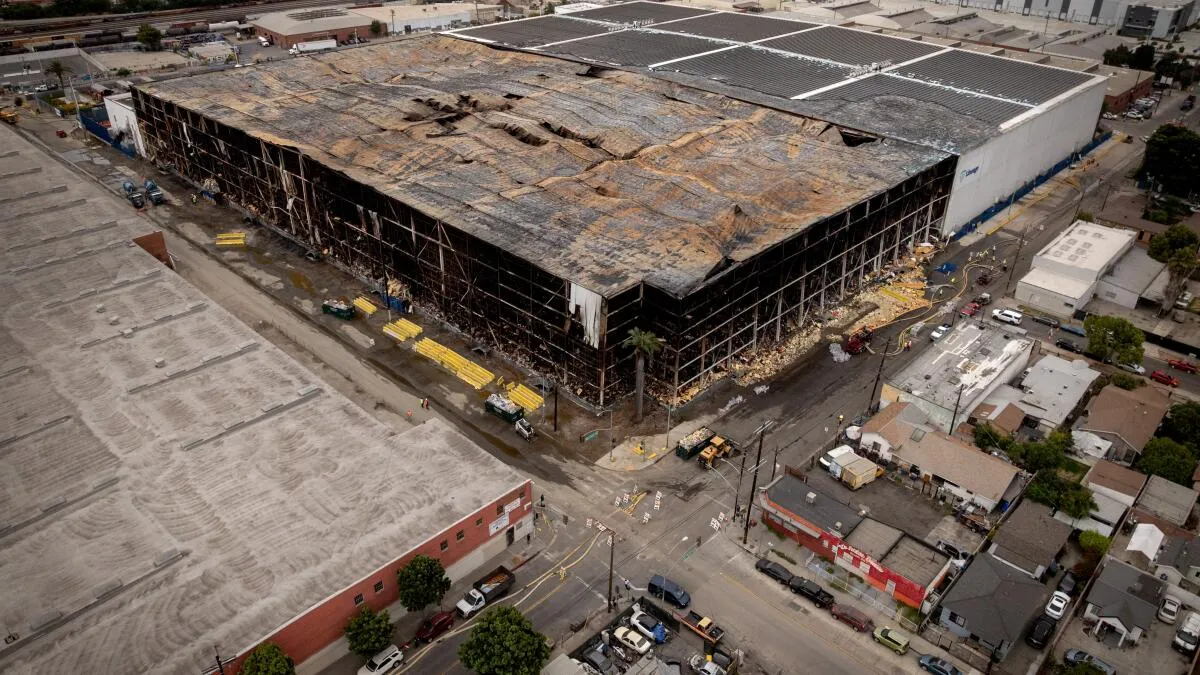
A year before a significant fire erupted at a Boyle Heights cold storage facility, the building's operator inquired with Los Angeles City Hall about removing an emergency shutdown switch from its rooftop solar panels.
Lineage, the operator of the facility, approached the city seeking to eliminate a rapid shutdown switch, a component mandated by state code for rooftop solar arrays. The company stated it was exploring alternatives it deemed safer than the rapid shutdown devices, which are intended to protect firefighters from electrical shock but have also been associated with increased fire risk. Lineage ultimately did not secure any variances or exemptions for its request. Details regarding the specific shutdown system in place at the time of the fire remain undisclosed by both Lineage and the city, with Altus Power, the owner of the solar panels, citing an ongoing investigation.
The solar panels have become a central focus in the investigation of the fire. Lineage officials believe the blaze originated during testing of the rooftop solar array by third-party subcontractors. While the Los Angeles Fire Department has not officially declared the cause of the fire, state regulations require rapid shutdown systems to quickly reduce voltage to a safe level for emergency responders. However, a recent report from technical advisory firm HelioVolta suggested that these rapid shutdown devices may contribute to fire risks, identifying them as the likely cause in a significant percentage of investigated rooftop solar system fires.
An alternative technology, microinverters, which convert electricity to a form usable by homes, is suggested by some experts as a means to mitigate fire risk. Lineage's inquiry to the city followed an earlier fire among the rooftop solar panels in 2024, the cause of which has not been disclosed by the Los Angeles Fire Department due to an ongoing investigation. Despite a shutdown switch being activated during the recent fire, officials noted the panels remained energized for several days, presenting a challenge in controlling the blaze.
Lineage has maintained that it does not own, operate, or maintain the solar panels, which are leased space. Nevertheless, company records indicate it utilized a lobbying firm to communicate with city agencies regarding the panels. Representatives from Lineage and its lobbying firm contacted the Department of Building and Safety in July 2025 to inquire about removing the rapid shutdown switch, but were informed by a manager that the switch is required by the California Electrical Code and could not be removed. A statement from Lineage later confirmed communication with city agencies about the solar array's safety, noting that no variances or exemptions were granted.
Disclosure forms reveal that Lineage also engaged its lobbying firm to address the rapid shutdown issue with the Los Angeles Fire Department and the Department of Water and Power, describing it as a "remedy relative to a rapid shutoff device alternative." The company reportedly paid $45,000 for lobbying services across these three city departments. While the Department of Water and Power stated it has no authority over rapid shutdown device requirements, it was involved in disconnecting the solar system from the customer side of the meter at the request of the Fire Department, as the solar panels continued to draw energy and posed an electrocution risk.
Fire officials acknowledged that the energy from the solar panels complicated firefighting efforts. Captain Anthony Tubbs of the Los Angeles Fire Department stated that while a shutdown switch was activated, the panels continued to generate power from sunlight for days. Fire Chief Jaime Moore indicated that the department is enhancing training for firefighters on handling large-scale solar arrays to ensure they are better informed on power shutoff procedures. The specific cause of the recent fire remains under investigation by the Los Angeles Fire Department.