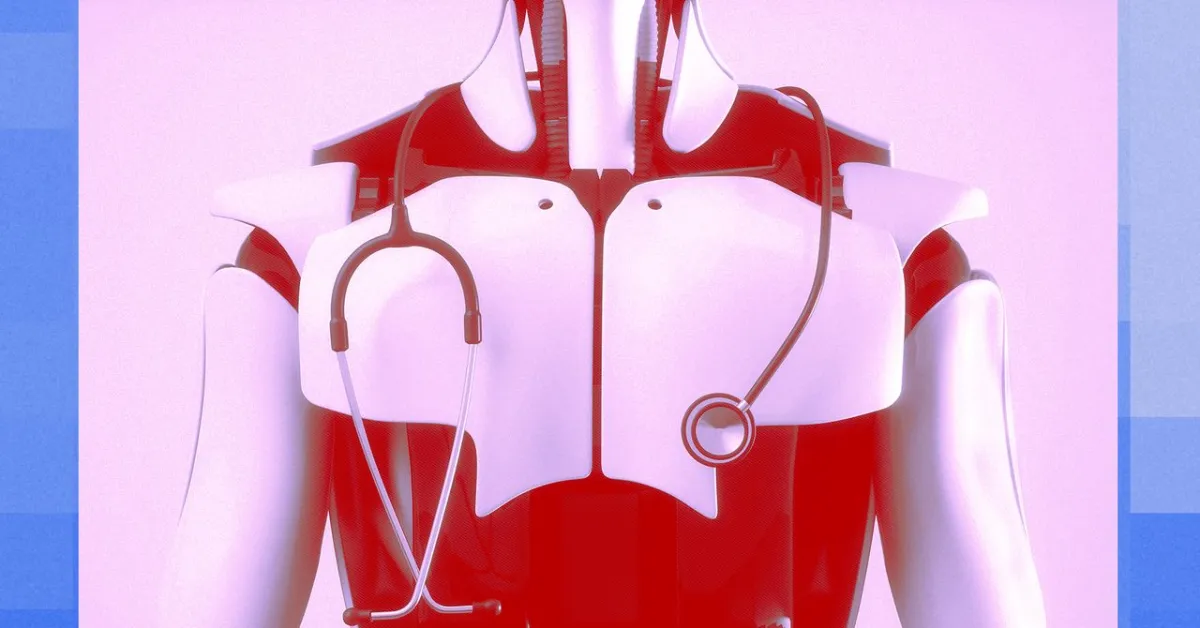
A new study suggests artificial intelligence might soon surpass human doctors, and even AI-doctor hybrids, in performing key medical functions, potentially reshaping the future of healthcare.
The article, published in the Journal of the American Medical Association, boldly posits that AI alone could deliver the best medical outcomes. Researchers analyzed studies on AI in medicine since January 2024 and concluded that AI is rapidly approaching a point where it will exceed human physicians in five fundamental medical tasks: taking medical histories, diagnosing illnesses, recommending tests, prescribing treatments, and managing chronic diseases. The study even suggests that "humans in the loop degrade AI performance," implying that doctors should step aside.
Lead author Ezekiel Emanuel, a renowned oncologist and bioethicist, admitted he once dismissed the idea of AI handling core medical functions. However, recent developments and discussions with venture capitalist Vinod Khosla, a long-time proponent of AI in medicine, have shifted his perspective. He now acknowledges the possibility that AI might eventually handle the majority of what doctors currently do.
The study's authors predict that "superior autonomous AI" could surpass humans using AI by 2030, a notion they describe as "unsettling but seems probable." This prediction has drawn criticism, with John Whyte, CEO of the American Medical Association, pointing out that some surveyed studies are simulations and don't fully support the conclusion. Whyte also emphasized that AI tools must be used within a physician-governed care plan, countering the idea of removing humans from the clinical loop.
Despite these concerns, Robert Wachter, head of medicine at UCSF, concedes the paper's argument has merit, acknowledging that AI and humans together are currently better, but that this dynamic could change. He invokes the "doorman fallacy," suggesting that like doormen who evolved to perform other valuable tasks beyond opening doors, doctors might find new roles. However, the potential for "de-skilling" as new generations of doctors rely heavily on AI for information is a significant worry, potentially accelerating AI's dominance in the field.
The debate extends beyond healthcare, raising broader questions about the future role of humans in an increasingly automated world. While AI may handle diagnostics and treatment plans, the uniquely human skills of empathy, communication, and complex surgical procedures might remain in the human domain, at least for now. The discussion highlights a potential future where AI offers first-class medical advice, prompting a wider societal conversation about human purpose in the age of advanced artificial intelligence.