Shanghai’s near two-month lockdown has turned China’s most vibrant city into a dystopian ghost town, with many of its people saying they are suffering to save Beijing’s “zero Covid” policy
Shanghai - Every day my cat and I sat by our window watching a metropolis of 25 million people shrink into a single street corner. My camera has been permanently mounted next to this two-metre square opening, my only shot of the outside world.
Since March 30, I’ve been shut inside my home, reporting on Shanghai's draconian citywide lockdown. Outside my window, the eerie silence is broken by the occasional shriek of ambulances shuttling Covid patients to hospital, and the sound of birds we had forgotten existed amid the drone of a bustling megacity. A single police officer in a hazmat suit is on patrol, while a skeletal network of delivery drivers zip up and down the street on scooters
But on social media and over the phone, I have witnessed the most modern, international and economically important city in China spiral into chaos. People running out of food, non-Covid patients not getting urgent medical care and protests erupting. More than two years after the start of the Covid pandemic, China remains at war with a virus the rest of the world has largely learned to live with. And its people are the collateral.
These past two month months, Shanghai experienced the biggest Covid wave in China since Wuhan in 2020. It was also the largest threat to Beijing’s “zero Covid” policy: a vast arsenal of measures to limit infections to a minimum, from tracking, testing and isolating positive cases to putting the general population in quarantine. According to official data, Shanghai cases hit 25,000 a day at the peak of the outbreak in April.
The world on my phone
Being stuck at home, I obviously didn’t see this all first hand. Instead, I watched it play out through the eyes of millions of others on social media. In China, online content is difficult to verify as official information is vague, and locals are discouraged from speaking with foreign media. My colleagues and I spent hundreds of hours scouring the internet to stay across all that was happening, doing no favours for our mental health.
Lockdown content has inundated WeChat and Weibo, China’s main social media platforms. People shared news, images, videos, memes and rumours among friends and in groups, all under the watchful eye of China's omnipresent internet censors. Often, things deemed “inappropriate” were deleted immediately.
But even on China’s surveilled internet, many things went viral. A mother bawling over her dead child’s body who she claimed was denied medical treatment; Covid-positive babies separated from parents if they were negative; a corgi dog clobbered to death after its owner was taken to a central quarantine facility; robot dogs with loudspeakers telling people to stay inside or get Covid tests; surveillance drones; cacophonies of residents banging pots and pans from balconies to protest against lockdowns restrictions. And that is just a few.
Some viral internet moments were memorialised in a video titled “Voices of April” released one night late last month. People both inside and outside the country shared the video over and over, faster than censors could scramble to delete them. It’s mostly scrubbed clean from the Chinese internet now, but still on YouTube with English subtitles
How did we get here?
Since 2020, China's central government has held grimly to “zero Covid”, limiting the official death toll to just over 5,000 people – a very small number compared to the one million plus who have died in the United States, which has less than a quarter of its population.
Chinese authorities clamp down hard and fast on any flare-up in cases. In many cities this means citywide lockdowns. But never in Shanghai, China’s finance and trade hub until this time. Instead, Shanghai authorities always took a “grid management” approach, localising at-risk areas for short, targeted shutdowns.
By mid-March, Shanghai cases were at 5,000 – very high by Chinese standards. Even then, the local government said: “Shanghai will not lockdown, and does not need to lockdown.”
As pressure mounted from the central government in Beijing to control the outbreak, Shanghai announced a two-phase partial lockdown starting March 28: four days in the east (Pudong), then four days in the west (Puxi). But on April 1, the first lockdown did not end even as the second started, and Shanghai entered a full-scale, citywide lockdown. Happy April Fool’s, we’d said. It is now been nearly two months.
Shanghai was not equipped to handle a lockdown of this scale. Over the phone, my colleagues and I spoke to some of the people who were caught on the wrong side of all this. A desperate son whose mother could not get life-saving chemo treatment for her lung cancer due to lack of hospital space. An exasperated resident who was sent to central quarantine to be housed with other people who had tested positive, despite already recovering from Covid. A disheartened office worker who had spent the entire lockdown in his office.
For the first time in Shanghai, it was phone and Zoom interviews only. I felt a frustrating sense of déjà vu after covering the pandemic from other countries in 2020 and 2021, a time when Shanghai was totally open and Covid-free. There were no limits on social gatherings, public venues were open, and no masks mandates in most places.
But not this time. Cracks were forming in China’s iron-clad “zero Covid” creed, and people were falling through.
‘Big Whites’: the nameless authority
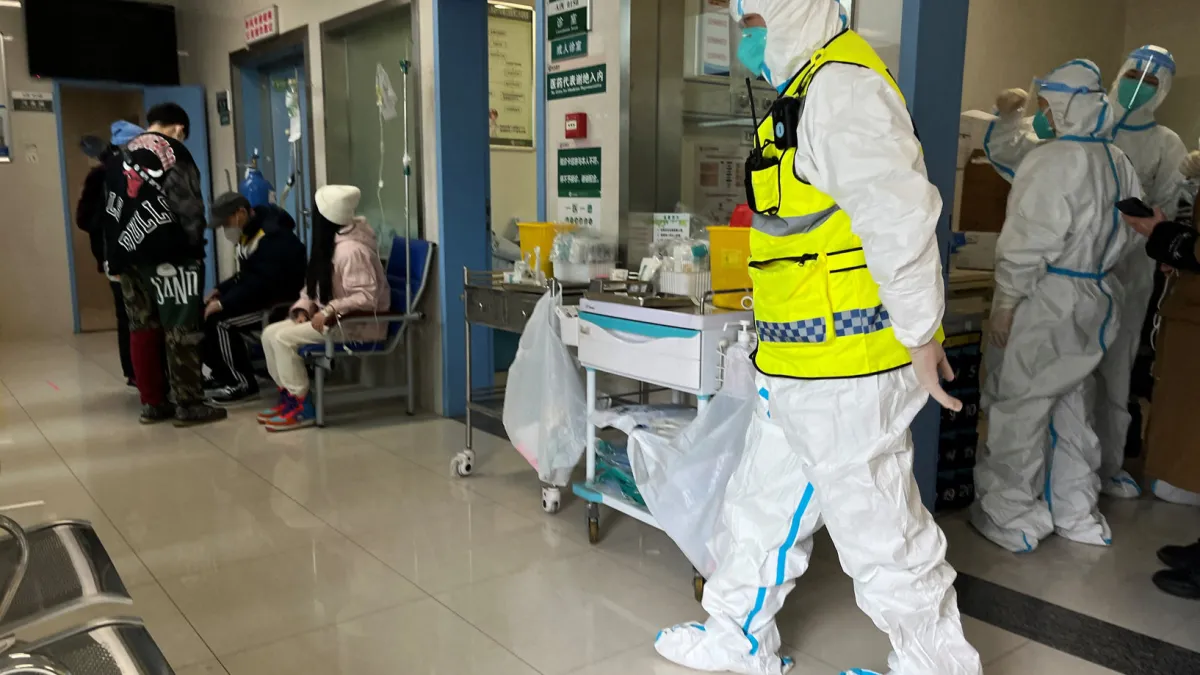
Most of the time the view outside my window was of nothing much. But if I was lucky, I captured some “Big Whites” in the streets below disinfecting, Covid testing and patrolling.
The “Big Whites” wear distinctive head-to-toe white and blue hazmat suits for Covid protection. They are medical staff, volunteers, migrant workers and even police. Dressed in this homogeneous garb, masks and face shields, “Big Whites” effectively run the lockdown as a single nameless authoritative entity. There are hundreds of thousands of them and they have become a symbol of the pandemic in Shanghai, both respected and feared.
Locked in, looking out: Shanghai’s endless zero-Covid nightmare
4 years ago