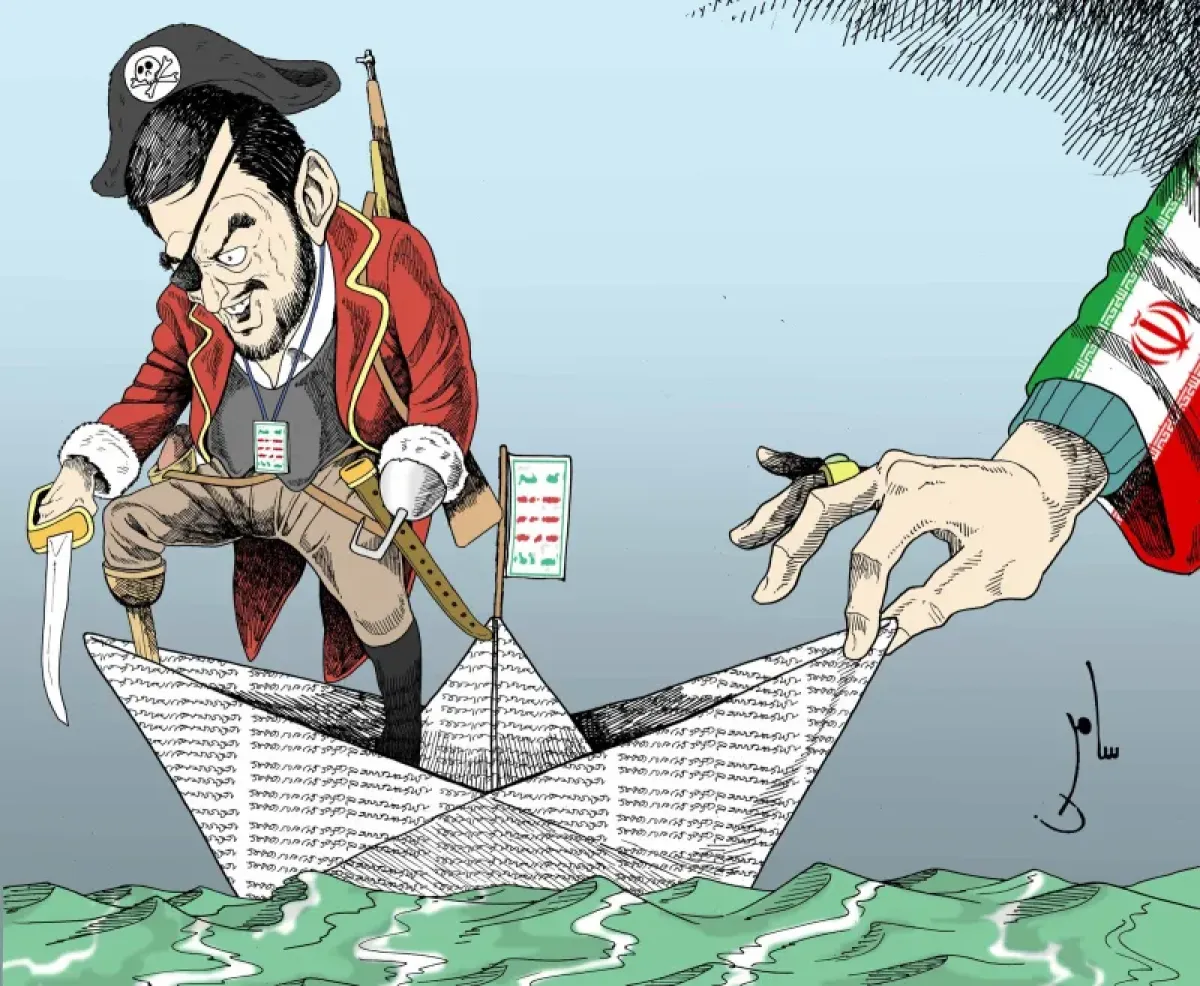
Recent statements by Iran's Quds Force commander, Esmail Ghaani, suggesting the Bab al-Mandab Strait could face a situation similar to the Strait of Hormuz, signal a significant shift in Iran's messaging to its regional and international adversaries. Tehran is no longer content with traditional pressure tactics in the Persian Gulf but is now explicitly indicating a readiness to extend threats to one of the world's most critical maritime passages via the Red Sea.
In an analytical reading of these statements, Dr. Ebtisam Al-Ketbi, founder and president of the Emirates Policy Center and a professor of political science, described Ghaani's remarks as a clear and direct threat. She stated that Iran might expand its pressure from the Strait of Hormuz to the Bab al-Mandab Strait, thereby extending its reach from the Persian Gulf to the Red Sea as part of a strategy to increase the cost of any confrontation with Tehran or its regional allies.
Al-Ketbi believes the significance of this declaration lies not in the immediate likelihood of closing the Bab al-Mandab, but in the threat of transforming it into a zone of perpetual tension and high risk for commercial vessels and oil tankers, mirroring the situation in the Strait of Hormuz over recent decades due to repeated threats and attacks linked to regional tensions.
According to Al-Ketbi, Iran is attempting through these messages to demonstrate its capacity to influence multiple strategic maritime chokepoints simultaneously. This effectively means transferring the conflict from a traditional military arena to the global economic and trade domain. While the Strait of Hormuz is the primary artery for Gulf oil exports, the Bab al-Mandab serves as the southern gateway to the Red Sea and the mandatory route to the Suez Canal, making it one of the most vital maritime passages for global trade between Asia and Europe.
Al-Ketbi posits that the mere threat to this critical passage is sufficient to provoke widespread concern among global shipping companies, energy markets, and marine insurance providers, even without concrete actions on the ground. She points out that past experiences have shown that maritime security risks do not require a complete closure of a strait to achieve their objectives; creating an unstable environment is enough to compel shipping companies to raise insurance costs or reroute to longer, more expensive paths.
The political science professor emphasized that the recent Iranian statements reflect a trend toward using the global economy as a leverage tool within regional conflicts. Any disruption in the Bab al-Mandab would not be confined to Red Sea littoral states but would extend to global supply chains, commodity prices, energy, and maritime shipping costs. She noted that ships being forced to circumnavigate the Cape of Good Hope instead of passing through the Red Sea and Suez Canal would mean a significant increase in voyage times, fuel consumption, and operational costs, ultimately impacting global markets and consumers worldwide. From this perspective, Al-Ketbi views Ghaani's statement not as a declaration of military battle, but as a threat leveraging an economic weapon with broad global impact.
Al-Ketbi further elaborated that the statements carry multiple political messages. The first is directed at Israel, conveying that continued military operations or targeting of Iran's allies in the region could lead to the opening of new fronts beyond Gaza and Lebanon. The second message targets the United States and European nations, implying that the security of international navigation in the Red Sea could become part of Iran's response equation to Western pressure.
Concurrently, these threats serve as an indirect message to Arab nations bordering the Red Sea and the Gulf, notably Egypt and the Gulf Cooperation Council states, whose economies heavily rely on the stability of trade and energy flows through these maritime corridors. Al-Ketbi highlights that the most dangerous dimension of Ghaani's statements is that Iran does not require direct military intervention to execute such threats. While Tehran has no direct border or presence at the Bab al-Mandab, it wields significant influence through the Houthis in Yemen, who have previously conducted attacks targeting commercial and military vessels in the Red Sea during periods of regional tension.
She believes the reference to the Bab al-Mandab reflects Iran's continued reliance on a "proxy war" strategy, utilizing allied groups as pressure tools to achieve political and military objectives without direct engagement in confrontation. In this sense, the threat pertains not only to the maritime passage itself but to the ability to sustain tension and deplete adversaries through multiple, geographically dispersed fronts.
Al-Ketbi pointed out that Ghaani's statements reveal a clear Iranian attempt to transform maritime passages into bargaining chips and political leverage by linking the security of global trade to the trajectory of regional conflicts. In her view, Tehran aims to convey that any confrontation with it or its allies will not remain geographically confined but could simultaneously extend to the Gulf, the Red Sea, and international trade routes.
She considers this approach to be part of what can be described as "multi-front extortion," where maritime geography, regional influence, and local proxies are employed to increase the cost of pressure on Iran and transform the global economy itself into a theater of conflict. Consequently, the president of the Emirates Policy Center believes that the threats concerning the Bab al-Mandab transcend mere political rhetoric, indicating an Iranian inclination to broaden the scope of regional tensions and directly link them to the security of international navigation and the interests of the global economy.