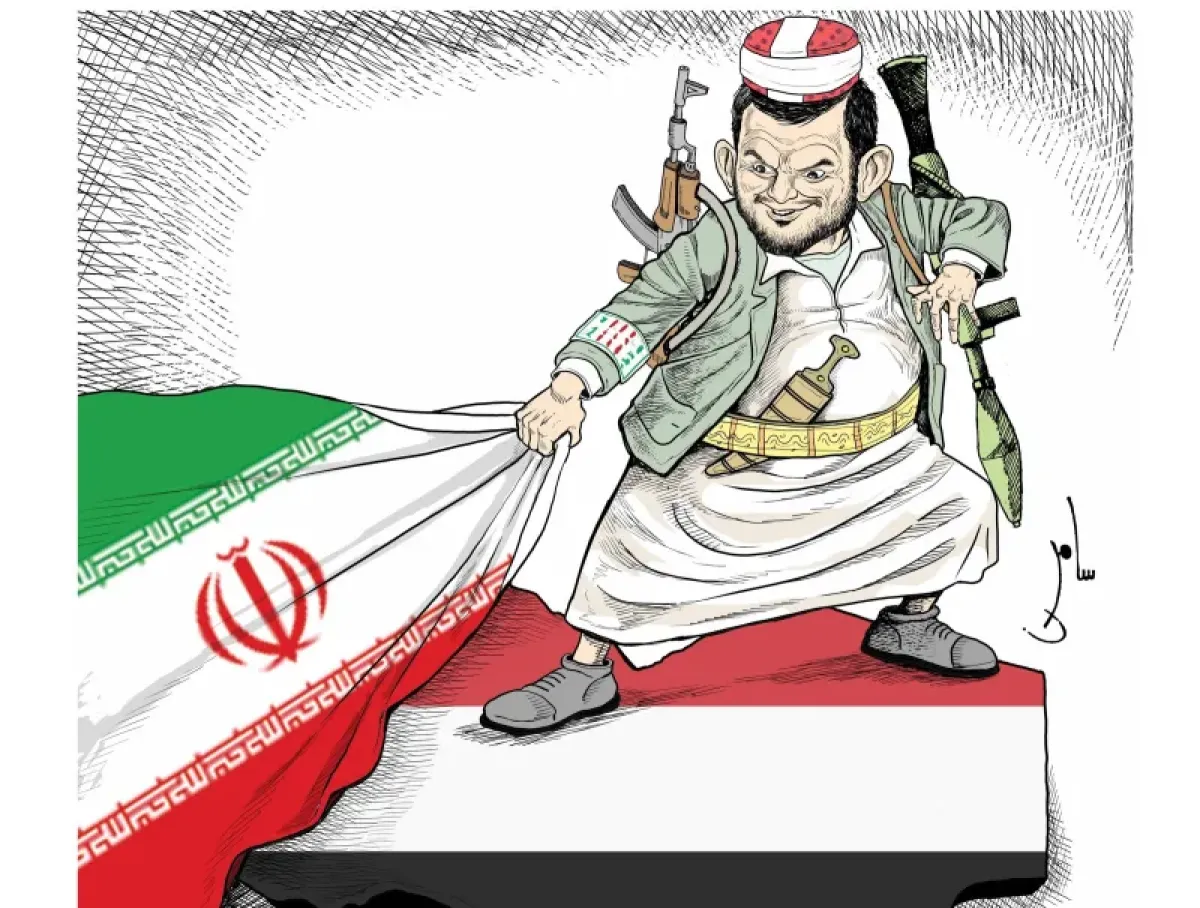
Recent statements by Houthi leader Abdul-Malik al-Houthi have reaffirmed the group's deep ties with Iran, exposing the extent of political and military coordination that guides the militia's actions within what is known as the "Axis of Resistance." This alignment appears to disregard the priorities of Yemenis, who are enduring a protracted war and an unprecedented humanitarian and economic crisis.
In a speech marking the occasion the group calls "Wilayah Day," al-Houthi declared his group's "full readiness" to confront any potential escalation, emphasizing "complete coordination" with regional allies regarding developments related to Palestine, Lebanon, and American movements in the Middle East. These pronouncements were made just one day after Iran's Quds Force commander, Esmail Ghaani, explicitly suggested the Bab el-Mandeb Strait could be used as a pressure point, similar to the Strait of Hormuz. Analysts interpret this as Iran potentially leveraging the Houthi group as a new bargaining chip against the international community and a threat to a vital global maritime route.
Observers view the synchronized statements from Tehran and Sana'a as indicative of a high level of coordination, confirming that the Houthi group no longer conceals its connection to Iran's regional project. This is further underscored by al-Houthi's own assertion of continued full coordination with regional allies on various military and political developments. This situation is particularly significant given escalating international concerns over navigation security in the Red Sea and Bab el-Mandeb, a critical artery for global trade and energy supplies. In recent months, Houthi attacks on commercial vessels have severely disrupted international shipping, forcing global carriers to reroute and incur substantial additional costs.
Analysts suggest that the threat to the Bab el-Mandeb is no longer solely a Yemeni issue tied to the local conflict but has become an integral part of Iran's deterrence strategy against Western pressure. This is supported by repeated statements from Iranian officials highlighting the strait's strategic importance and its potential as a parallel leverage point to the Strait of Hormuz. While the Houthis escalate regional threats and declare readiness for new confrontations, millions of Yemenis face a starkly different reality of economic collapse, widespread poverty, and escalating humanitarian needs. United Nations estimates indicate that over 18 million Yemenis require humanitarian assistance, while economic recovery prospects dwindle and essential services continue to deteriorate.
Critics of the Houthi movement argue that al-Houthi's recent statements clearly demonstrate that the group's leadership priorities are not rooted in Yemeni national interests but rather in its commitments within the Iranian-led axis. They contend that the group appears prepared to draw Yemen into open regional conflicts, potentially subjecting the country to a new wave of military strikes, sanctions, and economic instability, with little regard for the cost to the Yemeni people. These statements also raise increasing questions about Yemen's future, as the group continues to link its political and military decisions to regional calculations that extend beyond the country's borders. While Yemen requires stability, reconstruction, and improved living conditions, the group appears intent on solidifying its role as a prominent arm of Iranian influence in the region, according to observers.
Human rights activist Mohammed Amin has warned Yemenis of the repercussions of any potential military escalation, noting that nations engaging in war typically implement preemptive measures such as bolstering air defenses and securing essential supplies and shelters. In contrast, Yemeni citizens face these developments amidst extremely fragile humanitarian and economic conditions. Amin urged residents to take personal precautions, including stockpiling food and medical supplies in anticipation of any emergency. Majed Al-Mudhji, co-founder of the Sana'a Center for Strategic Studies, believes the current confrontation differs from previous escalation rounds, which the Houthis directly linked to defending Gaza. He estimates that this instance lacks a convincing internal justification for many Yemenis, as it is more clearly associated with defending Iranian interests than the Palestinian cause itself. Al-Mudhji posits that the Houthi involvement in this confrontation falls under their strategic obligations to Tehran, reflecting their position within Iran's network of regional alliances. From this perspective, the decision is not primarily based on Yemeni national interest calculations but on considerations related to the relationship between the group and its main regional ally.
Al-Mudhji concludes that while the Houthi leadership may consider domestic sentiment in its day-to-day affairs, these considerations have limited influence when it comes to major strategic decisions. Ultimately, the group's choices are shaped by its leadership's calculations and their vision of its place within the regional axis, rather than responding to Yemeni public opinion. Researchers specializing in Yemeni affairs confirm that the group has, over the past years, successfully built a political, security, and military system inspired by the Iranian model. This is evident not only in its ideological discourse based on the concept of "Wilayah" but also in the nature of its organizational and strategic relationship with Tehran, which has provided it with political, military, and logistical support throughout the war years. As regional tensions persist, Yemeni concerns are more pronounced than ever. The greater the tension between Iran and its adversaries, the higher the likelihood of the Yemeni arena being used as a pressure point in the regional conflict, placing millions of Yemenis at risk in a country still recovering from the ravages of war and economic collapse. In light of these developments, observers believe Abdul-Malik al-Houthi's recent statements were not merely an announcement of military readiness but a political message unequivocally confirming that the group's decisions are inseparable from Tehran's strategic calculations, and that the Bab el-Mandeb and the Red Sea have become integral to Iran's regional influence, even if the cost is increased hardship and suffering for the Yemeni people.