Houthi authorities in Yemen have transformed textbooks, once a free state-provided right, into a lucrative commercial venture, imposing new fees on students and exacerbating financial burdens on families struggling with economic hardship.
As the 2026-2027 academic year approaches, education officials under Houthi control have introduced new pricing for government-issued textbooks, ranging from 6300 to 9200 Yemeni Rials per student, depending on the educational level. This move has generated widespread discontent among parents and educators, who view it as an additional exploitation of citizens amidst a continuing economic collapse.
The new measures go beyond charging for previously free books; private schools are now mandated to procure curricula exclusively through the General Authority for School Book Printing Presses, an entity controlled by the Houthi group. This prohibition of alternative supply sources has consolidated the group's monopoly over the textbook market, effectively turning the educational process into a closed commercial activity managed by specific entities.
Sources within the Ministry of Education in Sana'a reveal that the General Authority for School Book Printing Presses has transitioned from a service-oriented institution to a profit-generating enterprise. In recent years, it has reportedly earned over 150 million Rials from printing books for private and non-governmental schools. These printing and supply operations are allegedly managed by a network of contractors and paper merchants connected to influential supervisors within the education sector, diverting funds intended for educational services or long-overdue teacher salaries towards the financial interests of a select few.
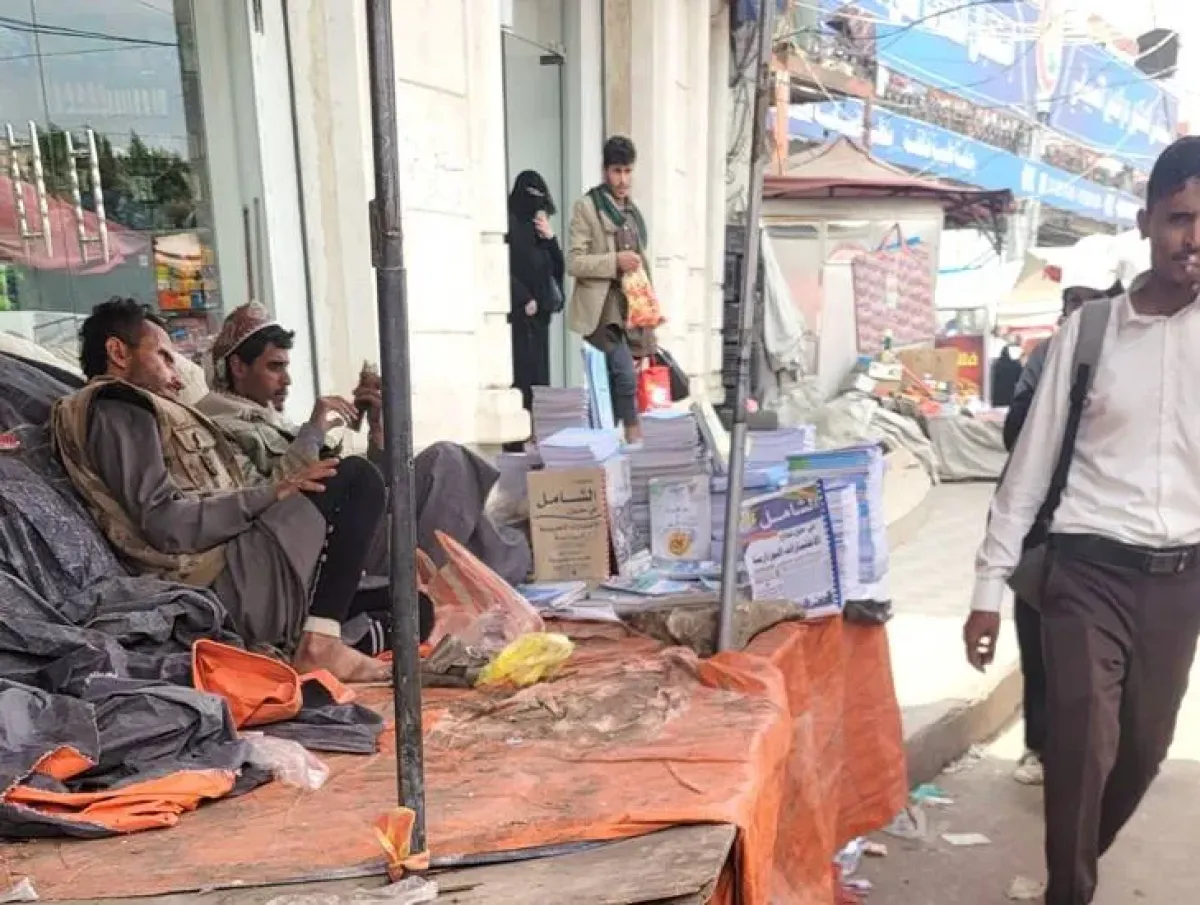
Furthermore, reports from printing press workers indicate the illicit duplication of original government curriculum printing plates for private presses. These entities then produce additional book quantities and sell them in parallel markets and on street sidewalks, operating outside any official oversight. Educational professionals suggest this practice explains the recurring scene of new textbooks being abundantly available on sidewalks and in popular markets, while thousands of students in government schools struggle to obtain their required materials.
The public sale of government textbooks on streets has drawn significant criticism, particularly amid persistent complaints of textbook shortages in public schools. Academic Ibrahim Al-Kibsi sarcastically noted that the Houthi-controlled Ministry of Education has effectively become a "street bookseller," while curricula are absent from government classrooms. He observed that books are readily available in private schools and Houthi-affiliated summer centers from the first day of the academic year, forcing public school students to seek them in the market at prices many families cannot afford. Al-Kibsi pointed out the irony that the group has extensively revised curricula to align with its ideology but has failed, or chosen not to, provide these materials to students within their government schools.
Observers contend that the most detrimental aspect of these policies is not merely the imposition of new educational fees but the manner in which textbook revenues are utilized. Despite the substantial annual earnings generated by the school book printing presses, tens of thousands of teachers in Houthi-controlled areas have not received their salaries for years. This has severely degraded the educational process and led to a significant exodus of educational personnel. These measures are being implemented against a backdrop of deteriorating living conditions for Yemeni families, for whom acquiring school uniforms, bags, and stationery already presents a considerable challenge. The added cost of purchasing textbooks, once a free state service, further strains household budgets.
Educators warn that the continued commodification and investment in education will widen the educational gap and increase school dropout rates, especially among the most impoverished families. It will also entrench disparities between public and private education. With each new academic year, the same pattern repeats in Houthi-controlled regions: textbooks are sold on sidewalks, government schools suffer acute curriculum shortages, and families are burdened with new expenses, while entities controlling the education sector continue to profit from students' right to education, with no tangible improvement in school conditions or teacher welfare.