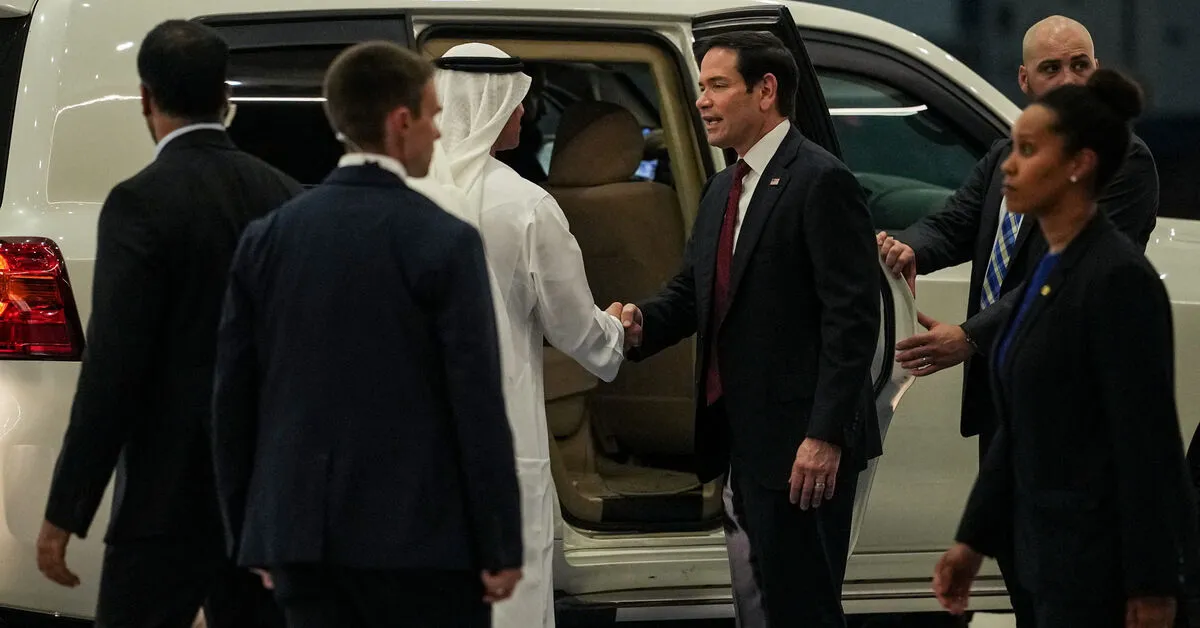
U.S. Secretary of State Marco Rubio commenced a significant Middle East tour on Wednesday, aiming to reassure Gulf allies unsettled by terms in the recent interim agreement with Iran, particularly a proposed $300 billion reconstruction fund perceived as overly generous.
Arriving in Abu Dhabi late Tuesday for a three-day visit, Rubio's diplomatic mission focuses on the accord reached last week to conclude the four-month U.S.-Israeli conflict with Iran. When questioned upon arrival about addressing allied unease, Rubio confirmed to reporters, "That most certainly will come up in these discussions," adding that other topics beyond the memorandum of understanding would also be covered.
Rubio's engagement follows a period of his relative absence from Iran-related diplomacy, during which Vice President JD Vance led recent talks with Iranian counterparts. His forthcoming remarks will be closely observed for indications of how he frames the deal, which some congressional Republicans have criticized as a concession.
The Secretary's itinerary includes visits to the United Arab Emirates and Kuwait, both of which host strategic U.S. military bases and were targets of Iranian missile and drone attacks during the recent conflict, leading to civilian casualties. The UAE, in particular, is experiencing economic challenges as the war prompted an exodus of expatriates, raising questions about the stability of its financial sector given its proximity to Iran.
Concerns among Gulf allies extend to the proposed reconstruction fund, with fears that Iran could utilize it to bolster its military capabilities. The accord notably does not address Iran's ballistic missile program, a critical issue for Gulf states that were struck by Iranian missiles and drones. Reports indicate that Iran has established clandestine cells in Iraq responsible for attacks, including drone strikes against targets in Kuwait, the UAE, and Saudi Arabia in recent months.