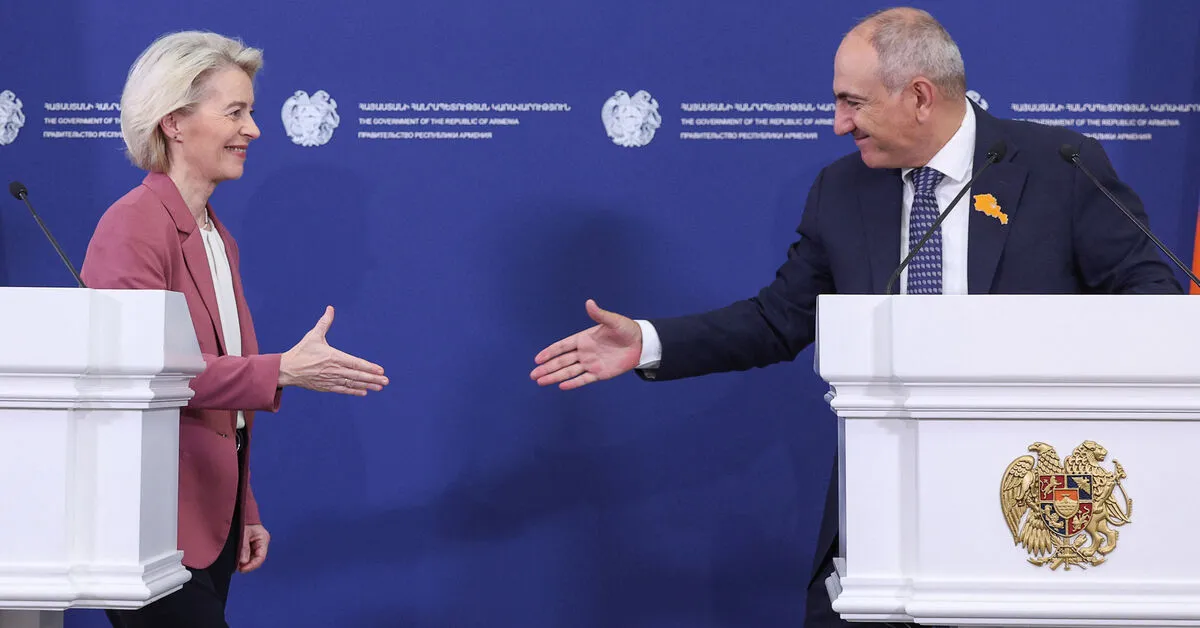
The European Union has announced an additional €18 million in economic support for Armenia and eased export regulations for Armenian goods, signaling increased commitment to the South Caucasus nation as it contends with economic pressure from Russia.
The measures come in the wake of Russia's imposition of extensive trade restrictions on Armenia leading up to the June parliamentary elections, which were won by the incumbent Civil Contract party. Russia has accused the West of interfering in the election and has echoed opposition claims of voting irregularities.
These restrictions from Moscow, implemented as Armenia has pursued closer relations with the West and sought EU membership, have significantly impacted key Armenian exports such as fresh produce, flowers, fish, and alcoholic beverages. Armenia is a member of a Russian-led economic bloc, and trade statistics indicate that Russia accounted for approximately 35% of Armenia's foreign trade last year, contrasting with the EU's 11% share.
During a visit to Yerevan, European Commission President Ursula von der Leyen assured Prime Minister Nikol Pashinyan of Brussels' commitment to bolstering support and facilitating Armenian access to European markets. "I know Armenia is still facing significant economic pressure from Russia," von der Leyen stated. "But rest assured: when pressure mounts on our partners, the EU steps up... You can count on us."
President von der Leyen further explained that the EU will eliminate tariffs on nearly 80% of Armenian exports destined for the bloc, thereby enhancing access for Armenian products to the EU's market of approximately 450 million consumers. The newly announced €18 million is part of a larger €52 million package allocated by the EU for Armenia in early June.
Additionally, President von der Leyen announced on Wednesday during a visit to Azerbaijan that Brussels has pledged €200 million in grant funding to enhance transport, energy, and digital connectivity across the South Caucasus, an initiative aimed at fostering peace between Azerbaijan and Armenia following decades of conflict.