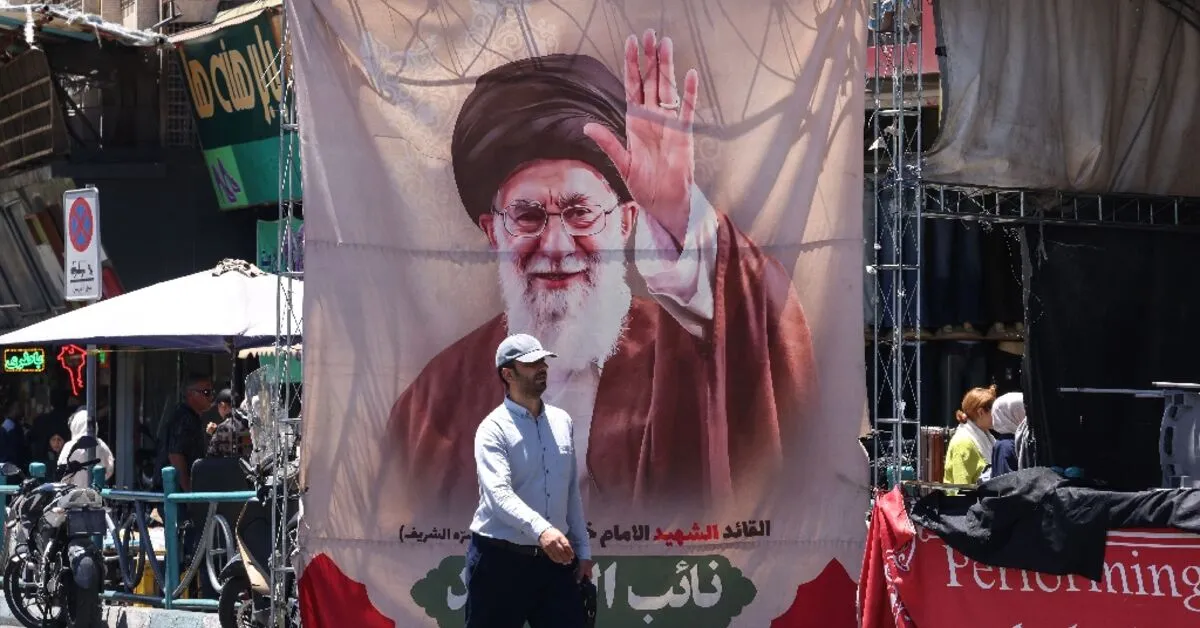
Ayatollah Ali Khamenei, Iran's Supreme Leader for over three-and-a-half decades, whose rule was marked by suppression of dissent and confrontation with the United States, died in a deadly Israeli air strike on February 28, which occurred on the first day of a five-week war. The strike, reportedly based on US intelligence, also killed several close family members.
Despite Khamenei's demise, his era continues to exert influence, with power reportedly transferred to his son, Mojtaba, who has not yet appeared publicly as the third Supreme Leader. Khamenei's social media accounts remain active, disseminating past statements, and his image persists on public displays alongside his predecessor, Ruhollah Khomeini, and his son Mojtaba. State media now refers to him as the "Martyr Imam Khamenei," solidifying his spiritual standing within the Islamic Republic.
Khamenei, 86, navigated numerous crises throughout his tenure with a combination of repression and political maneuvering. He weathered significant internal challenges, including the 1999 student protests, the 2009 mass demonstrations following disputed presidential elections, and the 2019 protests, all of which were met with brutal suppression. The "Woman, Life, Freedom" movement in 2022-2023, sparked by the death of Mahsa Amini, also ended in a violent crackdown.
During a June 2025 war against Israel, Khamenei reportedly went into hiding. Reports from US media suggested significant Israeli intelligence penetration within the Islamic Republic, leading to the elimination of key security officials in air strikes. Prior to the outbreak of the latest conflict in 2026, his leadership faced renewed street protests, which were suppressed by security forces, with rights groups reporting thousands of fatalities. Khamenei characterized the protesters as "rioters" supported by Israel and the United States.
Khamenei also endured physical challenges, including a partially paralyzed right arm from an assassination attempt in 1981, an attack authorities consistently attributed to the People's Mujahedin of Iran (MEK). He was known to display this disability prominently in photographs, seemingly as a testament to his revolutionary experience. Previously arrested under the Shah for his anti-imperialist activities, Khamenei rose through the ranks, serving as Tehran's Friday prayer leader and participating in the Iran-Iraq war. He was elected president in 1981 after the assassination of Mohammad Ali Rajai.
Originally, Ayatollah Hossein Montazeri was considered Ruhollah Khomeini's successor, but this changed after Montazeri objected to the mass executions of MEK members and other dissidents. Upon Khomeini's death, Khamenei was chosen as Supreme Leader by the Assembly of Experts, a decision he initially appeared to accept with reluctance. Throughout his rule, Khamenei managed six presidents, exerting supreme authority over a system with competing power centers, including the Revolutionary Guards. He consistently favored hardline policies and maintained a confrontational stance towards the United States, refusing to recognize Israel.
Thomas Juneau, a professor at the University of Ottawa, noted Khamenei's role as the most influential figure in Iran while still needing to manage various centers of power. His son, Mojtaba, is now expected to wield significant influence. A recent statement from Mojtaba Khamenei expressing openness to talks with the US, despite holding a "different view," has been described by Arash Azizi, a lecturer at Yale University, as "eerily reminiscent of his father's tradition" of maintaining a detached political posture.