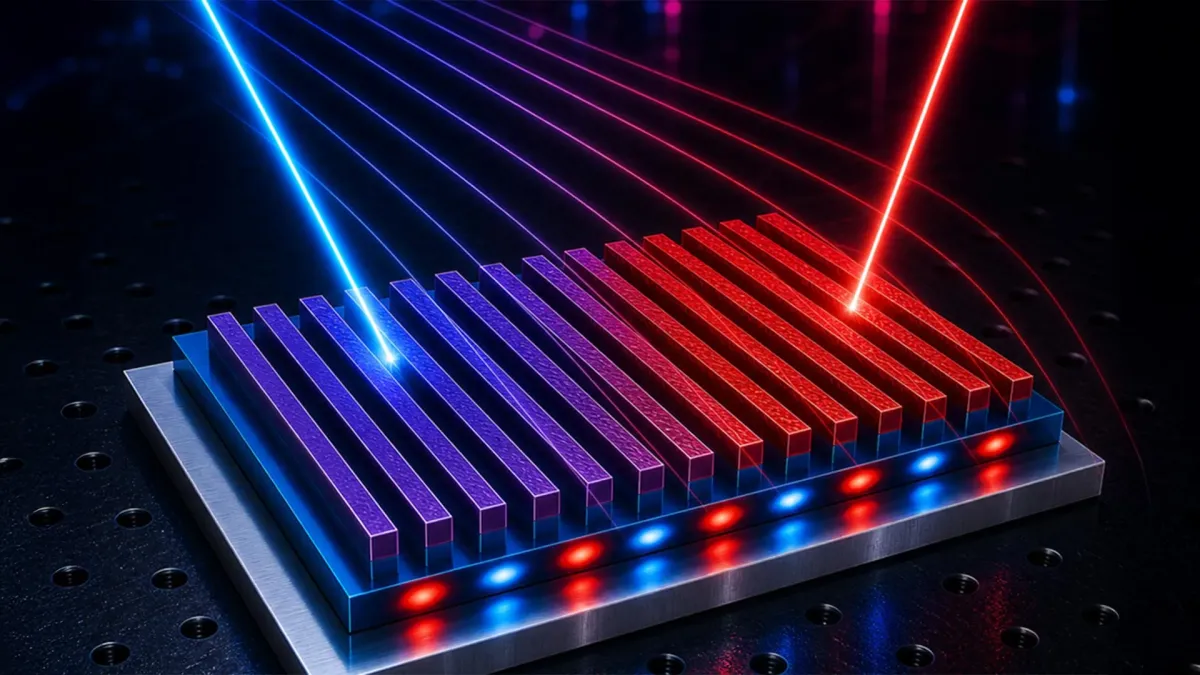
A groundbreaking new material developed by an international team, led by researchers from Osaka Metropolitan University, allows for the independent control of heat absorption and emission, a feat previously limited by fundamental physics principles. This breakthrough could revolutionize thermal management and energy technologies.
Traditionally, the way a material absorbs heat and emits it are linked, a concept known as reciprocity. This has made it challenging to manipulate thermal energy independently. The new device utilizes magneto-optical materials, which alter their light interaction under a magnetic field, allowing engineers to decouple these thermal processes. The team combined a magneto-optical material with a phase change material (GST) to create a device capable of directing heat radiation, switching this capability on or off, and crucially, retaining its state even without power.
"We made heat radiation behave in a 'smarter' way," explained Dr. Shunsuke Murai. "Achieving these capabilities in a working model could enable a new generation of efficient infrared emitters, thermal-energy devices, sensors, and photonic memory technologies."
This novel design significantly outperforms previous attempts. It demonstrates distinct responses to light from different directions, even at near-normal incidence, unlike older technologies that required steep angles and suffered reduced efficiency. The new material also offers reliable switching between states and maintains its configuration after power is removed, addressing key limitations of earlier systems.
Professor Koichi Okamoto highlighted the broader implications: "Our ultimate goal is to develop compact devices that can actively control heat radiation, much like electronic circuits control the flow of electricity. Such devices could be used in smarter infrared sensors, more efficient energy systems, and new types of photonic memory that store information using light and heat instead of electrical charges."