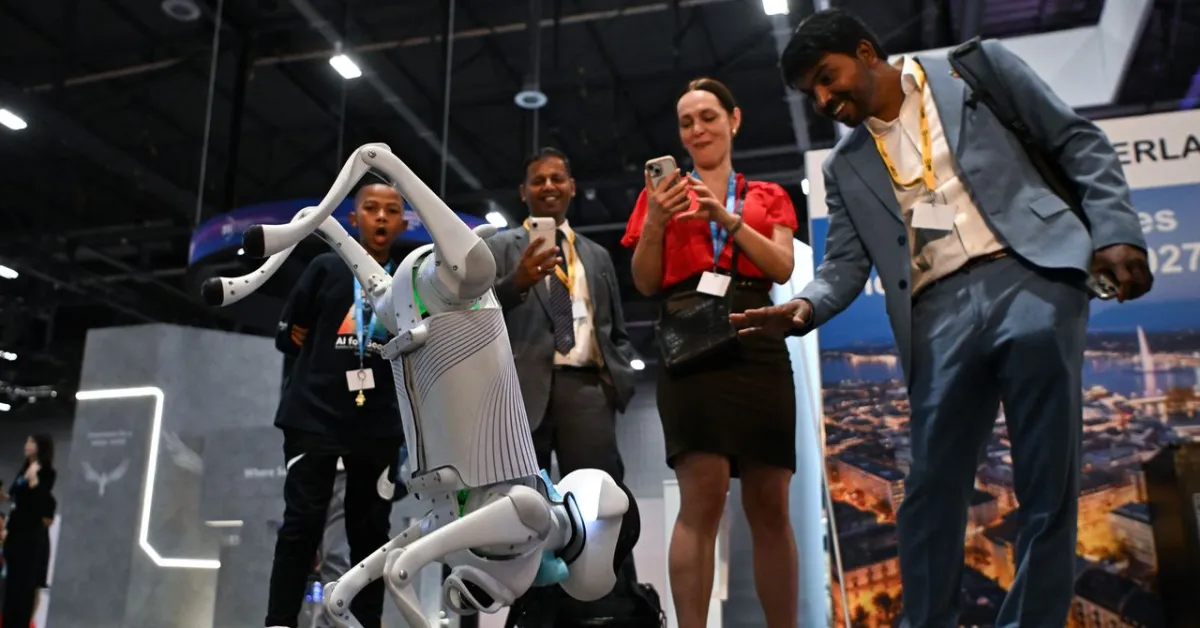
The UN's AI for Good summit brought together global leaders and tech innovators, showcasing everything from robot dogs and Teslas to rescue helicopters, all while grappling with the complex question of how to harness artificial intelligence for humanity's benefit.
Beyond the live coding demos and networking zones, the summit, organized by the UN's International Telecommunication Union (ITU), aimed to foster discussions on AI's potential to solve major global issues like hunger, disease, and climate change. This idealistic approach contrasts sharply with ongoing debates in Washington about AI risks and chip export controls.
Doreen Bogdan-Martin, secretary-general of the ITU, emphasized the conviction that AI, when deployed responsibly, can be a powerful tool for good. However, she acknowledged that AI itself presents challenges, even as we strive to use it for positive outcomes. The summit explored the meaning of "good" in AI, amid concerns that unchecked corporate power could exacerbate global inequality and erode human rights.
On the sidelines, humanitarian advocates urged a move away from blind reliance on big tech, calling for greater transparency and questioning multi-million dollar public funding deals with companies whose technology stacks are constantly evolving. The summit also saw moments of protest, with activists disrupting a keynote speech, alleging the misuse of technology against Palestinians.
Experts highlighted the difficulty in engineering for an abstract concept like "good," stressing that practical application often lags behind the hype. The debate also centered heavily on access to AI, including who controls the models, chips, and compute power, with concerns that restricted access could leave developing nations dependent on foreign infrastructure. Discussions pointed towards compute not just as a tech issue, but as a critical development challenge, advocating for inclusive infrastructure and the development of local AI models for diverse communities.
Throughout the event, the politics of infrastructure—who benefits and who controls—were a constant theme. The question wasn't just about AI safety, but whether nations outside the major tech-producing axes would have a voice in shaping its future. Engineers were urged to consider human rights not as an afterthought, but as an integral part of the design process, with calls for "middleware" to translate high-level principles into verifiable technical enforcement.
While the summit fostered dialogue and saw the formation of a 44-member commission to guide AI for Good, the rapid pace of AI development was palpable. On the bustling convention floor, with advanced robots zipping between booths, it was clear that the technology itself might be outpacing the global consensus on defining what "good" AI truly means.