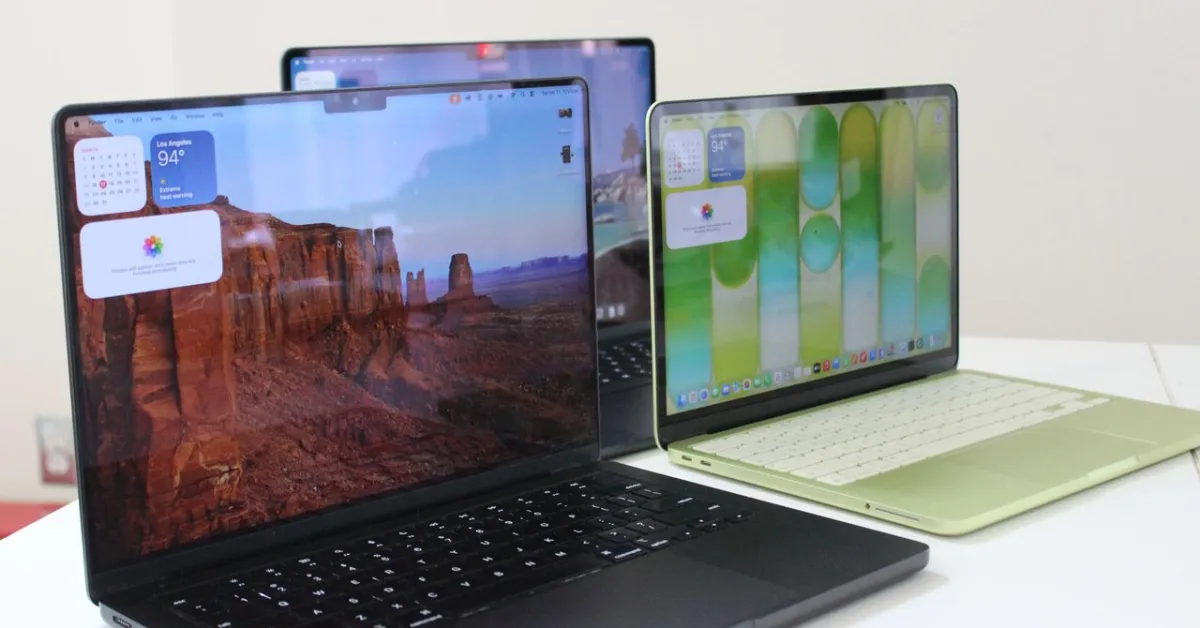
Apple's MacBook lineup is a complex ecosystem of processors, and with recent price increases, understanding which chip powers which model is more crucial than ever. From the foundational M1 to the cutting-edge M5 series, each chip offers distinct performance levels for various tasks. This guide breaks down the key differences to help you make an informed decision, whether you're eyeing a brand-new machine or a refurbished gem.
The M5 series, arriving in late 2025, represents Apple's latest silicon. The base M5 chip boasts up to a 10-core CPU and 10-core GPU, offering a 10-15% boost in CPU performance over previous generations, alongside significant upgrades in GPU, AI, and storage speeds. The M5 Pro and M5 Max, found in the 14-inch and 16-inch MacBook Pros, push performance further with more cores and enhanced memory bandwidth. Notably, these chips introduce "Fusion Architecture," a new iteration of UltraFusion, combining two dies for superior performance.
Looking back, the M4 series, launched in 2024, also delivered substantial gains. The M4 chip offers up to 1.8 times faster CPU and 2.2 times faster GPU performance than the M1, with a neural engine more than three times faster than the original. The M4 Pro and M4 Max further enhance this with higher core counts, increased unified memory, and support for advanced graphics features like ray tracing. These chips are integrated into various MacBook Pro, MacBook Air, and Mac Mini models from 2024 and 2025.
The M3 series, introduced in late 2023, provides a solid performance upgrade for everyday users and professionals alike. The base M3 chip offers up to 35% faster CPU and 65% faster GPU performance compared to the M1. The M3 Pro and M3 Max scale up performance for more demanding workloads, making them suitable for creative professionals. While the M3 lineup was the focus in 2023, Apple surprised with the M3 Ultra in 2025, which remains the most powerful M-series chip to date, outperforming even the M4 Max and M5, and is currently exclusive to the Mac Studio.
Earlier generations like the M2 and M1 series still offer compelling value, especially at their current price points. The M2 series, an incremental upgrade over the M1, was available in MacBook Air and MacBook Pro models from 2022-2023, suitable for general use and intermediate creative tasks. The original M1 chip, a game-changer at its 2020 debut, powered the first Apple silicon MacBook Air and Pro, offering remarkable speed and efficiency for its time, and remains a capable option for basic computing needs, often found at attractive prices from third-party retailers.