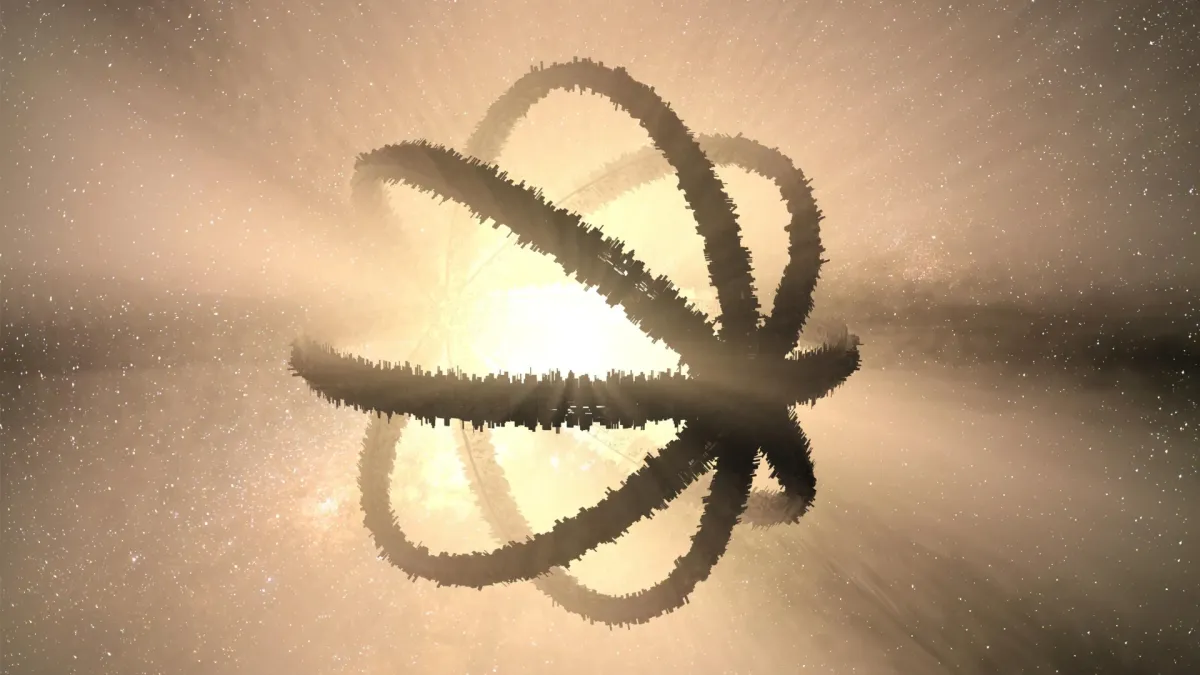
The search for extraterrestrial intelligence might be looking in the wrong place. A new study suggests that some of the coldest "stars" astronomers have observed could actually be massive alien megastructures known as Dyson swarms.
The concept of a Dyson sphere, first proposed by physicist Freeman Dyson in 1960, has evolved from a solid shell to a "swarm" of countless orbiting structures designed to capture a star's energy. While theoretical, the question remains: what would such a structure look like to astronomers? A recent study, soon to be published in Universe, dives into how these colossal constructions might appear through telescopes and identifies the star types most likely to host them.
Red dwarfs, the most common stars in our galaxy, are prime candidates. They burn fuel incredibly slowly, surviving for trillions of years, and their small size makes them more engineer-friendly. A Dyson swarm could orbit a red dwarf much closer than it would orbit our Sun, requiring less material. White dwarfs, the dense remnants of dead stars, are even more attractive. Their compact nature allows a swarm to orbit just a few million kilometers away, drastically reducing construction scale, and they provide a steady energy output for billions of years.
A Dyson sphere would drastically alter a star's appearance on the Hertzsprung-Russell (H-R) diagram, which plots stellar temperature against luminosity. Instead of emitting visible light, the megastructure would absorb most of the star's radiation and re-emit it as infrared heat. This would make the "star" appear much cooler, potentially as low as 50 Kelvin, a temperature range not occupied by any known natural stars. This unique infrared signature, combined with an absence of the dusty disks usually seen around stars, would be a major clue.
The study also points out that a solid Dyson sphere is likely impossible. Advanced civilizations would probably build a swarm of independent solar collectors. As these components orbit, they could create unusual, non-natural variations in brightness. The James Webb Space Telescope, with its advanced infrared capabilities, is perfectly suited to hunt for these hypothetical structures. While no alien megastructures have been confirmed yet, this research provides astronomers with new observational clues to distinguish potential alien technology from natural cosmic phenomena.