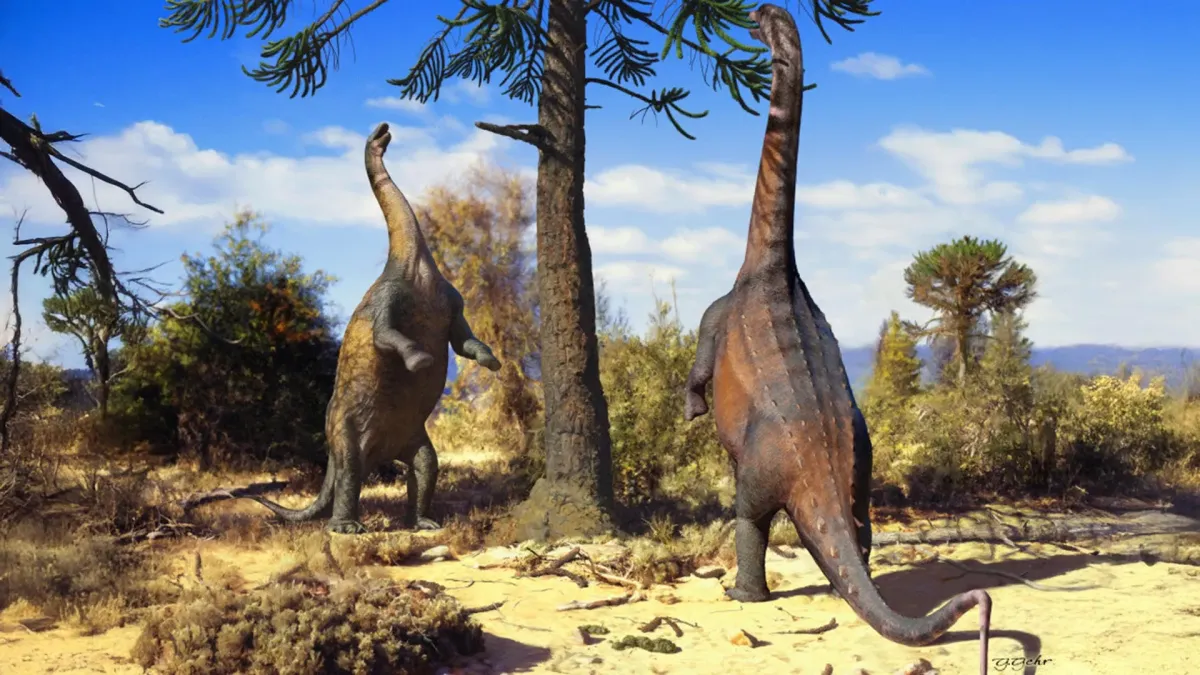
Younger versions of massive, long-necked dinosaurs might have been surprisingly agile, capable of standing on their hind legs for extended periods. New research suggests this ability helped them reach food, fend off threats, or find mates, but their immense size eventually made it too strenuous.
The study focused on two South American sauropods, Uberabatitan from Brazil and Neuquensaurus from Argentina, which lived about 66 million years ago. While large, they were comparable to modern elephants, not the absolute largest sauropods. Adult Uberabatitans could reach up to 26 meters, making them Brazil's largest known dinosaurs. The research, published in the journal Palaeontology and supported by FAPESP, used engineering principles to analyze how these dinosaurs handled the forces involved in standing upright.
Scientists employed finite element analysis (FEA), a computational method common in engineering, to estimate the stress gravity and body weight placed on the femur (thigh bone) when these dinosaurs shifted their weight to their hind legs. "Smaller sauropods like these had a bone and muscle structure that allowed them to stand more easily and for longer on their two hind legs," explained Julian Silva Júnior, the study's lead author and a researcher at São Paulo State University. "Larger ones were probably also able to stand, but for a shorter time and with less comfort, since the position caused a lot of stress on the femur."
The team created digital models of femurs from seven different sauropod species, representing various sizes and evolutionary paths, based on fossils from museums worldwide. The simulations revealed that Uberabatitan and Neuquensaurus experienced the least stress when standing on their hind legs, thanks to particularly robust femurs that could better distribute the forces. This suggests younger individuals were better equipped for bipedal stances.
While larger sauropods likely could still rise onto their hind legs, the study indicates they couldn't maintain the pose as comfortably or for as long as their smaller counterparts. Adult Uberabatitans, despite their impressive size, would have faced increased strain due to their greater weight, similar to other giant sauropods. Standing upright could have offered benefits like reaching higher vegetation, appearing more intimidating to predators, or aiding in mating rituals through visual displays or mounting.
The researchers acknowledge certain limitations, noting that their models didn't account for cartilage or the stabilizing support of the tail in a tripodal stance. However, they believe the comparative analysis provides a solid understanding of how these ancient creatures likely behaved millions of years ago. "The tool we use is very efficient for comparisons, even if the answer isn't exact for each one," Silva Júnior stated.