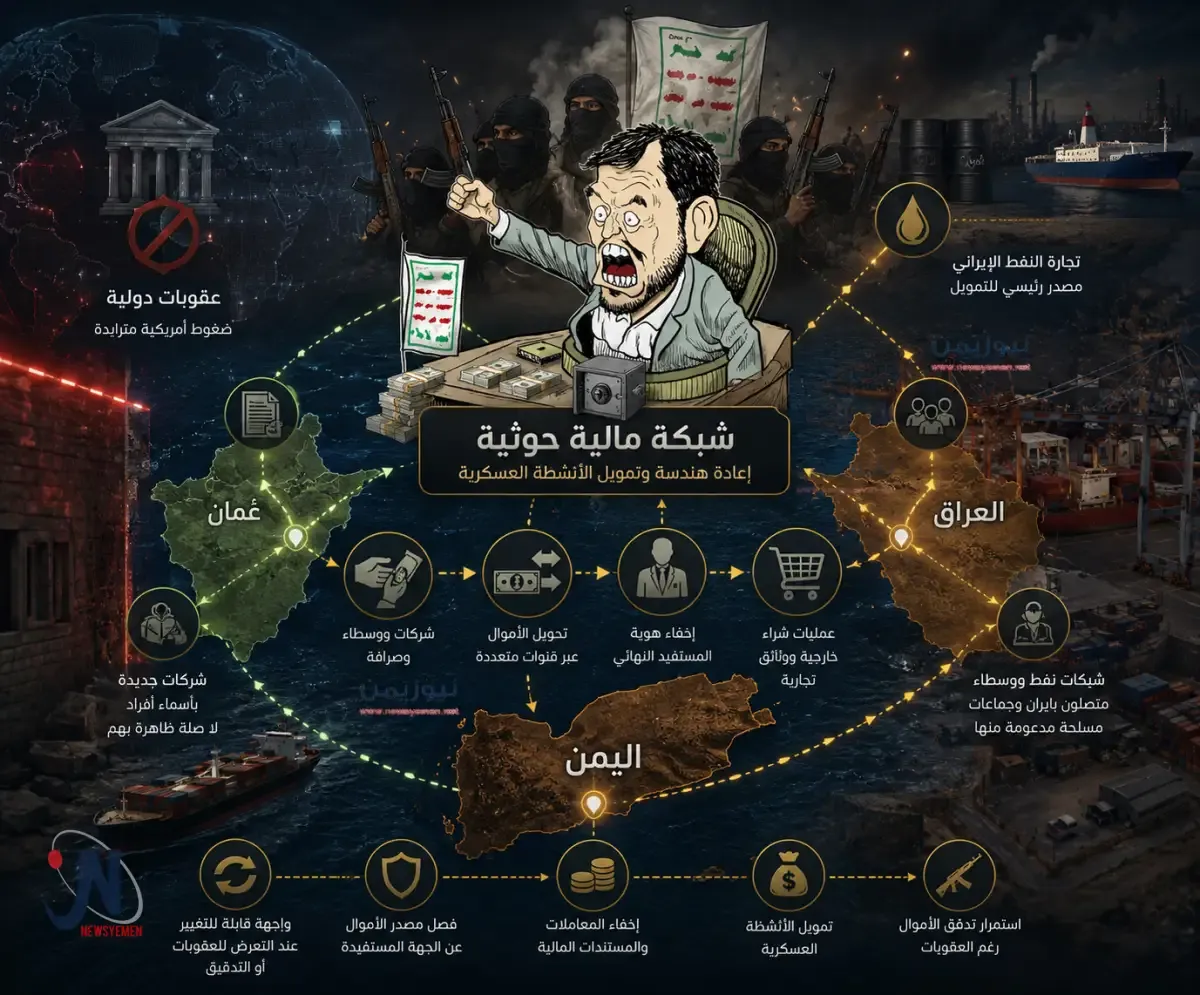
The Houthi militia, in coordination with Iran's Revolutionary Guard, is reportedly re-engineering its financial and commercial networks to maintain funding and sustain its military activities amidst escalating U.S. sanctions. This intricate operation leverages shell companies and intermediaries in Oman and Iraq to circumvent financial restrictions and obscure the ultimate beneficiaries of transactions.
According to a report by Sheba Intelligence, the Houthi group is utilizing a multi-layered network of companies, brokers, and exchange houses that pass through Oman and Iraq. This structure facilitates the transfer of funds, trade in Iranian oil, and foreign procurement, all while attempting to conceal the identity of the end recipient and sever direct links to the Houthis. The group has reportedly established new companies under individuals with no apparent direct affiliations, using them to import goods, settle payments with foreign suppliers, and generate necessary commercial documentation for sensitive shipments to bypass restrictions on entities linked to them.
This shift signifies a strategic move away from overt financial channels towards a more flexible network capable of repeatedly changing its facades when subjected to sanctions or scrutiny. This model separates the source of funds from the beneficiary by routing resources through various companies, brokers, oil traders, and exchange offices before reaching entities that finance Houthi operations and procurement. The danger of this mechanism lies in its ability to keep Houthi names absent from banking and commercial documents, making it arduous for regulatory bodies to trace the complete flow of funds and granting the group greater capacity to continue financing its networks despite sanctions.
Oman and Iraq play distinct roles within this new financial framework. Oman reportedly provides access to international markets, financial services, and commercial documentation, while Iraq is linked to oil networks and intermediaries connected to Iran and its supported armed groups. The report cautions that the use of registered companies in these countries does not imply the involvement of their authorities or legitimate commercial sectors, as the described mechanism exploits legal trade and financial channels to mask beneficial ownership and the final destination of funds. The trade of oil is particularly crucial, with Iranian oil and its derivatives potentially serving as a means to generate liquidity outside direct financial transfers to known Houthi entities.
The U.S. Treasury Department has previously documented similar methods involving shell companies, intermediaries, and exchange houses to facilitate Iranian oil revenue and Houthi funding. These maneuvers occur amidst U.S. estimates suggesting Houthi networks generate substantial income from illicit activities; the Treasury Department reported in January 2026 that illicit oil sales provide the group with over $2 billion annually. These figures indicate that the battle against Houthi financing extends beyond pursuing specific companies or individuals, encompassing a broad economic network capable of self-regeneration through new fronts and alternative trade routes.
Concerns, according to Sheba Intelligence, also extend to potential financial or material support for the Somali militant group Al-Shabaab, with some trade and smuggling routes between Yemen and the Horn of Africa possibly being utilized. However, the agency stated it has not independently verified a direct funding channel between Iran's Revolutionary Guard, the Houthis, and Al-Shabaab. Nevertheless, past U.S. sanctions and investigations have revealed smuggling and funding networks spanning Yemen and Somalia.
The revelation of this network underscores that financial sanctions alone may prove insufficient to cut off Houthi funding sources, provided the group can substitute companies and intermediaries and redistribute its operations across multiple commercial and financial hubs.