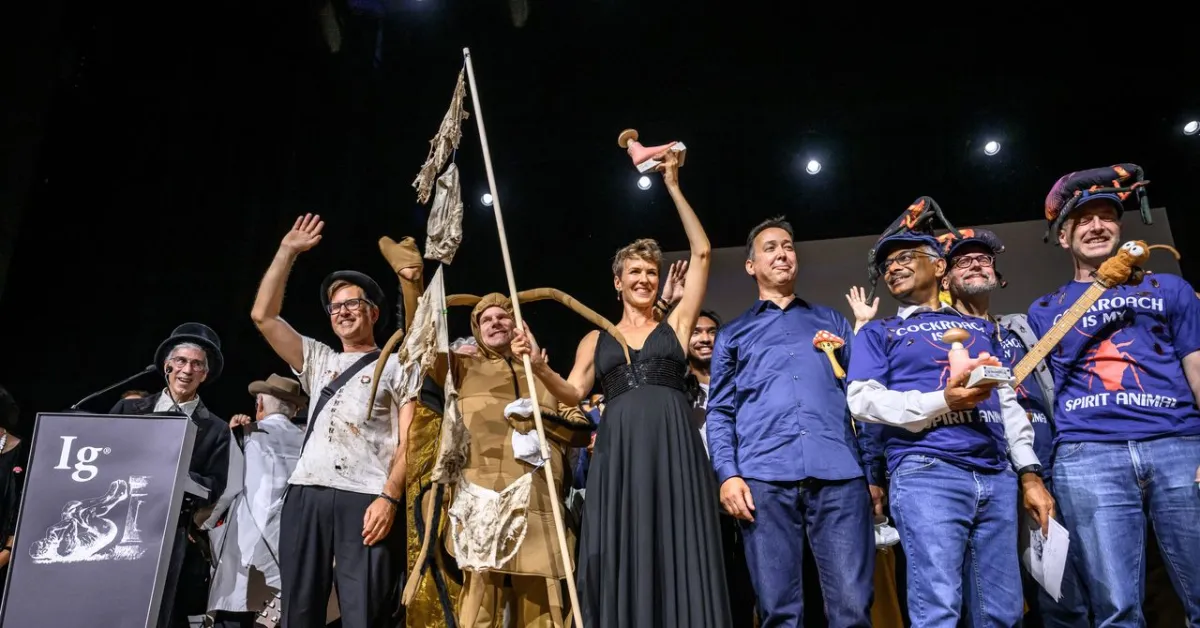
The Ig Nobel Prizes, celebrating science that first makes you laugh and then makes you think, have unveiled their 2026 winners. This year's ceremony, held in Zurich, Switzerland, honored 10 bizarre yet thought-provoking research projects, ranging from the scientific definition of a kiss to using buried underwear to gauge soil health.
The Biomechanics prize went to researchers who scientifically defined a kiss as "a non-agonistic interaction involving directed intraspecific oral-oral contact, with some movement of the lips or oral structures and without the transfer of food." This definition extends kissing to various species, including great apes, dogs, cats, pigeons, and even tortoises, though the meaning of their kisses varies.
In Economics, a study found that higher social class might predict increased unethical behavior, suggesting that individuals from wealthier backgrounds tend to prioritize self-interest more. Meanwhile, the Chemistry prize recognized the nutritional potential of "cockroach milk," a high-protein substance produced by certain cockroaches, analyzed for its nutrient-dense crystalline form.
The Medicine prize was awarded posthumously to Tokuji Unno for his dedication to studying the correct way to blow one's nose, recommending a one-nostril-at-a-time approach with a long, forceful exhale. Biology prize winners investigated what makes snakes bite, discovering that stepping on their head yielded the highest probability of an attack, while aiming for the tail was the least risky.
Further awards included Physics for creating splash-free urinals through optimal liquid impact angles, and Technology for repurposing mosquito proboscises as fine needles for 3D printers. The Olfaction prize went to research confirming that parents find their babies' scent more pleasant than their teenagers'. The Peace Prize acknowledged that people often prefer friends who are kind to them but cruel to enemies, and Soil Science celebrated the "underwear index" – using decomposed underwear to assess soil health.