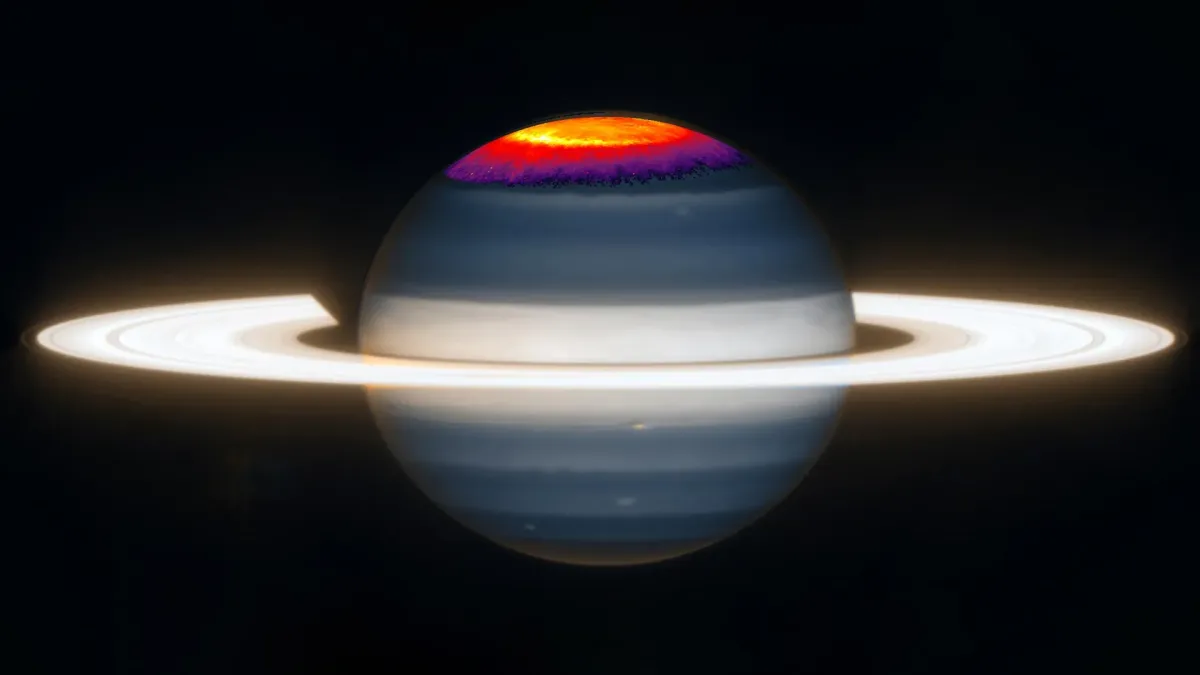
Astronomers have finally cracked the case of Saturn's seemingly wobbly spin rate, a puzzle that has baffled scientists for decades. New insights from the James Webb Space Telescope (JWST) point to the planet's vibrant auroras as the key to understanding why Saturn's rotation appears to change.
For years, measurements suggested Saturn's rotation speed was inconsistent, as if the giant planet were subtly speeding up or slowing down. This perplexing phenomenon left researchers scratching their heads. The latest findings, published in the Journal of Geophysical Research: Space Physics, reveal that the spectacular northern lights on Saturn are responsible for a complex cycle of heat, winds, and electrical currents that can make the planet's spin appear to fluctuate depending on how it's measured.
The mystery gained traction after NASA's Cassini spacecraft observed in 2004 that Saturn's rotation rate seemed to be gradually shifting. This was hard to explain, as planets don't typically alter their spin speeds on short timescales. In 2021, a team led by Professor Tom Stallard of Northumbria University proposed that Saturn's rotation wasn't actually changing. Instead, they suggested that electrical signals related to the aurora were being influenced by winds in Saturn's upper atmosphere. These winds generated electrical currents that interfered with the auroral signals scientists used to estimate the planet's rotation. While this explained the misleading measurements, the driving force behind these atmospheric winds remained unknown.
To get to the bottom of it, Stallard and an international team utilized the powerful James Webb Space Telescope. They continuously observed Saturn's northern auroral region for an entire Saturnian day, capturing unprecedented detail. By focusing on infrared light emitted by trihydrogen cation, a molecule that acts as a natural thermometer in Saturn's upper atmosphere, the researchers created the most detailed maps yet of temperatures and charged particle densities within the auroral zone. JWST's observations were roughly ten times more precise than previous instruments, allowing for the identification of localized heating and cooling patterns.
The new data aligns perfectly with computer models developed over a decade ago, which predicted that the atmospheric heating must occur precisely where the strongest auroral particles strike Saturn's atmosphere. This suggests that Saturn's aurora is not just a beautiful light show; it's a planetary heat engine. The energy from the aurora heats specific atmospheric regions, which generates winds, leading to electrical currents that, in turn, fuel the aurora itself, sustaining a self-perpetuating cycle. "What we are seeing is essentially a planetary heat pump," explained lead researcher Professor Tom Stallard. "Saturn's aurora heats its atmosphere, the atmosphere drives winds, the winds produce currents that power the aurora, and so it goes on. The system feeds itself."
This discovery has implications beyond Saturn, hinting at a deep connection between a planet's atmosphere and its magnetosphere. The exchange of energy between the atmosphere and the magnetosphere could explain the stability of this process over long periods and may be occurring on other planets as well. "This result changes how we think about planetary atmospheres more generally," added Professor Stallard. "If a planet's atmospheric conditions can drive currents out into the surrounding space environment, then understanding what is happening in the stratospheres of other worlds may reveal interactions we have not yet even imagined."