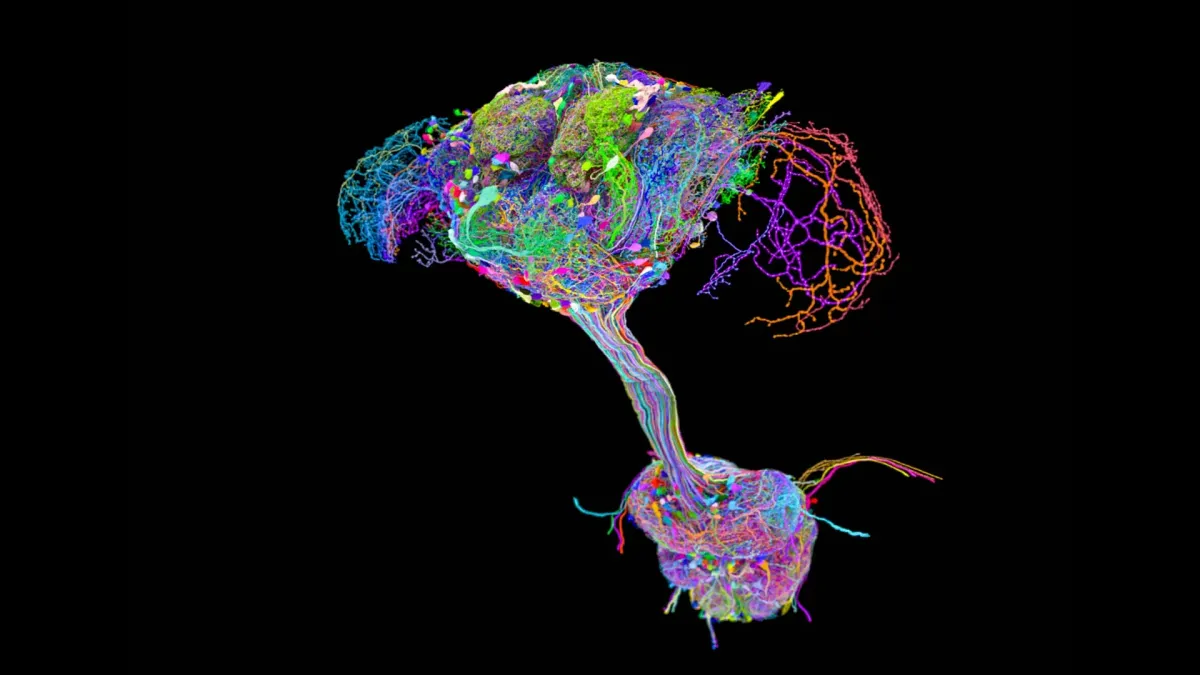
In a groundbreaking achievement, an international team of researchers has created the first comprehensive map of all neural connections in the central nervous system of an adult fruit fly, linking the brain to the body's wiring. This monumental feat offers an unprecedented look at how brains and bodies collaborate to produce complex behaviors and opens new avenues for understanding the fundamental rules governing nervous systems.
The newly detailed connectome expands upon previous fruit fly brain maps by incorporating the fly's nerve cord, essentially its spinal cord equivalent. This complete picture allows scientists to investigate how sensory input is processed and translated into actions like walking and flying. "We can see all of the neurons and their connections as a complete unit for the first time and ask, 'What do we learn from that?'" explained co-senior author Rachel Wilson of Harvard Medical School (HMS).
A key finding from studying the connectome is that many fruit fly behaviors appear to be managed by local neural circuits within specific body parts, rather than being dictated by a single command center in the brain. This challenges the long-held notion of a highly centralized control system. The complete connectome is now publicly accessible online, providing a powerful new resource for neuroscientists worldwide.
Fruit flies are a vital model in neuroscience due to their relatively simple nervous systems (about 160,000 neurons) that still support complex behaviors such as navigation and learning. The researchers meticulously mapped the connections by slicing a fruit fly into ultra-thin sections, using electron microscopy to capture millions of images, and employing AI to assemble a 3D map. This process effectively "embodies" the connectome by linking central nervous system neurons to those in appendages and sensory organs.
The research has already yielded insights into motor control. Instead of a top-down brain command, the study reveals that leg movements, for example, are primarily controlled by local neural circuits dedicated to that leg, which then coordinate with other leg circuits. Similar patterns were observed in circuits controlling wings and mouthparts, suggesting a highly distributed control system. "Our findings suggest that control for actions is highly distributed in local modules that link up and work together in different ways," stated co-first author Alexander Bates.
Looking ahead, this connectome is expected to fuel numerous future studies, akin to the impact of the Human Genome Project. Researchers plan to add more details, such as neuropeptide communication, and explore whether these distributed control principles apply to more complex organisms, including humans. The findings could also offer valuable biological data for advancing artificial intelligence and robotics.