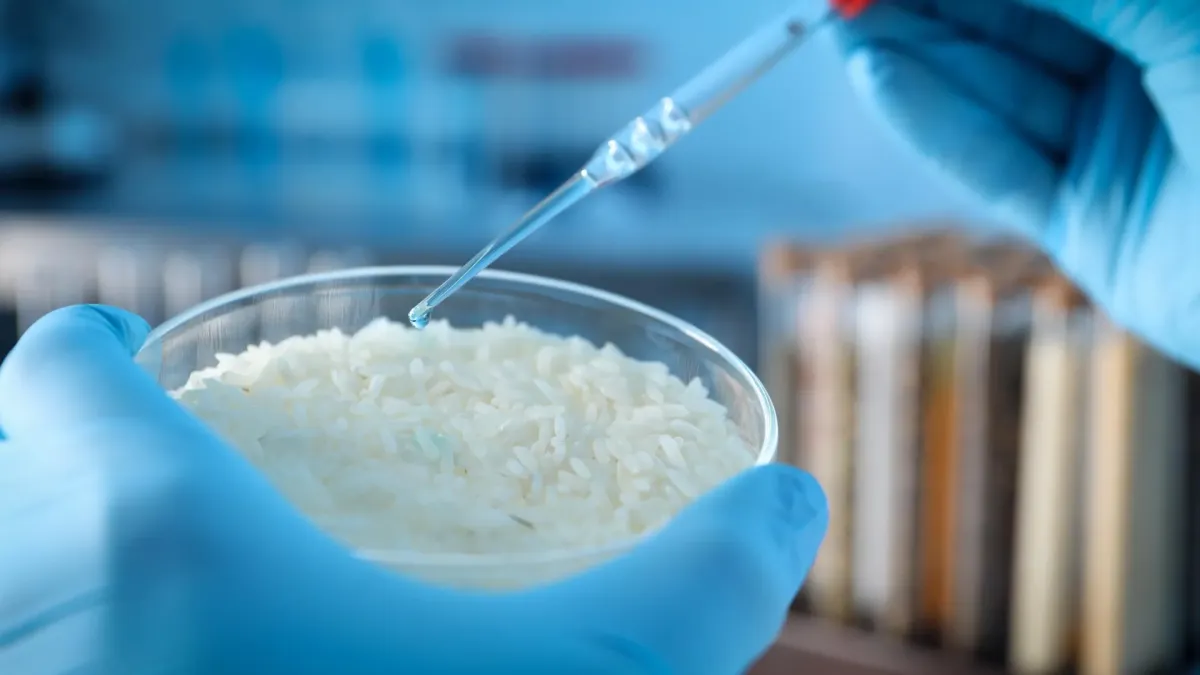
Scientists have discovered a bizarre property in everyday rice that could revolutionize smart materials, leading to self-adjusting soft robots and responsive protective gear.
It turns out that tightly packed rice grains behave in a surprisingly counterintuitive way under pressure. When compressed slowly, they hold their ground and remain strong. However, when squeezed rapidly, they actually get weaker. This "rate softening" phenomenon, uncommon in most materials, occurs because friction between grains plummets under quick forces, weakening the internal load-bearing network.
Researchers, led by the University of Birmingham, have harnessed this unusual characteristic to engineer a new type of metamaterial. By combining rice-based granular units with materials like sand, which strengthen under rapid loading, they created a composite that can adapt its stiffness based on how quickly it's stressed.
"Rice might be best known as a staple food globally, but it's rarely associated with advanced engineering," explained Dr. Mingchao Liu from the University of Birmingham. "Our research shows that it can form the basis of a new class of functional materials. Rather than treating this phenomenon as a curiosity, we turned it into a design principle." This approach allows the material to bend, buckle, or stiffen differently in response to slow movements versus sudden impacts, all without needing any electronics or sensors.
The implications for soft robotics are huge. Imagine lighter, safer robots that can automatically adjust their flexibility for delicate tasks or work safely alongside humans. This speed-sensitive material could also enhance protective equipment, absorbing impact energy more effectively during collisions and potentially reducing injuries.
This breakthrough highlights how common materials can be re-imagined as intelligent systems, responding to their environment purely through their own mechanical properties, proving that innovation can often be found in the most unexpected places.