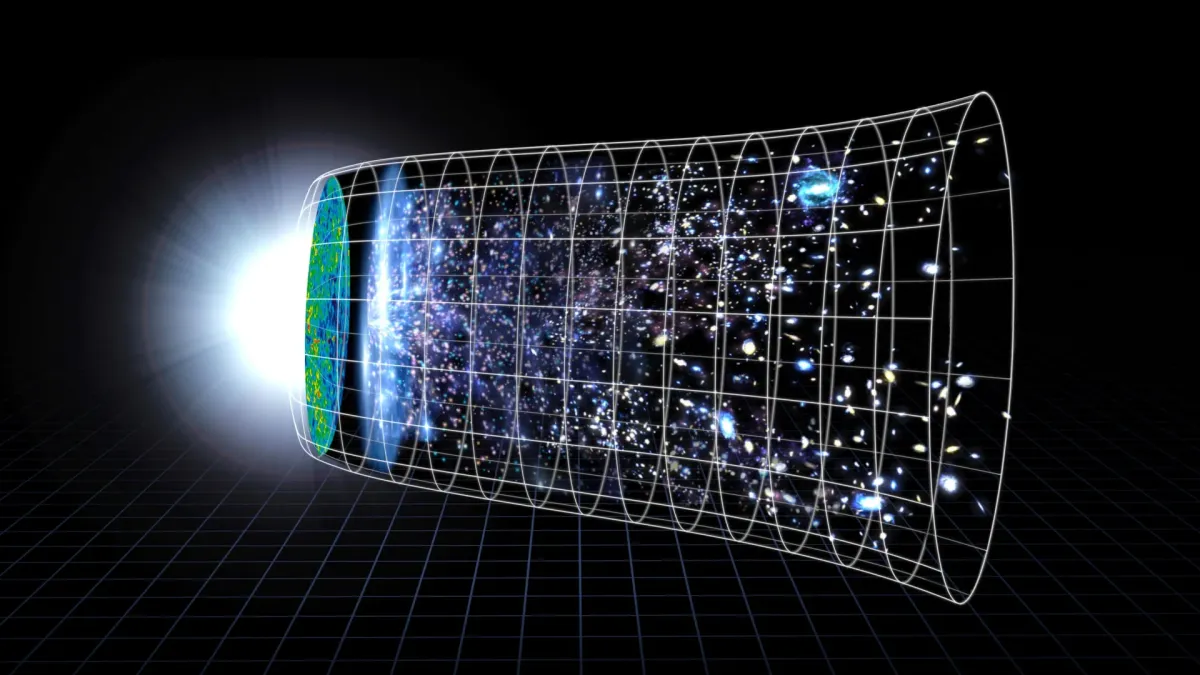
Scientists have clarified a mind-bending cosmic phenomenon: the universe can expand faster than light without violating Einstein's foundational physics. This is thanks to the unique nature of cosmic expansion, which stretches the space between galaxies rather than objects hurtling through space at superluminal speeds.
The universe's constant expansion complicates how we measure vast distances. As light from distant galaxies embarks on its billion-year journey to Earth, the space it travels through continues to grow. This means the light captured by telescopes shows a galaxy as it was eons ago, not its current location. To pinpoint a galaxy's present distance, astronomers rely on sophisticated cosmological models, like the widely used LCDM model, which factor in the universe's expansion history.
Our observable universe, despite being roughly 13.77 billion years old, extends about 45 billion light-years in every direction. This vast reach is possible because the space between us and those ancient light sources has expanded dramatically over billions of years. This boundary, known as the particle horizon, defines the limits of what we can currently observe.
The apparent contradiction of seeing objects 45 billion light-years away in a 13.77 billion-year-old universe is resolved by understanding that cosmic expansion isn't bound by the speed of light limit that applies to objects moving *through* space. While a nearby rocket can't break the light speed barrier, the vast distances across the cosmos can expand at rates exceeding it. This is measured by redshift, where the light from receding galaxies is stretched to longer, redder wavelengths.
We can still detect light from galaxies beyond the "Hubble distance" (where galaxies recede faster than light) because their light began its journey when they were closer. However, there's a cosmic event horizon, currently about 17 billion light-years away, beyond which any light emitted *now* will never reach us due to ever-increasing separation. Dark energy's accelerating expansion further exacerbates this, potentially leading to a future where distant galaxies fade from view entirely, leaving observers in a seemingly emptier cosmos.