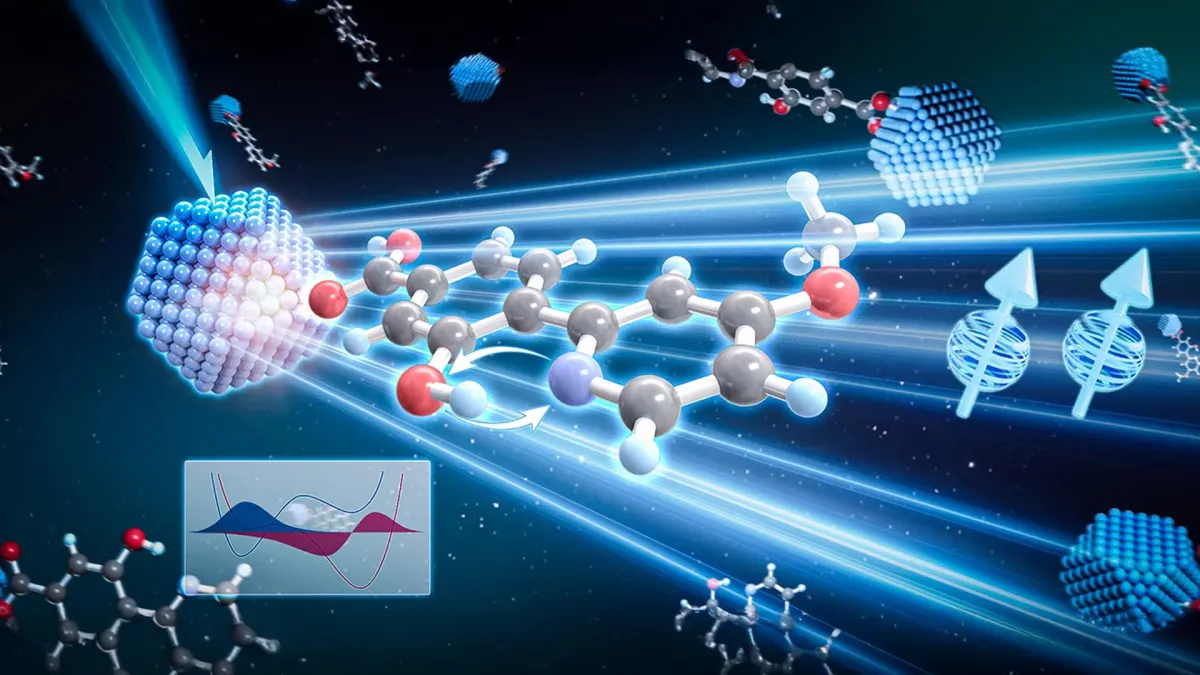
Scientists have discovered a novel quantum mechanism, dubbed proton shuttle-assisted triplet energy transfer (PS-TET), that dramatically boosts the speed and efficiency of energy transfer in materials. This breakthrough, observed in a system involving quantum dots and dyad molecules, could unlock new possibilities for controlling energy flow in advanced technologies.
The research, led by Prof. Kaifeng Wu at the Dalian Institute of Chemical Physics, delves into how proton movement influences triplet energy transfer, a crucial pathway for energy movement in both natural and artificial systems. Unlike singlet energy transfer, triplet energy transfer operates differently, and understanding its interaction with proton dynamics opens doors for sophisticated energy control.
In the PS-TET process, when light excites zinc selenide (ZnSe) quantum dots, a fascinating sequence unfolds. A hole shifts from ZnSe to a phenol molecule, while a proton simultaneously moves from the phenol to a pyridine molecule. This is followed by an electron transfer from ZnSe to the phenol radical. Crucially, the proton then returns to its original position. This intricate, proton-guided dance significantly accelerates and enhances triplet energy transfer compared to similar systems lacking this proton shuttle.
Remarkably, the rate of this PS-TET process showed minimal change with temperature, indicating that the proton's journey isn't a typical heat-driven one. Instead, the evidence points towards quantum mechanical tunneling, where the proton seemingly passes through energy barriers. Calculations supporting proton vibrational wavefunction overlap further bolstered this quantum interpretation, guiding the system toward efficient energy migration.
This discovery has major implications for molecular technologies that utilize spin-triplet excited states. Prof. Wu suggests that by controlling the presence or absence of proton shuttles, scientists could potentially enhance processes like photoredox and environmental catalysis or, conversely, suppress unwanted triplet states in organic optoelectronic devices such as solar cells and lasers, thereby improving their performance.