Researchers have engineered a groundbreaking filtration membrane featuring ultra-precise, one-nanometer pores, a development that could slash industrial energy consumption and boost water reuse globally.
This innovative technology, a collaborative effort between institutes in India, Singapore, and the S N Bose National Centre for Basic Sciences, tackles the energy-intensive nature of industrial separations, which account for up to half of global industrial energy use. Traditional methods like distillation are energy hogs, while existing membrane filters often suffer from inconsistent pore sizes and degradation.
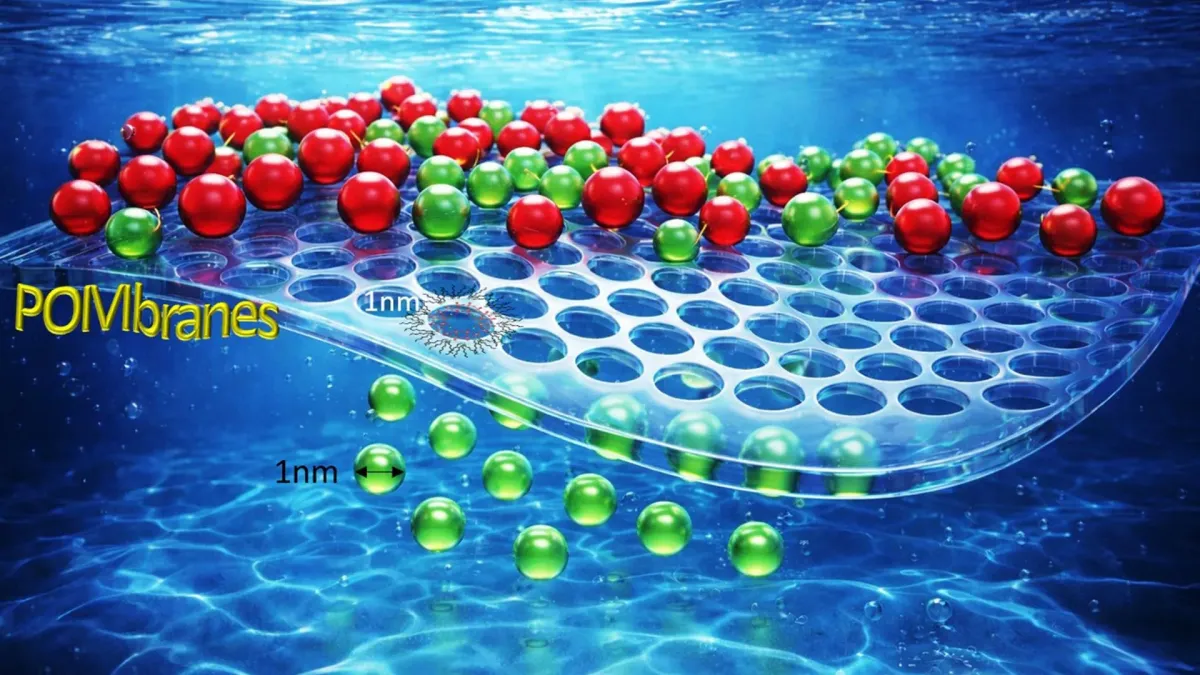
Dubbed "POMbranes," these new membranes are inspired by nature, mimicking biological systems like aquaporins to regulate molecular flow with exceptional precision. The secret lies in polyoxometalate (POM) clusters, which form stable, permanently open pores exactly one nanometer wide – a significant leap from the unstable plastic filters of the past.
"These POMs are tiny, crown-shaped metal clusters that have a permanent, perfect hole in their centre that does not change or lose shape," explained Priyanka Dobariya, a lead researcher from CSMCRI. By linking these clusters with flexible chains, scientists created large, ultrathin films where molecules are forced through these nano-sized gateways, acting like a high-tech sieve.
Testing revealed that these POMbranes can differentiate molecules with incredibly fine distinctions, performing almost ten times better than current technologies. "Our membranes show almost ten times better separation performance compared to existing technologies, while remaining flexible, stable, and scalable," stated Dr. Ketan Patel of CSMCRI. Their flexibility, stability across various pH levels, and potential for large-scale production make them ideal for industrial adoption.
The implications are huge, particularly for industries like textiles and pharmaceuticals, which are major economic drivers. In textiles, the membranes could efficiently remove dye from wastewater, enabling significant water recycling and reducing chemical waste. For pharmaceuticals, they offer a way to improve drug purification and solvent recovery, cutting energy use while maintaining strict quality standards.
Described as a versatile "platform technology," POMbranes could transform a wide range of industrial separation tasks. This nature-inspired approach to molecular-level precision showcases how innovative design can provide scalable solutions to critical industrial challenges, paving the way for more sustainable manufacturing.