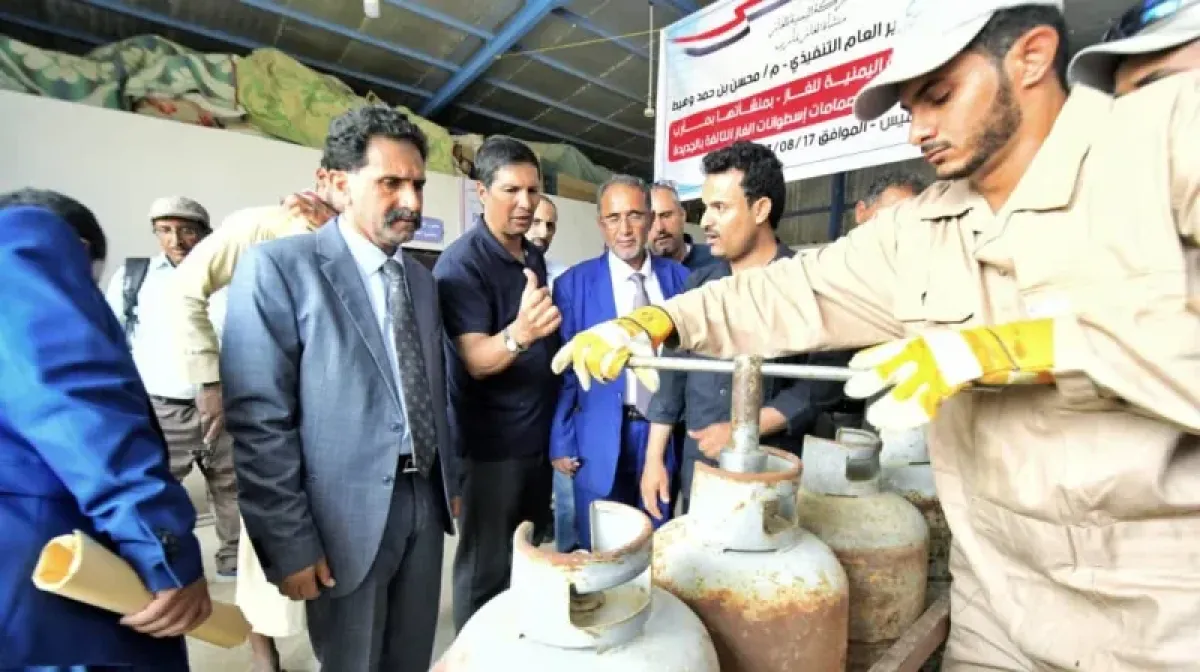
Yemen's Minister of Oil and Minerals, Mohammed Abdullah Bamqai, has revealed a government plan to import household gas from abroad due to insufficient domestic production to meet consumption demands.
In an interview with the official "Yemen" channel, Minister Bamqai stated that current daily production of household gas from the Safer facility in Marib amounts to approximately 54 tankers, a quantity he confirmed is inadequate for local consumption in the liberated areas.
The minister acknowledged that Marib's Safer facility previously supplied the entire domestic market, including areas controlled by the Houthi militia. However, he noted a significant decline in production following the militia's decision to prohibit gas entry from Safer and opt for foreign imports. Bamqai elaborated that Safer's production once reached about 128 tankers daily, exclusively for household use. After the militia's decision, substantial quantities of gas were reportedly reinjected, with the remaining volume allocated for household consumption in liberated territories.
While not providing explicit reasons for the production decline despite rising demand in liberated areas, the minister indicated that addressing the issue requires substantial financial resources. He implicitly assigned responsibility to the management of the Safer company, citing a decision to divert gas quantities to commercial uses. This redirection, he argued, led a large number of vehicles to use gas instead of gasoline, exacerbating the current crisis.
The Minister also discussed government initiatives, in coordination with local authorities in liberated provinces, aimed at resolving the gas crisis. He indicated that the ministry is seriously considering foreign imports if global prices decrease and regional tensions subside. However, his statements presented a contradiction, as he simultaneously highlighted the inadequacy of domestic production and the intention to import, while reaffirming the government's commitment to the Balhaf gas export project.
Minister Bamqai disclosed a meeting in Cairo between the government, the operating company, and partners of the Balhaf project last month. This meeting concluded with an agreement to extend the project's contract by two additional years. The agreement also stipulates that the operating company and partners will bear the losses incurred by the export halt, while the state retains its right to due taxes and a review of the gas pricing stipulated in the agreement. Furthermore, the utilization of the Balhaf project for a gas power plant was discussed, with the operating company and partners agreeing to facilitate gas transport via the project's pipeline and utilize its processing unit. An agreement was reached to secure sufficient gas for a 1000-megawatt power generation, with the government currently seeking funding for the plant's establishment. The Safer company has been tasked with conducting a technical study on the power plant's transmission lines, with approximately 60% of the study completed and slated for government review soon.