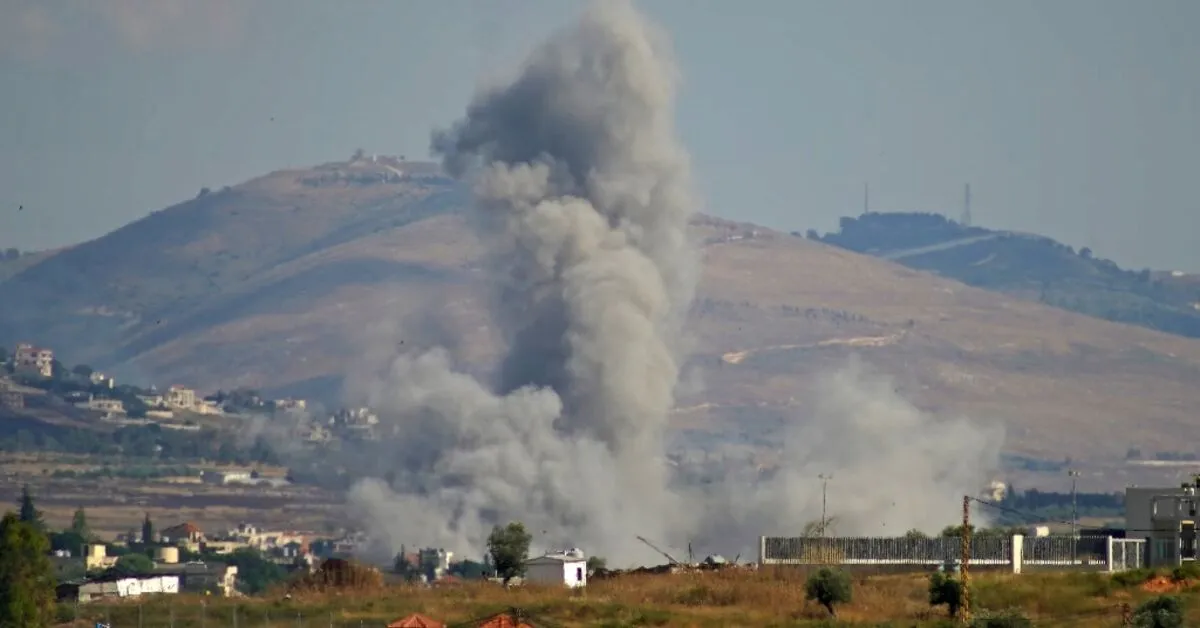
Lebanon reported Israeli strikes in its southern and eastern regions on Saturday, coinciding with Israeli military evacuation warnings issued for Nabatieh and more than twenty other locations ahead of anticipated raids.
The latest exchanges occurred as international diplomatic efforts involving the United States and Iran indicated progress toward a potential deal to end the broader Middle East conflict, a conflict that has increasingly involved Lebanon following Hezbollah's attacks on Israel in support of its ally, Iran.
Lebanon's state-run National News Agency (NNA) confirmed that Israeli airstrikes had impacted several areas, with a particular focus on the vicinity of Nabatieh. An independent journalist observed explosions near Kfar Remman, a frequently targeted location, and witnessed a smoke plume emanating from Kfar Tebnit, an area not included in the evacuation advisories. The Lebanese army subsequently reported that one of its soldiers sustained severe injuries from an Israeli drone strike on the road between Kfar Remman and Nabatieh. Earlier attempts to target the soldier were reported near a hospital close to the city. NNA also reported that an Israeli strike resulted in the death of a local official in Rihan, located in the southern Jezzine region.
The Israeli military had disseminated two advisories urging residents in 24 locations, both within and surrounding Nabatieh and closer to the coast, to "evacuate your homes immediately and move to the north of the Zahrani River," a zone approximately 45 kilometers from the southern border. Last month, Israel designated all areas south of this river as "combat zones," leading to intensified strikes. Hezbollah, meanwhile, claimed responsibility for launching drone attacks against Israeli military vehicles in the south and stated it had repelled an overnight Israeli "infiltration" attempt near Kfar Tebrnit, engaging Israeli forces in a firefight. The group also reported clashes with Israeli soldiers near Majdal Zoun, closer to the border. Israel's military confirmed intercepting a suspicious aerial target crossing from Lebanon and announced that over 70 Hezbollah infrastructure sites were struck within the preceding 24 hours. Further strikes later hit two areas in Lebanon's eastern Baalbek region, according to NNA.
Iran maintains that Lebanon's inclusion is essential for any agreement to resolve the wider Middle East crisis, with a senior US official indicating on Friday that a draft peace deal "includes Lebanon." Neither Israel nor Hezbollah have adhered to previous ceasefire proposals, and a conditional truce announced this month following Lebanese-Israeli negotiations in Washington has also failed to halt hostilities. Hezbollah has rejected both direct talks and the conditional accord, which mandates its cessation of attacks without explicitly requiring Israel to do the same or withdraw its troops from Lebanon. Lebanon reports that Israeli military actions have resulted in 3,756 fatalities to date. Lebanese leaders have voiced concerns that Tehran views their country as a "bargaining chip." Hezbollah lawmaker Ali Fayyad suggested on Saturday that Lebanon should accept any US-Iran deal that encompasses the nation, advocating for the Lebanese state to negotiate independently rather than be subjected to Israeli pressure or American directives.
The Prime Minister of Pakistan, involved in mediating between Tehran and Washington, expressed optimism on Saturday that a deal was closer than ever. Lebanese President Joseph Aoun issued a statement characterizing Lebanon's situation as a "fateful test," urging national unity around a sovereign state that monopolizes weaponry, enforces the law, and protects all citizens, rather than remaining "hostage to the logic of militias." Further discussions between Lebanon and Israel are scheduled for later this month.