Researchers have developed a novel material composed of interlocking particles that can switch from a robust, solid-like state to a loose collection of components almost instantly, potentially revolutionizing fields from construction to robotics.
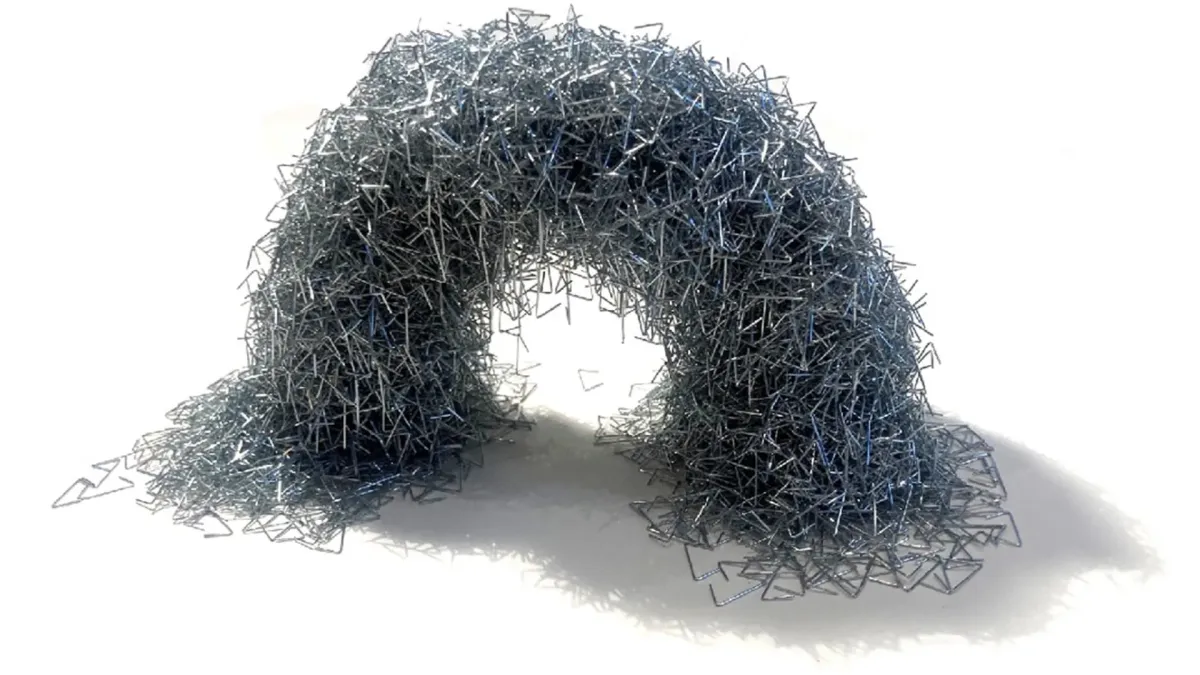
Inspired by the way office staples tangle together, scientists at CU Boulder's Paul M. Rady Department of Mechanical Engineering are exploring how specially shaped particles can create materials with both impressive strength and remarkable reversibility. The goal is to engineer materials that are adaptable, strong, and easily recyclable.
Professor Francois Barthelat, who leads the Laboratory for Advanced Materials & Bioinspiration, explained that while the concept of building blocks and geometry has been explored for years, the focus on interlocking, entangled particles is recent. "We are excited about the combination of properties we can get out of these systems," he stated, highlighting the technology's broad potential.
The core of this innovation lies in "entanglement," a phenomenon where particles interweave and form connections, much like the fibers in a bird's nest or the components in bone. The key discovery by the CU Boulder team is that the shape of the particles dramatically influences their behavior. Unlike smooth sand grains that don't interlock, altering a particle's shape allows for significant control over its mechanical properties and how it connects with others.
Through computational simulations and real-world tests, the researchers found that a "two-legged" particle, mimicking the shape of a staple, achieved the highest degree of entanglement. This unique shape allows the material to exhibit both high tensile strength and toughness simultaneously, a challenging feat for conventional materials. The material's state can be controlled by vibration: gentle shakes encourage interlocking and strengthening, while stronger vibrations cause it to unravel.
This "strange" material, existing in a state somewhere between liquid and solid, opens exciting engineering avenues. Potential applications include more sustainable construction, where structures could be disassembled and reused instead of demolished, and in robotics, enabling small robots to entangle for tasks and then separate. Barthelat even drew a parallel to the shapeshifting T-1000 from Terminator 2, acknowledging the futuristic possibilities while noting the current challenges in scaling up production.
The team is now experimenting with even more complex particle designs, featuring additional "legs" similar to burrs that cling to clothing, aiming to achieve even stronger entanglement effects and unlock further material innovations.