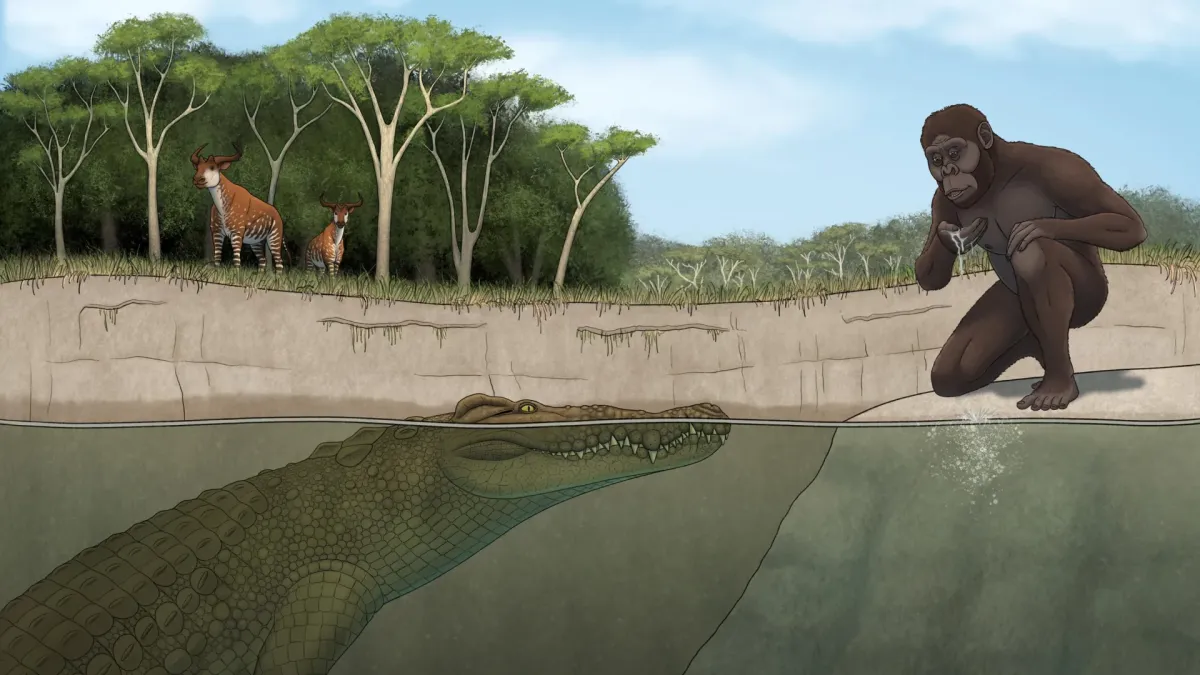
A newly identified species of massive crocodile, dubbed "Lucy's hunter," stalked the same East African rivers and lakes as our early human ancestors over 3 million years ago. Researchers have named the formidable predator Crocodylus lucivenator, reflecting its historical significance as a major threat to Lucy and her kind.
This ancient croc lived between 3.4 and 3 million years ago in what is now Ethiopia, a period and region famously associated with Australopithecus afarensis, the species to which the iconic fossil Lucy belongs. Discovered in 1974, Lucy's skeleton was groundbreaking, providing crucial evidence that bipedalism evolved before larger brain sizes in human evolution.
Crocodylus lucivenator was no small fry. Measuring an impressive 12 to 15 feet long and weighing up to 1,300 pounds, it was the sole crocodile species in the Hadar landscape, a diverse environment of shrublands, wetlands, and waterways. Researchers believe it was an ambush predator, lying in wait in the water for unsuspecting animals, including early hominins, to approach for a drink.
"It was the largest predator in that ecosystem, more so than lions and hyenas, and the biggest threat to our ancestors who lived there during that time," explained Christopher Brochu, lead author of the study published in the Journal of Systematic Palaeontology. "It's a near certainty this crocodile would have hunted Lucy's species. Whether a particular crocodile tried to grab Lucy, we'll never know, but it would have seen Lucy's kind and thought, 'Dinner.'"
What set this crocodile apart was a distinctive hump on its snout, a feature more commonly seen in American crocodiles than in African Nile crocodiles, and possibly used for courtship displays. Its snout also extended farther beyond its nostrils, resembling the elongated snouts of modern crocodiles. Analysis of 121 fossil remains, including skulls and teeth from the Hadar Formation, allowed scientists to reconstruct this ancient predator.
One fossil even revealed evidence of a violent past, with partially healed injuries on its jaw suggesting a fight with another crocodile. "The fossil record preserves similar injuries in extinct groups as well, so this kind of face-biting behavior can be found throughout the crocodile family tree," noted Stephanie Drumheller, a co-author. "We can't know which combatant came out on top of that fight, but the healing tells us that, winner or loser, this animal survived the encounter."