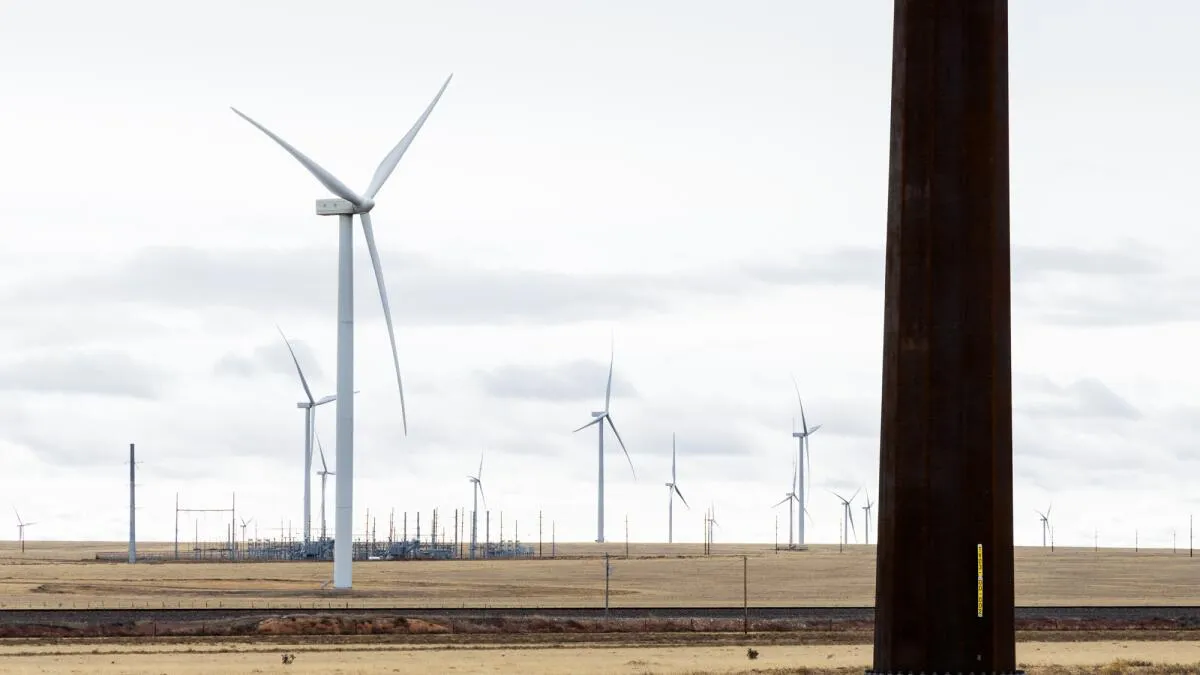
The SunZia project, one of the largest clean energy undertakings in U.S. history, is now operational, transmitting electricity from a vast wind farm in New Mexico to Arizona and California, marking a significant advancement in the distribution of renewable energy across the Western United States.
The ambitious $11 billion SunZia project, developed by Pattern Energy, features 916 wind turbines with a combined capacity of 3.5 gigawatts, capable of powering approximately one million homes. This scale significantly surpasses that of the next two largest U.S. wind farms, Alta Wind in California and Great Prairie in Texas, according to the U.S. Energy Information Administration.
A critical component of the project is a 550-mile high-voltage direct-current transmission line that channels wind power from New Mexico to the Palo Verde substation in Arizona, ultimately feeding into Southern California, which will receive about two-thirds of the transmitted power. Since SunZia began its testing phase in April, California's Independent System Operator (CAISO) has recorded unprecedented levels of wind power on its grid on multiple occasions, indicating a substantial impact on the state's energy supply.
Energy analyst Dennis Wamsted highlighted the project as a milestone, stating that it effectively harnesses a substantial wind resource in New Mexico for use across the Southwest. He emphasized the benefits for consumers and proponents of the transition away from fossil fuels. The project's ability to deliver wind power, particularly during nighttime hours when winds are strong, complements California's solar generation, which is abundant during the day, and existing battery storage systems.
CAISO President and CEO Elliot Mainzer affirmed that large-scale transmission infrastructure is crucial for meeting the escalating energy demands of the West and enhancing grid reliability, contributing to a more resilient, flexible, and affordable electric system. This development occurs amidst global investments in renewable energy, contrasting with a period of reduced federal emphasis on such projects in the U.S. under the previous administration.
Despite a lengthy development process spanning nearly two decades, involving ownership changes, permitting delays, and redesigns, the SunZia project demonstrates the feasibility of constructing large-scale energy infrastructure. However, the project has faced opposition from environmental groups concerned about habitat disruption and impacts on wildlife migration, as well as from organizations focused on cultural and architectural preservation along the transmission line route. Legal challenges have been filed, alleging non-compliance with historic preservation rules and potential irreversible damage to sensitive areas.
Senator Martin Heinrich, who played a key role in facilitating the project's completion, views SunZia as a model for future large infrastructure undertakings in the U.S., underscoring that transmission capacity, rather than generation, is often the limiting factor in delivering clean energy. He advocates for permitting reform to streamline the approval process for similar projects, stating the necessity of undertaking multiple projects of SunZia's scale to meet rising energy demands across the nation.