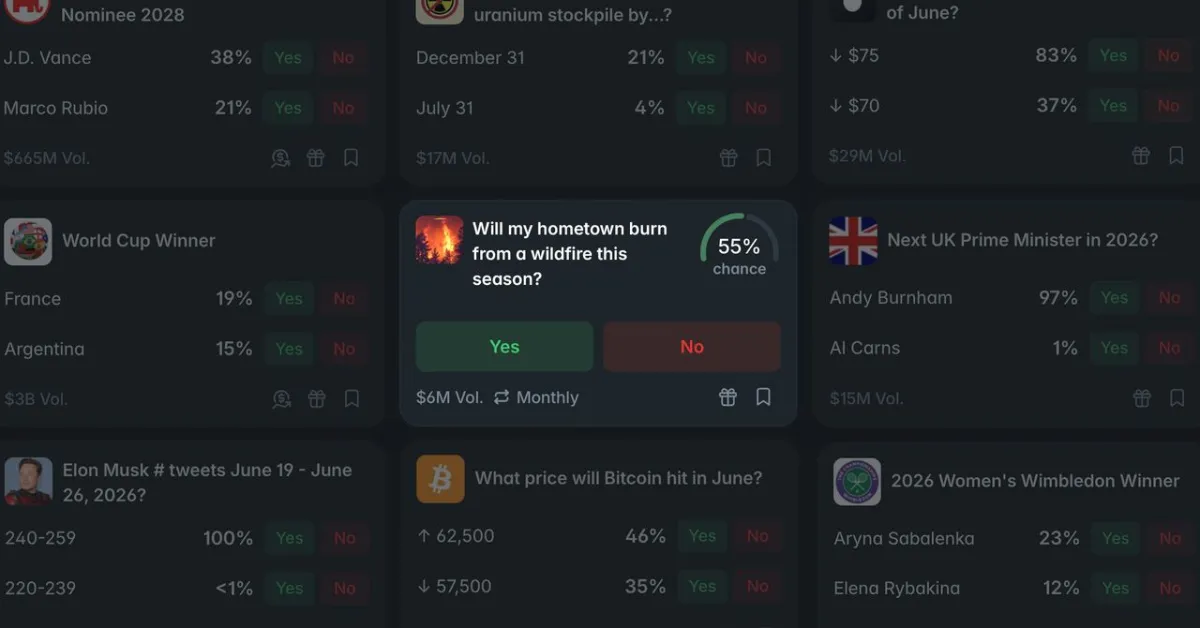
As wildfires rage, a controversial new trend is emerging: prediction markets where people bet on fire outcomes, drawing sharp criticism from survivors and ethicists.
Imagine losing your home and everything you've worked for to a wildfire, only to discover that others were financially profiting by betting on its destruction. This is the reality for wildfire survivors like Sylvie Andrews, who lost her home and years of sacrifices to the Eaton Fire in California. While she and thousands of others were forced to evacuate, some individuals reportedly used platforms like Polymarket to wager on how the fires would spread, how long they'd last, and the extent of the damage.
Prediction markets operate like sophisticated gambling sites, allowing users to bet on a wide range of future events, from elections to natural disasters. The core mechanism involves buying "contracts" that fluctuate in price between $0 and $1, reflecting the collective belief in an event's likelihood. For instance, a 50-cent price on a "yes" contract suggests a 50% chance of the event occurring. These platforms typically charge a fee on all wagers. In January 2025, Polymarket listed nearly 20 questions related to Southern California wildfires, attracting $1.2 million in bets, according to Aeon Magazine.
Survivors like Andrews and Susan Sherman, who lost her childhood home to the Palisades Fire, find the practice "morally reprehensible," "crass," and "heartless." The burgeoning prediction market industry, especially with a new wildfire season looming, is raising serious ethical alarms. Critics argue that these markets not only encourage callousness but could also incentivize dangerous behavior, including arson. Unlike events like hurricanes, fires can be deliberately manipulated, and the US Forest Service has stated that systems tying financial gain to wildfire outcomes are incompatible with their mission to protect lands and communities.
Beyond arson, there's concern about potential insider trading, where individuals with privileged information about firefighting strategies or a fire's trajectory could exploit it for financial gain. Ann Skeet, a senior director at the Markkula Center for Applied Ethics, highlights the fundamental ethical dilemma: "When you start gambling on somebody’s potential death or harm, you’re really diminishing the value that you’re placing on human life."
The trend is evolving, with new platforms like Wyldfyre emerging, specifically focused on California fires and boasting the tagline, "You can’t predict wildfire. But you can trade on it." While currently offering simulated trading, real-money betting is planned. Despite claims of providing a "public good" through collective intelligence, official firefighting agencies like the US Forest Service and Cal Fire state they do not use prediction market data, relying instead on validated science and proven predictive tools.
As prediction markets gain traction, legislative efforts are underway to curb their scope. Federal and state lawmakers are proposing bans on betting related to illegal activities, terrorism, and even individual deaths. While wildfire betting isn't explicitly covered yet, the debate is heating up. For survivors like Sylvie Andrews, the hope is that if people do profit from such devastating events, they might consider donating their winnings to those affected.