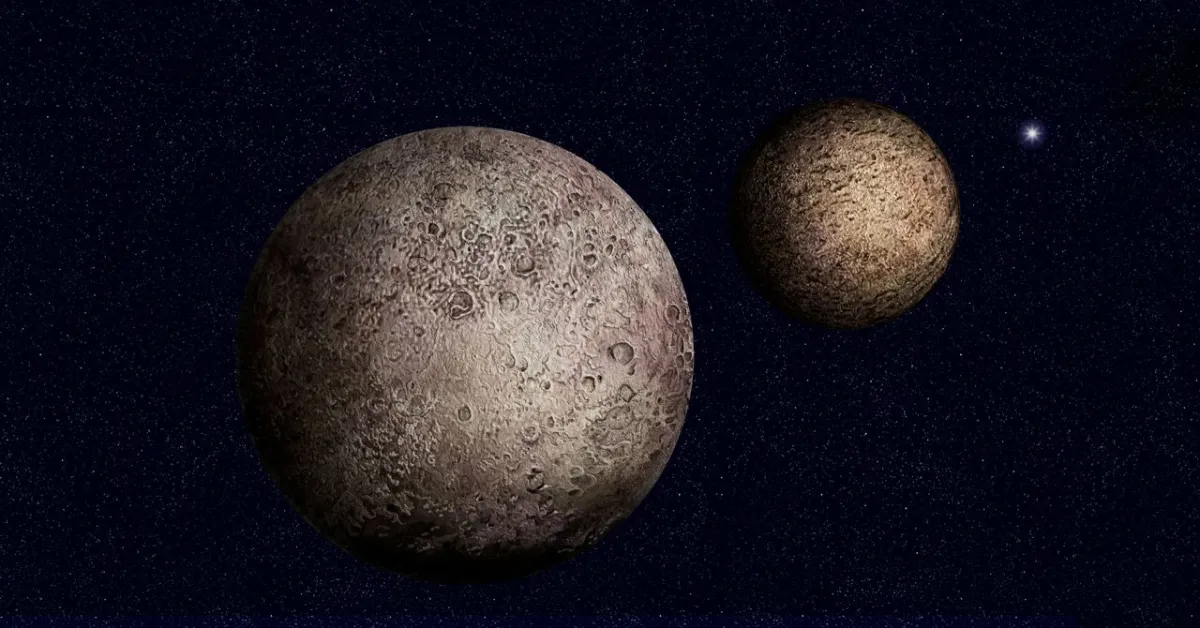
Astronomers are scratching their heads after the James Webb Space Telescope (JWST) detected an unknown chemical signature on both the dwarf planet Pluto and Saturn's moon Titan, a discovery that doesn't match any known compounds in scientific databases. Researchers are confident this isn't a technical glitch, but rather evidence of a mysterious substance, potentially a mix of materials never studied or even a completely new type of chemistry.
The intriguing finding, detailed in a study awaiting publication in Astronomy & Astrophysics, centers on an absorption band spotted at 5.113 micrometers on both celestial bodies. These worlds are separated by billions of kilometers and boast vastly different environmental conditions. The signal's presence in observations from two different JWST instruments has led the research team to rule out calibration errors or other technical issues.
Spectroscopy, the technique used here, works like a fingerprint for chemicals. Each element or molecule absorbs light at specific wavelengths, creating a unique pattern. Scientists have spent decades building extensive libraries of these spectral signatures to identify substances like water, methane, and ammonia on planets, moons, and even exoplanets. However, in this case, comparisons with existing data yielded no definitive matches.
The discovery of a spectral signature that doesn't correspond to any known compound is highly unusual. Researchers have explored various possibilities, analyzing lab spectra of ices and organic compounds like acetylene and benzene that might exist on these distant worlds. None have perfectly matched the observed signal. The leading theory suggests it might be a known compound in a physical state or mixture that hasn't been studied in a lab, though the possibility of a completely uncharacterized chemistry isn't being dismissed.
What makes this mystery even more captivating is the shared signature appearing on two such dissimilar worlds. Titan boasts a dense nitrogen and methane atmosphere, liquid methane lakes, and a surface temperature around -180°C. Pluto, conversely, has a wispy atmosphere, an icy surface of nitrogen, methane, and carbon monoxide, and temperatures plunging near -235°C. Despite these extremes, both worlds undergo complex organic chemistry influenced by solar and cosmic radiation, which could be producing novel compounds that settle on their surfaces.
Unraveling this cosmic puzzle will require more JWST observations and laboratory experiments designed to replicate the chemistry of these icy environments. NASA's upcoming Dragonfly mission to Titan offers a glimmer of hope; while it won't directly analyze this specific infrared signature, its onboard laboratory could identify candidate compounds, potentially helping to solve one of the JWST's most compelling outer solar system mysteries.