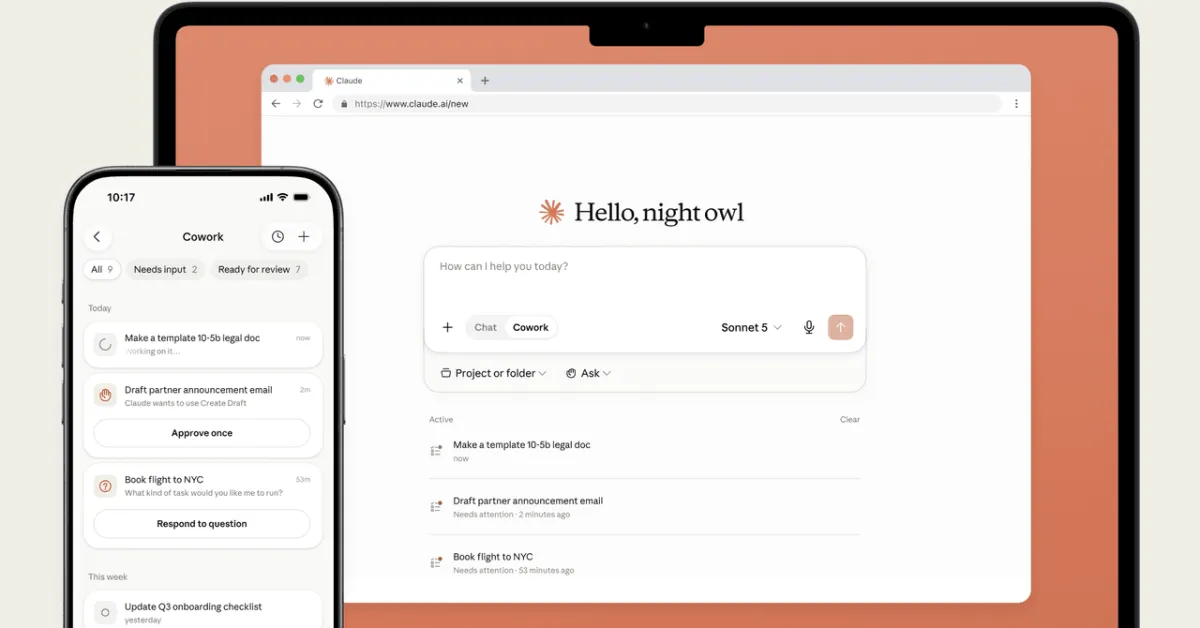
Say goodbye to leaving your laptop awkwardly ajar just to keep your AI agent running. Anthropic just announced that Claude Cowork, its digital task-master AI, is ditching the desktop-only life and heading straight for your smartphone.
This means you can schedule tasks to run overnight or while you're offline without needing to keep your device powered on and screen open. Anthropic is also rolling out limited versions of Cowork directly within the existing Claude smartphone app and web browser, no desktop connection required.
Imagine this: you've got a big deal renewal coming up tomorrow. With a single prompt, you could ask Cowork to dig through your emails, Slack messages, meeting transcripts, and even recent online chatter to prep all the necessary info. Then, ask it to whip up a reference doc for the meeting and draft a pre-written email. Previously, this all depended on your desktop session being active. Now, Cowork can keep grinding away even after you've clocked out, catching those late-night messages.
When I first tested Claude Cowork back in January, I was seriously impressed. It actually followed through on tasks like organizing a chaotic pile of screenshots into neat, labeled folders and helped me schedule calendar events. While it wasn't flawless and carried risks like prompt injections, Cowork felt like a genuine leap forward for everyday users interacting with their devices.
This isn't the first time Claude users could tap into Anthropic's AI on mobile. The previous "Dispatch" feature let you send task requests from your phone to your desktop. The catch? Your computer had to be awake and the app open. Some users resorted to leaving laptops on, but now, Cowork can handle tasks independently of an active desktop session.
This move aligns with a broader Silicon Valley trend toward "always-on," semi-autonomous AI agents controlled via simple text commands. This shift was largely kicked off by a viral, fan-made agent called OpenClaw, which gained traction in early 2026 as users handed over control of their digital lives.
Competitors quickly took notice. OpenAI hired OpenClaw's creator and launched its own adaptive agent, Codex, while Google introduced Spark. Anthropic, meanwhile, has been focusing on making its AI more accessible, building on the success of Claude Code, which automated developer tasks. Cowork essentially takes that power and translates it from the command line into a user-friendly chatbot format for everyone.
The new Cowork features will initially roll out as a beta for subscribers of Anthropic's $100/month Max plan, with plans to extend it to the $20/month Pro tier. It's still uncertain if free users will get access.
Anthropic also released data showing that white-collar workers are increasingly integrating its tools into their routines. "Business process and operations" (think data reports and checklists) and "content creation and copywriting" (like slide decks and proposals) are the top two usage categories.
Both OpenAI and Anthropic are pushing to integrate their chatbots and agents into a seamless, smartphone-first experience. OpenAI's Codex Remote allows similar desktop agent control from phones, and its iOS app now offers more Codex task management. Anthropic's latest release goes a step further by merging the Claude chatbot and Cowork agent directly into the browser and desktop interfaces.
This strategy reflects a growing belief in Silicon Valley that AI-driven automation will become central to how we use our devices, moving beyond just tech enthusiasts. Instead of launching separate apps, companies are embedding these powerful capabilities directly into the chatbots millions already use on their phones.