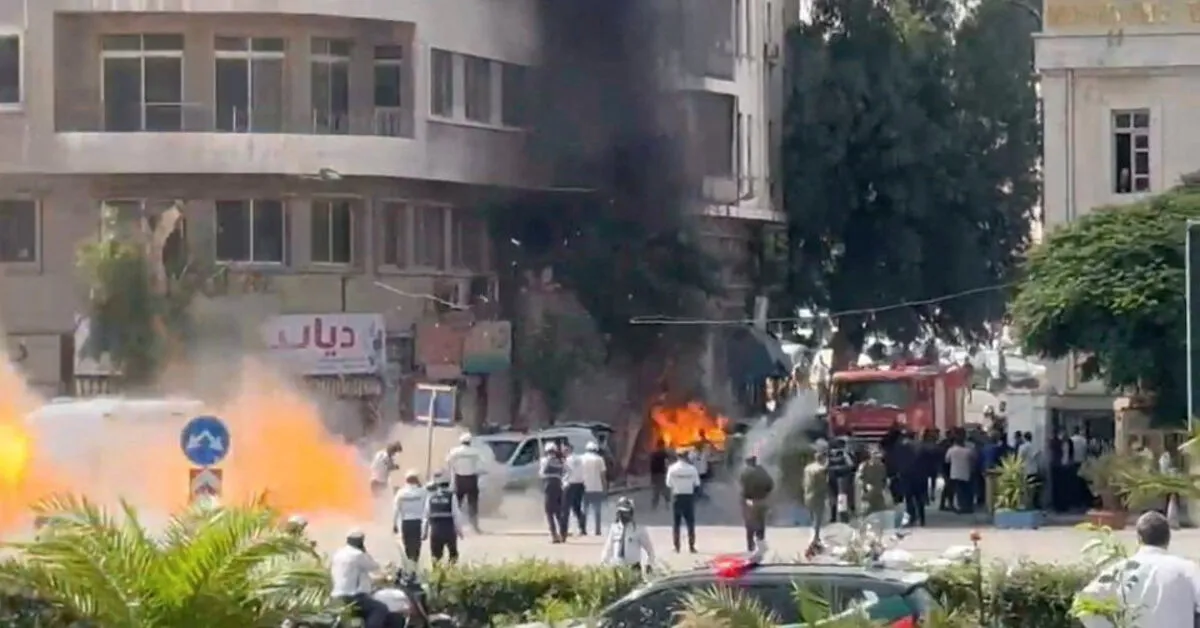
Preliminary investigations into a bombing near a Damascus hotel frequented by President Macron suggest affiliation with the Islamic State, a senior Syrian security official stated. The explosions injured 18 people, casting a shadow over the French President's visit.
The Sunni Muslim group known as Islamic State (IS) originated in Iraq and Syria, where it established a self-proclaimed caliphate, asserting dominion over all Muslims and largely superseding al-Qaeda. At its zenith between 2014 and 2017, IS controlled substantial territories in both nations, governing millions and imposing a stringent interpretation of Sharia law marked by extreme brutality, including public executions and torture. The group's fighters were also implicated in, or inspired, attacks globally.
Following the collapse of its territorial strongholds in Raqqa, Syria, and Mosul, Iraq, due to a U.S.-led coalition campaign, IS fighters retreated to remote areas within these countries. The group maintains a significant presence in Iraq and Syria, along with operations in parts of Africa, Afghanistan, and Pakistan. Its fighters operate in dispersed cells, with leadership remaining clandestine, making an accurate assessment of its membership difficult. The United Nations estimates its membership in its former heartlands to be around 10,000.
Africa has become a focal point for IS operations. Since experiencing major setbacks in the Middle East, the group's activity has increasingly shifted to Africa, which accounted for 86% of its global operations in the first quarter of 2026, according to the Armed Conflict Location & Event Data Project. While the faction ISWAP is primarily based in northeastern Nigeria, other branches are active in the Sahel region, Somalia, Mozambique, and the Congo. The Islamic State's Khorasan branch (ISIS-K), named after an old regional designation, has attracted numerous foreign fighters and is active in areas including parts of Iran, Turkmenistan, and Afghanistan. Affiliates also remain active in the southern Philippines, notably Mindanao.
Recent intelligence indicates a potential resurgence of IS activity, with leaders and Western allies warning of the group's capacity to exploit the post-2024 political landscape in Syria and Iraq. IS has declared a new operational phase in Syria, targeting the government with a series of attacks. Sources suggest the group is activating sleeper cells, conducting surveillance, and distributing weaponry and explosives. The UN Office of Counter-Terrorism reported foiled assassination attempts against Syrian government officials by IS. The group's influence has also been noted in lone-wolf attacks, such as the 2025 Sydney Bondi Beach shooting, which police indicated may have been inspired by IS. In 2024, ISIS-K claimed responsibility for a mass shooting at a concert hall near Moscow, and the group has been linked to other plots in Russia and Azerbaijan.
The overarching goal of Islamic State remains the propagation of its extreme ideology and the establishment of its governance. Post-territorial collapse, the group has transformed into a decentralized underground movement, relying on clandestine cells, loosely connected operatives, and discreet communication networks rather than large, conventional formations. This shift towards autonomy for smaller groups and individual militants enables the organization to withstand sustained counterterrorism efforts.