New research suggests Jupiter's powerful magnetic field created a protected zone, allowing it to gather multiple large moons, while Saturn's weaker field prevented similar moon formation.
While both Jupiter and Saturn are giant planets boasting huge moon families, their satellite systems are strikingly different. Jupiter boasts four massive moons, including the solar system's largest, Ganymede. Saturn, on the other hand, is dominated by Titan, the second-largest moon. This disparity has long puzzled astronomers trying to understand how these gas giants formed their moon companions.
A team of researchers from Japan and China, including Kyoto University, developed a new model to tackle this mystery. They used advanced simulations to recreate the conditions around young Jupiter and Saturn, focusing on how their magnetic fields and surrounding disks of material evolved. This allowed them to estimate how the planets' magnetic fields changed over time and model the circumplanetary disks from which moons form.
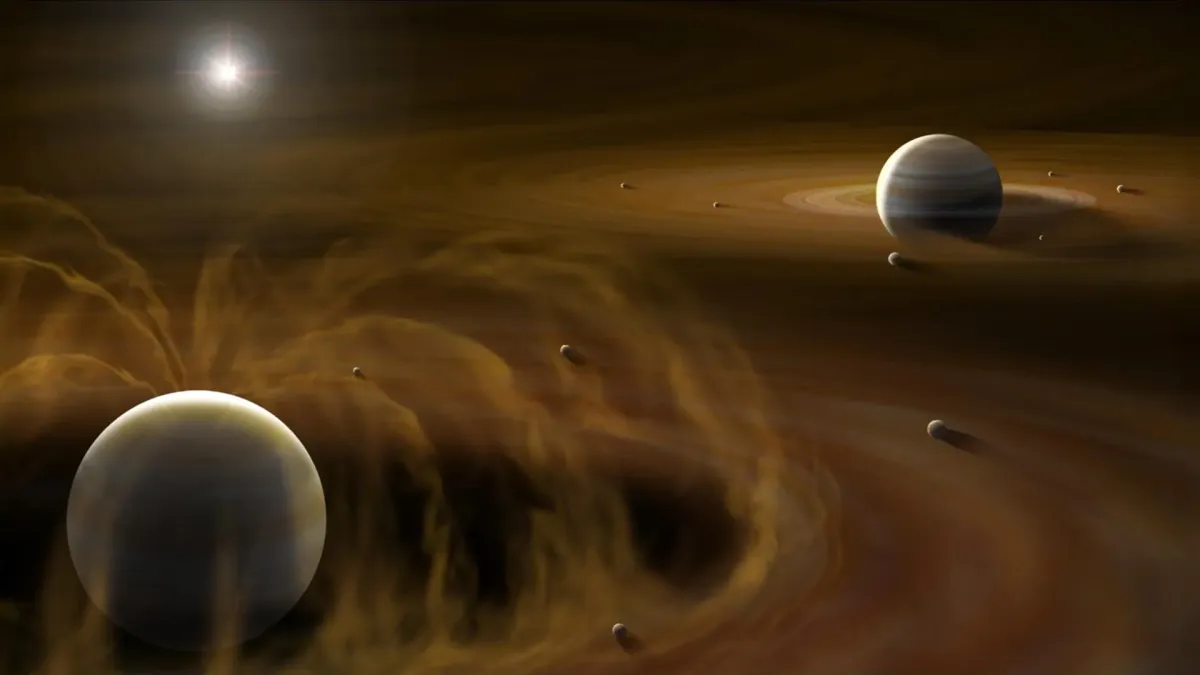
The simulations revealed a key difference: Jupiter's early, potent magnetic field generated a "magnetospheric cavity" within its circumplanetary disk. This cleared inner region acted like a safe harbor, helping Jupiter capture and hold onto its large moons like Io, Europa, and Ganymede as they migrated through the disk. In contrast, Saturn's younger, less powerful magnetic field couldn't create a similar protective bubble.
Without this shielded zone, potential moons orbiting closer to Saturn likely didn't survive the chaotic early solar system. This new theory offers a compelling explanation for why Jupiter has a collection of large moons while Saturn's collection is primarily headlined by Titan.
These findings could also shed light on moon systems around planets outside our own solar system. The model predicts that planets as massive as Jupiter are likely to develop compact systems with multiple moons, whereas gas giants closer to Saturn's size might typically end up with just one or two significant moons.