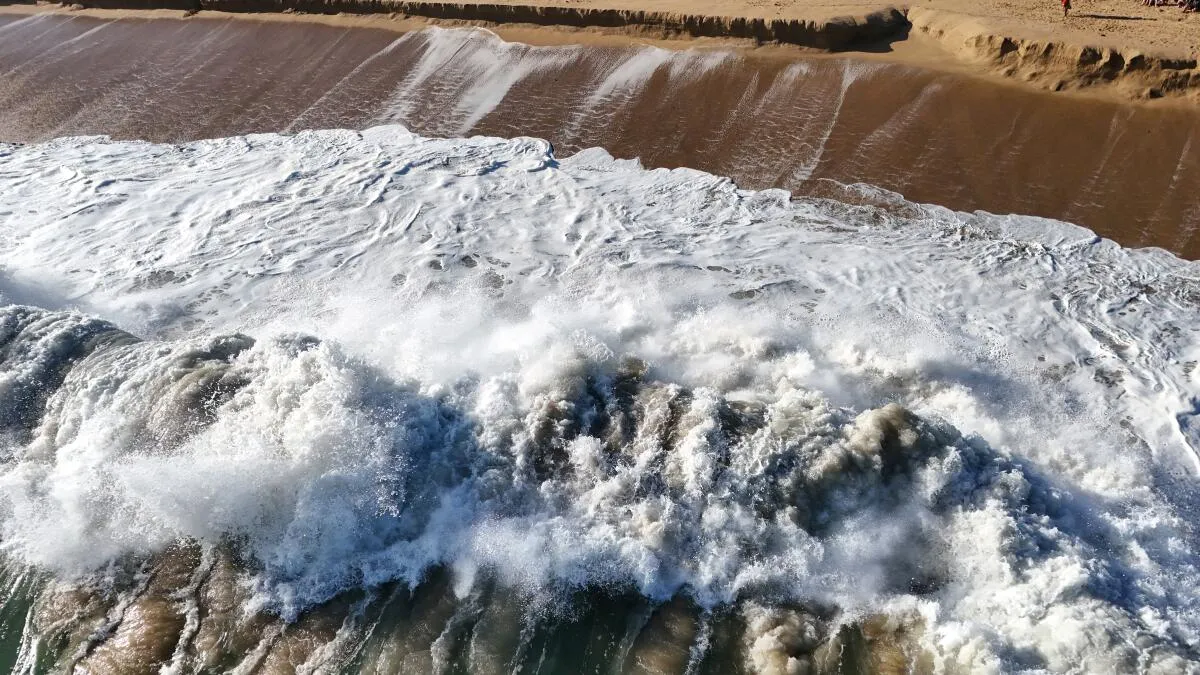
Powerful hurricane-driven swells have stripped away sand at Newport Beach's Wedge, revealing remnants of decades-old infrastructure, including rocks, concrete chunks, and rusted metal rods, buried beneath the shoreline.
The erosion is particularly noticeable near the west jetty, a popular surfing location. Newport Beach Lifeguard Battalion Chief Adam Yacenda confirmed the exposed materials are a result of sand removal. He explained that the U.S. Army Corps of Engineers constructed jetties in the area many decades ago to mitigate beach erosion and safeguard waterfront properties near the Newport Harbor entrance.
“A lot of sand has been carved away, uncovering things that haven’t seen the light of day in decades,” Yacenda stated. He noted the presence of PVC pipes, wires, and even a railway tie among the unearthed items, some of which are intermittently visible underwater.
These significant swells coincide with an intensifying El Niño pattern, known for warming ocean waters and increased rainfall, which has been previously linked to severe beach erosion along the California coast. Several hurricanes have formed in the eastern and central Pacific recently, generating dangerous surf conditions for Southern California.
The sand erosion at Newport Beach mirrors incidents elsewhere along the coast. In Los Angeles County, Point Dume State Beach was closed due to extreme erosion destabilizing the bluff edge. Similarly, in Carlsbad, strong surf damaged a parking lot at Tamarack State Beach, which had recently undergone a significant sand replenishment effort.
The unearthing of these historical materials has ignited public curiosity and raised safety concerns for surfers at the Wedge. Some local residents speculate that the exposed items could be part of an older groin structure predating the current jetty system. Jetties are typically built to maintain harbor entrances, while groins are shorter structures designed to combat beach erosion and widen sandy areas.