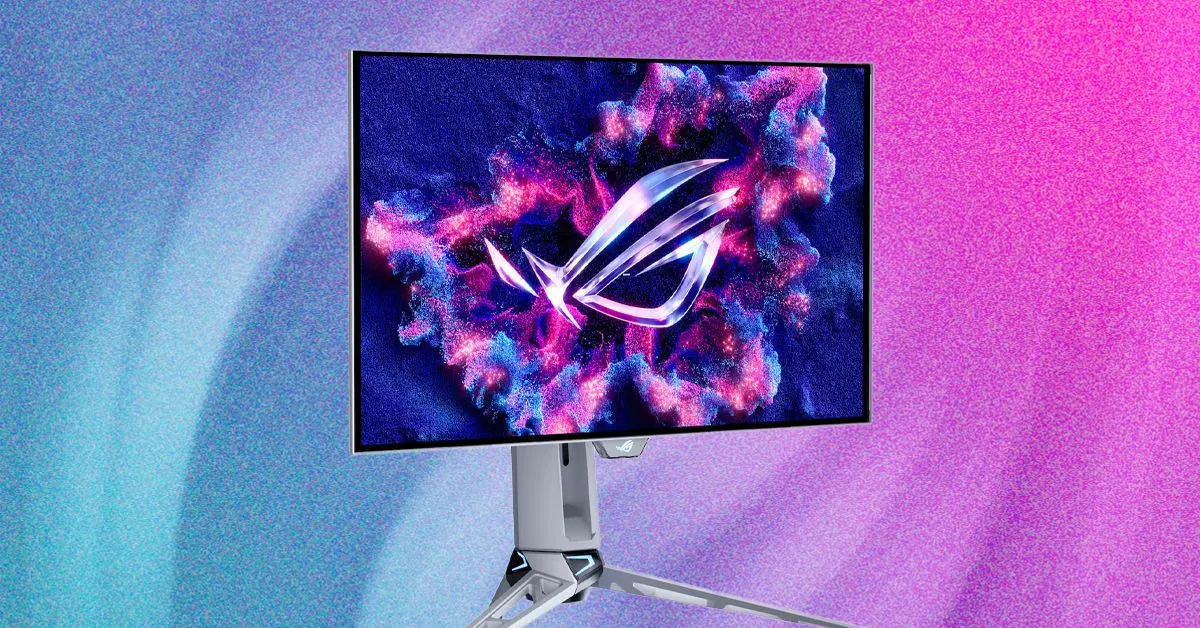
Asus' new PG27UCWM monitor is making waves by addressing a major downside of OLED displays: distracting reflections. While offering stunning visuals, the monitor's glossy finish can be a dealbreaker for some, but Asus seems to have found a middle ground with its latest offering.
Technically, the PG27UCWM boasts impressive color performance, covering 94 percent of DCI-P3 and 89 percent of AdobeRGB. While slightly less than top-tier QD-OLEDs, its ultra-clear, high-contrast panel amplifies the visual impact, placing its overall image quality in the upper echelon. This is partly thanks to the RGB Stripe OLED technology, which enhances "color volume" – the ability to maintain color fidelity at maximum brightness.
However, the vivid display comes with a highly reflective, mirror-like surface. This isn't an issue in a dark room, but ambient light can make reflections quite noticeable, potentially impacting the viewing experience. This glossiness is a divisive feature; some OLED enthusiasts love how it boosts contrast and color, while others, preferring matte finishes, find reflections disruptive.
Underneath the glossy exterior, the PG27UCWM features a 3840 x 2160 resolution tandem RGB Stripe OLED panel. It utilizes a conventional RGB sub-pixel layout, unlike some earlier OLEDs that suffered from reduced clarity. This setup, sometimes marketed as "5th-Gen QD-OLED," is now available in the more standard 27-inch size, finally resolving text clarity issues that plagued previous OLED monitors. With a pixel density of about 165 pixels per inch, text is exceptionally sharp on both Windows and Mac systems.
HDR performance is where the PG27UCWM truly shines, hitting up to 800 nits of brightness, consistent with other premium OLEDs. It also supports Dolby Vision HDR, a rare feature. In HDR gaming, the monitor's brightness, contrast, and resolution create a powerful visual experience. Asus even includes brightness adjustment options to tone down the intensity if needed.
While not the absolute brightest on the market, the PG27UCWM offers significantly better HDR performance than entry-level OLEDs. It also matches the HDR capabilities of competitors like the Alienware AW3426DW and Acer Predator X27 X1. For motion, the monitor hits a snappy 240 Hz at 4K, with an option to drop to 1080p for an even higher 480 Hz refresh rate, keeping it competitive in the high-end OLED space.