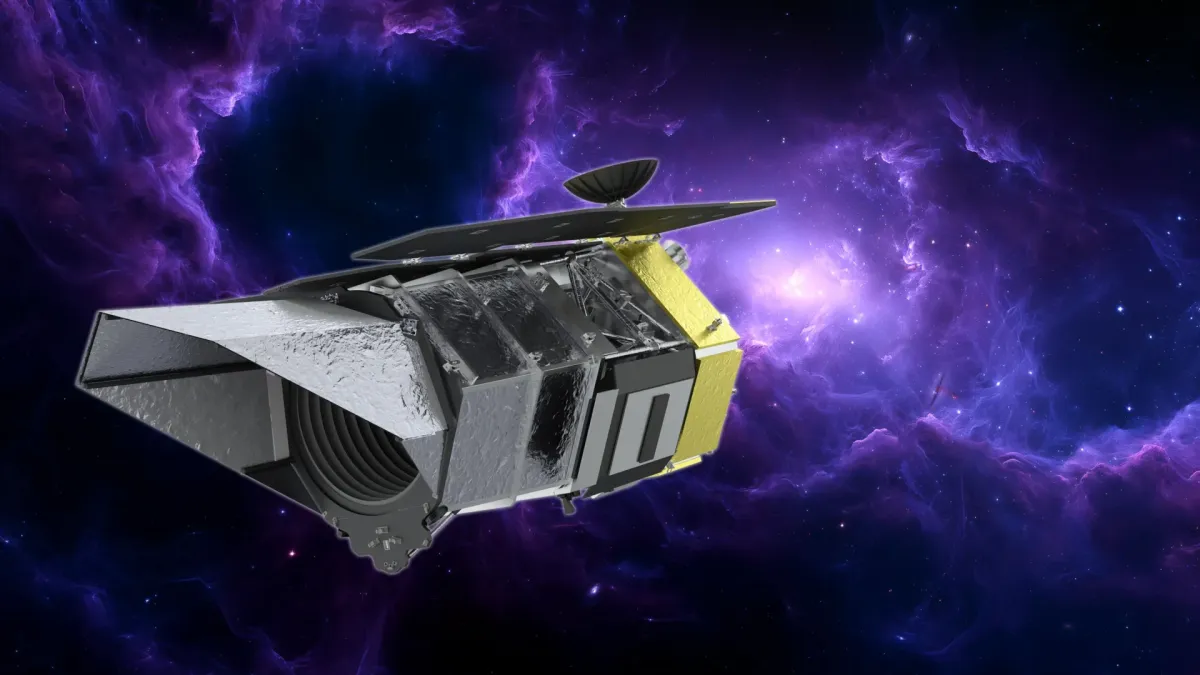
NASA's Nancy Grace Roman Space Telescope is on the brink of launch, poised to become the agency's next major astrophysics mission, following in the footsteps of the groundbreaking James Webb Space Telescope. This new observatory is engineered to scan vast swathes of the cosmos at an unprecedented pace.
While Webb dives deep into specific cosmic regions, Roman is designed for breadth, surveying huge areas of the sky. Both telescopes excel in detecting infrared light, enabling astronomers to combine their data for a richer understanding of the universe. Roman boasts a 7.9-foot primary mirror, matching Hubble's size, but its Wide Field Instrument promises to image areas 100 times larger than Hubble's cameras while maintaining similar sensitivity. Over its decades-long mission, Hubble has observed a tiny fraction of the night sky; Roman aims to map the entire sky with comparable resolution, revealing everything from dying stars to distant galaxy clusters.
A significant mission objective for Roman is to unravel the mysteries of dark matter and dark energy, the invisible forces making up most of the universe. The University of Arizona is heavily involved, with researchers developing techniques like kinematic lensing to precisely measure these phenomena by combining Roman's images with spectroscopic data. This work is expected to significantly advance our understanding of cosmic expansion and structure.
Roman's Wide Field Instrument will also be crucial for building a comprehensive map of the universe. By identifying galaxies, pinpointing their locations, and analyzing their properties across immense distances, scientists will compile massive catalogs. These catalogs, when interpreted with sophisticated physical models and requiring substantial computing power, will shed light on the universe's structure and evolution. The University of Arizona is equipping its labs with high-performance computing systems to handle this data-intensive task.
Furthermore, Roman's Coronagraph Instrument is set to revolutionize exoplanet discovery. Utilizing advanced masks and filters, it will block the intense glare of host stars, allowing for the direct imaging of nearby planets – a feat previously extremely difficult. This instrument is expected to be 100 to 1,000 times more powerful than current space-based coronagraphs, potentially detecting planets a hundred million times fainter than their stars, paving the way for future missions dedicated to finding habitable worlds.
Once Roman begins its science operations in January 2027, its data will be publicly accessible. The University of Arizona will lead nine investigations, delving into topics like supermassive black holes, galaxy formation, and cosmic dust, supported by over $2 million in funding. This collaborative approach underscores Roman's role in a new era of cosmic exploration.