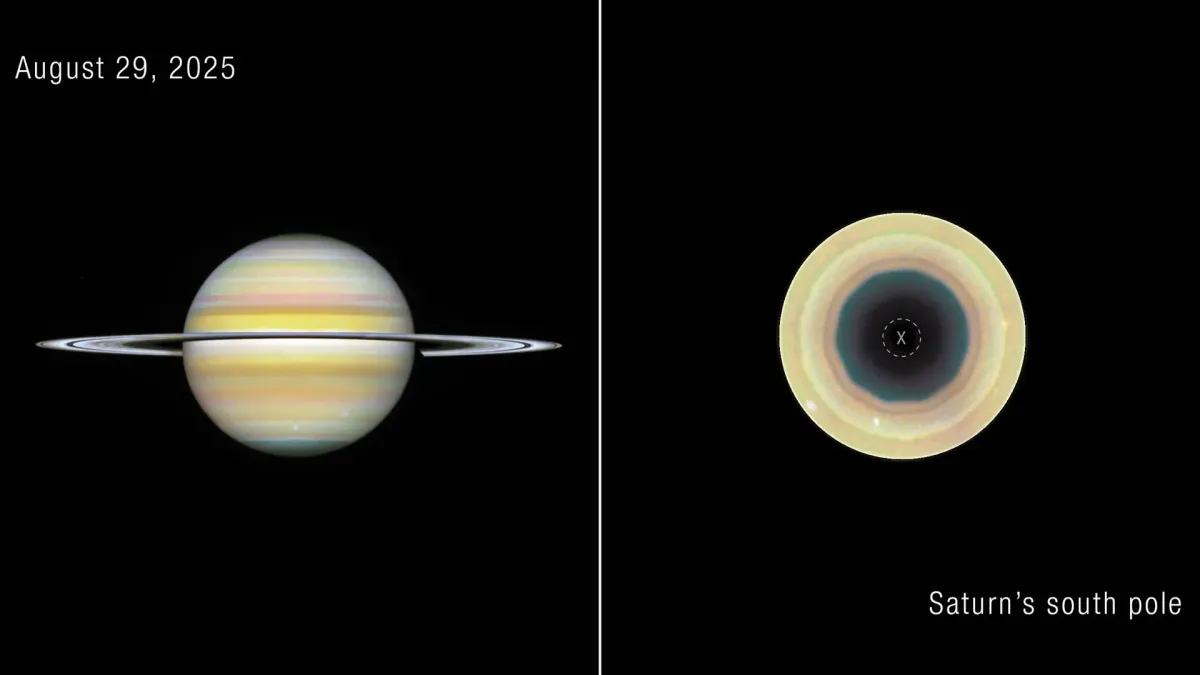
NASA's Hubble Space Telescope has detected a massive, evolving 10-sided wave pattern circling Saturn's south pole, marking the first time such a regular jet stream structure has been observed in the planet's southern hemisphere. While bearing some resemblances to Saturn's famous northern hexagon, this new feature shows key differences, suggesting scientists might be witnessing a distinct atmospheric phenomenon in development.
Researchers pieced together the formation of this unique wave using several years of Hubble observations, dating back to 2023. Earlier images revealed subtle hints of the structure before it became the clearly defined pattern observed more recently. These insights come from Hubble's Outer Planet Atmospheres Legacy (OPAL) program, which has been capturing annual images of the outer planets for over a decade.
"We've never seen anything quite like this in Saturn's southern hemisphere," stated Amy Simon, a co-author of the study and OPAL principal investigator at NASA's Goddard Space Flight Center. "The northern hexagon has been consistently present for over 40 years. This new feature, however, appears to be strengthening, offering us a rare chance to observe a massive atmospheric pattern taking shape."
Saturn's changing seasons played a crucial role in this discovery. As the planet transitioned through its seasonal cycle, its south pole gradually became visible again from Earth. Astronomers studying images from ground-based observatories were the first to notice the unusual structure, which was later confirmed and detailed by Hubble's advanced capabilities.
The newly identified wave exists within one of Saturn's powerful jet streams and appears to extend through multiple atmospheric layers, indicating it's more than just a surface-level cloud pattern. Scientists are intrigued by its recent emergence and are now working to understand its origins, stability, and potential long-term evolution, with further observations planned using both Hubble and the James Webb Space Telescope.