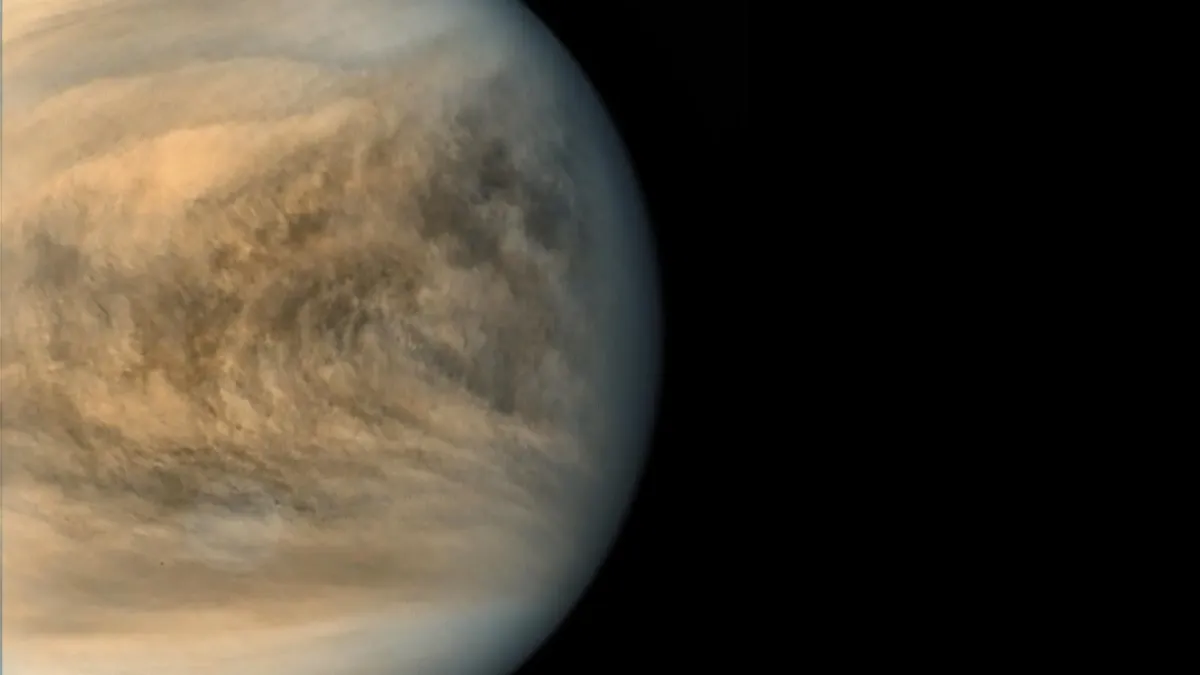
Scientists have placed new, stringent limits on what could be causing Venus's upper clouds to absorb ultraviolet light, a substance known as the "unknown absorber" that has baffled researchers for a century. While Venus appears pale yellow in visible light, it reveals dark and bright features in ultraviolet, hinting at a mysterious chemical at play.
A new study, published in Astrobiology, approached the problem by imagining Venus's cloud material, primarily sulfuric acid droplets, could be collected and studied as a concentrated liquid in a lab. This is a key distinction because the optical properties of dispersed cloud particles can differ significantly from the bulk material itself. Think of cigarette smoke: its particles scatter light to appear white, but if collected, the burned tobacco forms a dark, tar-like sludge.
Using radiative-transfer modeling combined with astronomical observations, the research team calculated how strongly the liquid within Venus's cloud droplets would need to absorb UV and blue light to match what we observe. The results show that the required absorption coefficient is substantial, meaning the unknown absorber must either be incredibly efficient at absorbing light, present in very high concentrations, or both.
Highly absorbing, carbon-based organic molecules are a potential candidate, though "organic" here simply means carbon-based and not necessarily linked to life. For comparison, molecules similar to efficient pigments like chlorophyll or heme would require concentrations around 10 grams per liter. The absorption pattern observed on Venus also suggests the substance is a chemically defined absorber that resists breaking down into the typical dark, tar-like mixtures seen when organics dissolve in concentrated sulfuric acid.
While the findings don't prove life exists on Venus or identify the absorber, they significantly narrow down the possibilities for both organic and inorganic candidates. Future missions to Venus, like those proposed by the Morning Star Missions initiative, aim to conduct in-situ experiments and use instruments like the Autofluorescence Nephelometer to directly analyze cloud particles for fluorescent signatures associated with organic molecules, potentially solving this enduring planetary mystery.