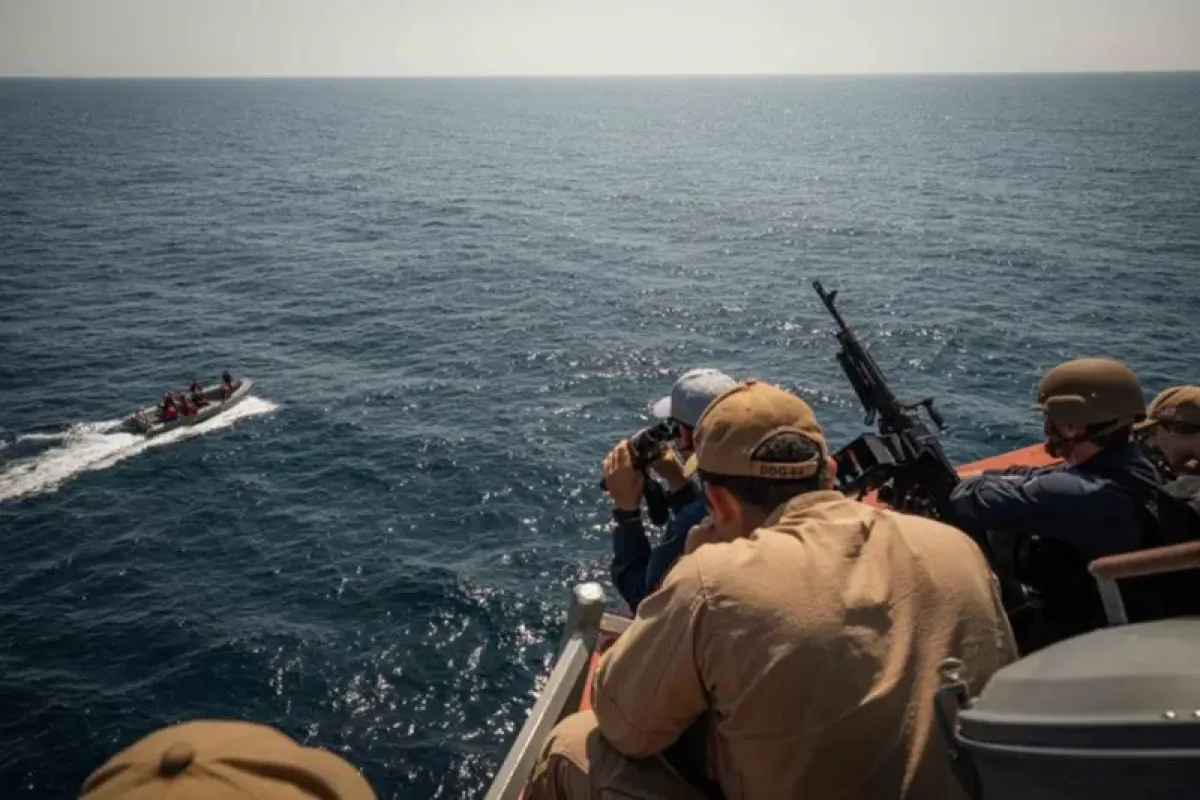
The Egyptian Navy's presence in the Red Sea is under scrutiny as Houthi threats against Egypt escalate, placing Red Sea security at the heart of regional tensions.
The threats issued by the Houthi militia against Egypt, following Cairo's decision to provide defensive support to Saudi Arabia, present an imminent regional national security challenge for Egypt. This challenge extends beyond mere political solidarity with Riyadh, directly impacting the protection of Egypt's strategic interests in the Red Sea and the security of one of the world's most vital international trade arteries. Concerns are mounting that the current tensions could evolve into a broader military confrontation.
An analysis published by "Al Majalla" magazine highlighted the potential ramifications of Egypt's stance. It warned that the Houthis' interpretation of any Egyptian defensive support to Saudi Arabia as an "act of war" indicates the group's readiness to expand its threatS, extending the conflict beyond Yemen and the Gulf to encompass regional security calculations. This leaves Cairo facing difficult choices between safeguarding its interests and avoiding entanglement in a new war.
The threats from Houthi leader Mohammed Ali al-Houthi, issued on October 27th, followed the Egyptian Parliament's authorization for President Abdel Fattah el-Sisi to provide defensive support to Saudi Arabia. This development signifies Cairo's shift from purely political and diplomatic positions to a greater willingness to contribute to the security of its Gulf ally, amidst escalating regional threats. This transition is notable when contrasted with Cairo's policy after the October 7, 2023 attacks, when Egypt avoided direct military involvement in the regional escalation, including Houthi attacks on commercial shipping in the Red Sea, despite their direct economic impact on the Suez Canal and revenue decline.
The analysis from "Al Majalla" posits that the significance of Egyptian support for Saudi Arabia transcends political commitments and bilateral relations, touching upon broader strategic considerations. Paramount among these is preventing the Yemeni coastlines, under Houthi influence, from becoming a platform for enhancing Iranian influence near vital maritime routes. The group's control over significant portions of Yemen's western coast, coupled with recurrent threats to international navigation, grants Tehran, according to this assessment, an influential leverage in a highly sensitive global trade region. The continuation of this threat poses risks to Egypt beyond the decline in Suez Canal traffic, including the potential alteration of power balances and security arrangements in the Red Sea environs.
These concerns are amplified by other regional challenges facing Cairo, including Ethiopian actions in the region and Israel's growing presence in the region of Somaliland. These developments necessitate that Egypt reassess its surrounding security environment and refrain from treating the Houthi threat as an isolated crisis unrelated to other geopolitical shifts. From this perspective, Egyptian defensive support for Saudi Arabia appears less like a response to an ally's request and more like a strategic move to counter the expansion of Iranian influence on the opposite shore of the Red Sea and to maintain a regional balance that prevents the maritime corridor from becoming an instrument of political and military blackmail.
Conversely, the analysis does not overlook the potential cost of any direct Egyptian military involvement against the Houthis. It warns that the group might escalate its responses to include vital Egyptian facilities and interests, such as ports, airports, energy depots, and tourist sites. Such actions could negatively impact economic stability and investor confidence, even before a full-scale military confrontation. These possibilities underscore the gravity of the Houthi threat, as the group now threatens not only the interests of adversaries within Yemen or Saudi Arabia but also leverages escalating rhetoric to pressure nations whose vital interests are linked to Red Sea security. Furthermore, any direct confrontation could plunge Egypt into a multi-faceted conflict, intertwined with Iranian, Gulf, and regional calculations, potentially leading to military and economic depletion at a time when Egypt faces internal challenges and economic pressures that make the cost of engaging in an open conflict extremely sensitive.
The repercussions of this option extend beyond the military domain, potentially disrupting the diplomatic track that Cairo has been cultivating with Tehran in recent years. It could also weaken communication channels that allow Egypt to influence regional issues and diminish its capacity to act as a mediator in any potential settlement of the conflict between the Houthis and Saudi Arabia.
These factors present Cairo with a highly complex strategic dilemma. Retreating from supporting Saudi Arabia or maintaining a limited political stance could allow threats to Red Sea security and Egyptian interests to persist. Conversely, direct military engagement might open a new front, expand the scope of risks, and curtail Egypt's diplomatic maneuvering room. The predicament lies in the Houthis' exploitation of expanding threats to impose regional pressure dynamics, forcing Red Sea littoral states and those connected to its security into costly choices, regardless of whether they opt for confrontation or avoidance. This grants the group the ability to influence the calculations of nations beyond Yemen, revealing that the consequences of their military control and armed activities are no longer confined to Yemen.
A fundamental paradox emerges: Cairo seeks to protect Saudi and Red Sea security without becoming a direct party to an open war, while the Houthi group attempts to portray any defensive contribution to the Kingdom's security as hostile action requiring a response. Through this rhetoric, they aim to broaden the definition of confrontation, making support for maritime security or aiding a threatened state a pretext for threatening the interests of other nations. The Houthi threats expose the extent of the risks posed by the ongoing militarization of the Red Sea and its exploitation in regional conflicts. They also place a greater responsibility on the international community to protect international navigation and prevent the use of maritime routes as tools for pressure and blackmail. The issue is no longer solely about Egypt's stance on Saudi Arabia but about the capacity of regional nations to prevent the Red Sea from becoming an open arena for settling scores and expanding Iranian influence.