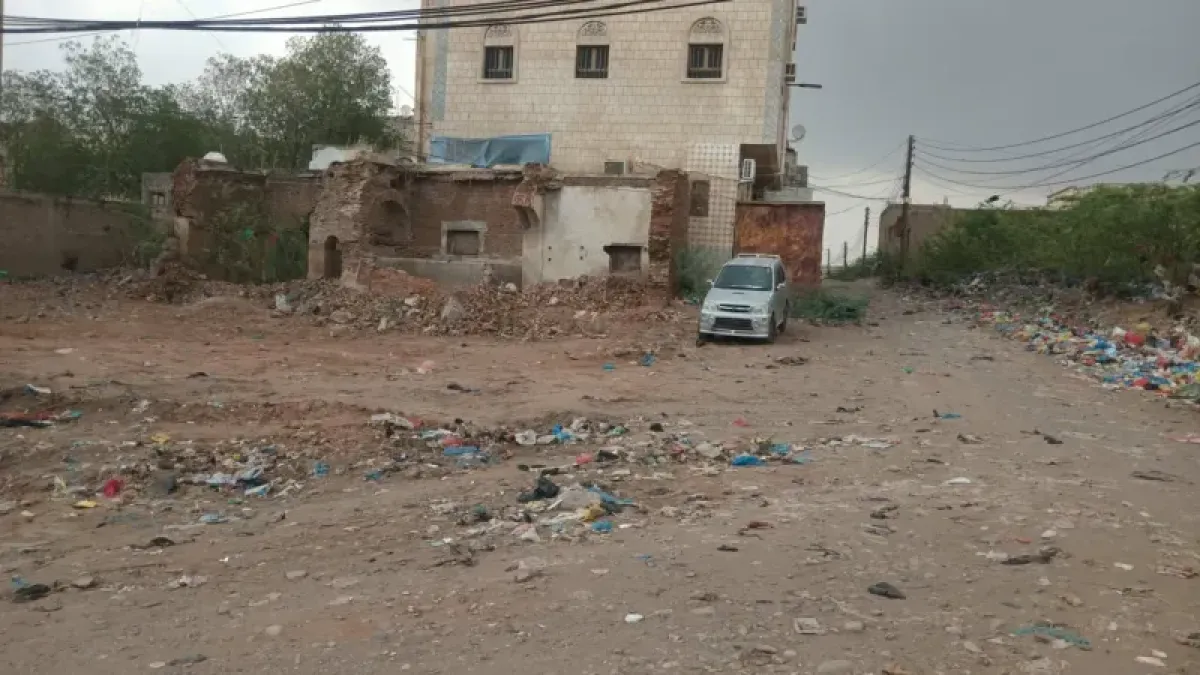
The demolition and looting of the historic old electricity company building in the city of Beit Al-Faqih, Hodeidah Governorate, has sparked widespread local outrage, with accusations directed at Houthi-aligned leaders and supervisors for orchestrating what activists describe as organized looting campaigns targeting government property, service facilities, and public lands within areas controlled by the group.
The building, which stood for decades as a recognized service landmark in Beit Al-Faqih, has become the latest casualty in a pattern of property and land seizures. This development coincides with a surge in public complaints regarding the expanding influence of powerful networks allegedly engaged in the illicit disposal of state assets and public utilities, operating without any oversight or legal accountability.
Basim Junaani, a media and human rights activist, stated that the demolished structure served as the headquarters for an electricity company established in the 1970s by Haj Ali Abdulrahman Taher and other partners. He emphasized that the building was a well-known landmark for the city's residents for many years. Junaani further alleged that influential individuals proceeded to demolish the remaining parts of the building and fence off the land, presumably for appropriation and sale, implicating local figures associated with Houthi leadership in the operation. He highlighted that this incident is not isolated but is part of a series of acquisitions of private and public properties witnessed in the city in recent years.
Activists circulated images depicting the building shortly before its demolition and after the removal of its walls, with subsequent efforts to fence the land. Many observers have characterized this as evidence of the extent of disregard for public property in the governorate. Analysts view the severity of the situation not merely in the destruction of a dilapidated building but as a recurring model for seizing public assets through the removal of existing landmarks and the imposition of a new reality to facilitate the disposal of land to investors or influential individuals, amid the absence of state institutions and oversight bodies.
Walid Al-Qudaimi, Minister of State and First Undersecretary of Hodeidah Governorate, commented on the incident, stating that land and property seizures are not new. He accused influential figures of involvement in similar cases that have affected government lands, properties, and sites designated for public services, recreational areas, and schools. Al-Qudaimi also noted previous accusations, including the appropriation of lands belonging to the Yemen Red Crescent and other public assets that were subsequently converted into residential plots or transferred for the benefit of influential individuals. He described the ongoing events as reflective of a repeating pattern of tampering with public property in areas under Houthi control.
This incident occurs within a context of escalating accusations against Houthi militias and their local supervisors for managing networks of appropriation and looting targeting government lands and real estate in Hodeidah Governorate. This activity exploits the absence of state institutions and the paralysis of judicial and oversight mechanisms, which has facilitated a widespread market for the disposal and redistribution of public property to individuals close to the group. Human rights advocates report that public property in several Houthi-controlled governorates has become vulnerable to organized seizure, ranging from state lands to service facilities, educational institutions, and public parks, resulting in the loss of numerous assets that constitute vital parts of the community's infrastructure and services.