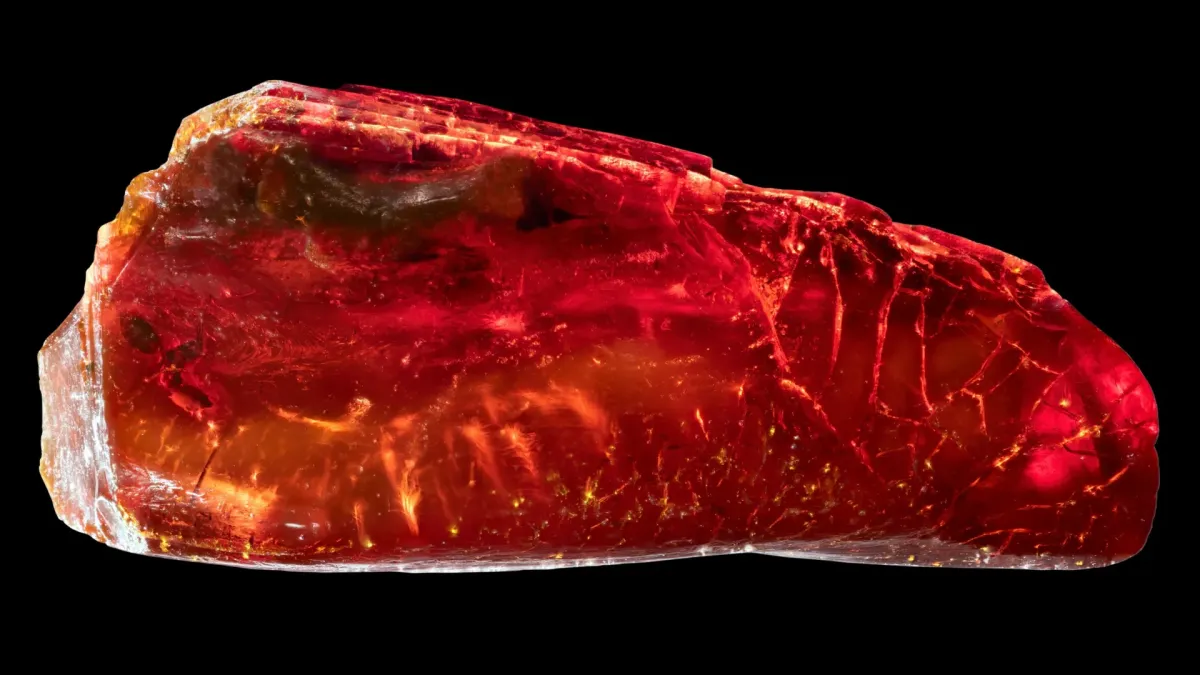
Scientists have unearthed a 40-million-year-old ant, along with other ancient insects, hidden within pieces of amber from the personal collection of the renowned German writer Johann Wolfgang von Goethe. Advanced imaging technology allowed researchers to reveal these tiny creatures, preserved for eons in fossilized tree resin.
Goethe's amber collection, now managed by Klassik Stiftung Weimar and housed at the Goethe National Museum, comprises 40 pieces of Baltic amber. Two of these specimens contained fossilized animals that were nearly invisible to the naked eye because the amber pieces had never been polished. To get a closer look, researchers from the University of Jena employed modern scanning techniques at the German Electron Synchrotron (DESY) in Hamburg.
Using synchrotron micro computed tomography, the team created detailed 3D images of the fossils, revealing three insects: a fungus gnat, a black fly, and an ancient ant. The ant, identified as an extinct species called †Ctenobethylus goepperti, particularly captured the scientists' attention.
"Thanks to its excellent preservation and extensive investigations, we were able to describe it in greater detail than ever before and gain new information about the species and its relationships," explained Bernhard Bock from the Phyletisches Museum of the University of Jena. The scans allowed for unprecedented examination of features, including fine body hairs on the worker ant and internal skeletal structures within its head and thorax, offering valuable insights into the species' anatomy and evolution.
The research team also developed a complete digital reconstruction of the fossil, making it available online. "We have fully processed the specimen and, based on the newly acquired information, created a 3D reconstruction that is available online," said Daniel Tröger from the University of Jena. "This model helps colleagues worldwide to identify and compare further fossils of this species." Comparisons with the modern ant genus Liometopum suggest these ancient ants likely lived in large tree nests, which could explain their common preservation in amber.
While Goethe owned these amber specimens, his interest focused mainly on their optical properties, even using them to create lenses for his color theory studies. By his time, amber and its fossils were already subjects of scientific study, with early publications available in his library. However, the full scientific significance of these fossils was yet to be understood, and the discoveries made today were beyond the imagination of researchers from his era.
"Goethe is regarded as the founder of morphology and would likely have been delighted to see how we were able to gain valuable insights in this field using entirely new methods," remarked Bernhard Bock. "At the same time, the results demonstrate the value of such historical collections. It is truly fascinating that an object originating from his hand and his era, when this science was just beginning, can still enrich us so much today." The findings underscore the enduring scientific value of historical museum collections, with modern imaging techniques revealing hidden stories from Earth's distant past within seemingly ordinary objects.