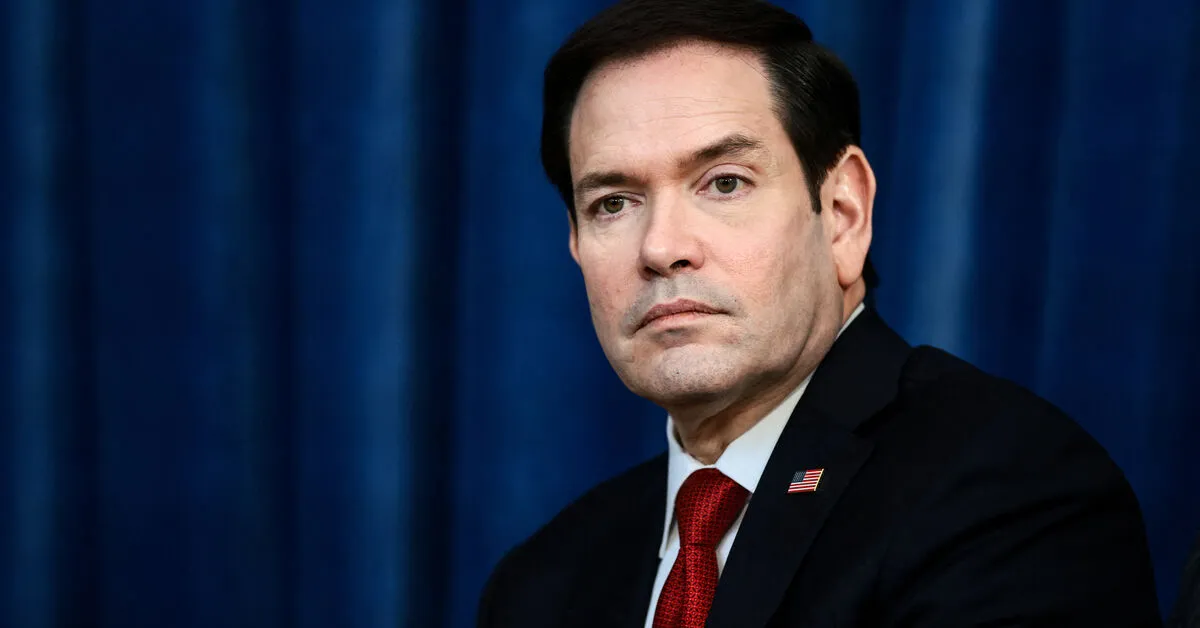
U.S. Secretary of State Marco Rubio is undertaking a critical diplomatic mission to persuade skeptical Gulf Arab leaders to accept Washington's new accord with Iran. The leaders of the Gulf Cooperation Council (GCC) countries harbor significant concerns that the agreement may embolden Tehran and disrupt the regional security balance and vital oil flows.
Rubio's itinerary includes meetings in the United Arab Emirates, Kuwait, and Bahrain, where he will engage with officials from the GCC monarchies, which also comprise Saudi Arabia, Qatar, and Oman. The crux of the dispute lies in key provisions of the draft agreement, which reportedly omit limits on Iran's ballistic missile program, propose a $300 billion reconstruction fund for Tehran, and could potentially expand Iran's regional influence and control over critical maritime trade routes.
All six GCC nations, staunch U.S. allies, provided varying degrees of logistical support to Washington during the recent conflict with Iran, and all experienced retaliatory Iranian airstrikes. Privately, some of these nations express disappointment and surprise over an interim agreement that could pave the way for U.S. normalization with Iran, a predominantly Shi'ite nation viewed by most Sunni-led GCC states as their principal adversary.
The concerns of these nations carry substantial weight for U.S. policymakers. The UAE, Saudi Arabia, Qatar, Kuwait, and Bahrain all host significant U.S. military installations, forming the bedrock of American security infrastructure in the Middle East. Any reassessment of their security ties with the U.S., however subtle, could significantly impact American military strategy in the region. Secretary Rubio faces the challenge of reassuring these allies without appearing to undermine the U.S.-Iran memorandum of understanding, which President Donald Trump has strongly endorsed despite domestic criticism.
While leaders from GCC countries publicly advocated for a diplomatic resolution prior to the recent conflict and during its progression, the specific terms of the MoU have reportedly caused private shock among regional officials. A primary concern centers on ballistic missiles; while the Trump administration had previously stated that dismantling Iran's ballistic missile capabilities was a key objective, the MoU reportedly does not address this issue. Furthermore, the proposed $300 billion reconstruction fund for Tehran raises fears among regional neighbors that Iran could leverage these resources to enhance its military capabilities and bolster support for destabilizing proxy groups.
Additionally, the accord seems to concede a significant role for Iran in controlling the Strait of Hormuz, a critical chokepoint for oil and gas exports for Kuwait, Qatar, and Saudi Arabia. This potential shift in regional power dynamics, coupled with statements from U.S. officials about a broader "reset" for Tehran, has generated considerable wariness among GCC states. Veteran Saudi columnist Abdulrahman Al-Rashed noted in Arab News that the agreement could "rehabilitate Tehran's regime as a regional power," with funds likely directed towards military strengthening rather than economic development.