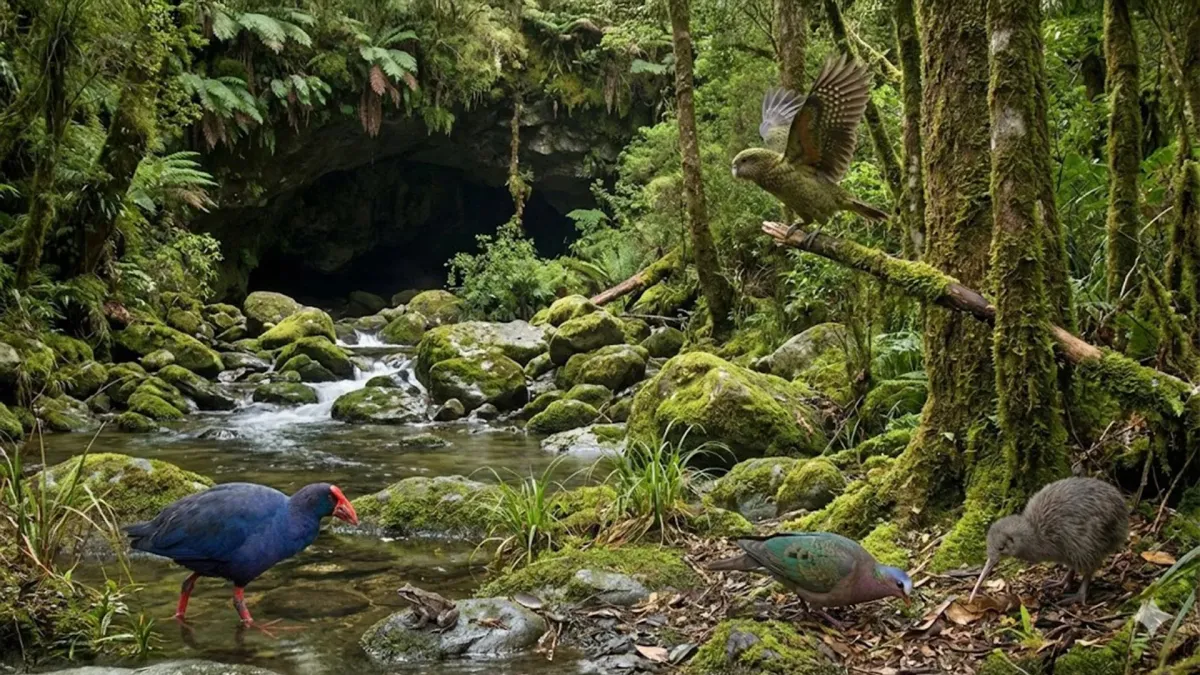
Scientists have cracked open a million-year-old time capsule hidden beneath New Zealand, revealing a lost world of ancient birds and frogs. The remarkable fossil discovery in a cave near Waitomo on the North Island offers an unprecedented glimpse into an ecosystem that vanished long ago.
Researchers from Australia and New Zealand unearthed remains from around 1 million years ago, including a previously unknown relative of the iconic kākāpō parrot. This is the first time such a large collection of ancient terrestrial vertebrate fossils from this period has been found in New Zealand. The cave preserved fossils from 12 bird species and four frog species, painting a rare picture of life centuries before humans arrived on the islands. The findings, published in Alcheringa: An Australasian Journal of Palaeontology, suggest New Zealand's wildlife was already facing massive changes long before human settlement, with volcanic eruptions and climate shifts repeatedly altering habitats.
Lead author Associate Professor Trevor Worthy of Flinders University noted that the fossils reveal a bird community vastly different from what exists today. "This is a newly recognized avifauna for New Zealand, one that was replaced by the one humans encountered a million years later," he stated. "This remarkable find suggests our ancient forests were once home to a diverse group of birds that did not survive the next million years." The study highlights that approximately 33-50% of species disappeared in the million years before humans reached Aotearoa New Zealand.
Co-author Dr. Paul Scofield, Senior Curator of Natural History at Canterbury Museum, explained that these extinctions were likely driven by natural environmental upheavals. "These extinctions were driven by relatively rapid climate shifts and cataclysmic volcanic eruptions," he said. The discovery fills a major gap in New Zealand's fossil record, providing insights into a 15-million-year period previously absent from scientific understanding. "This wasn't a missing chapter in New Zealand's ancient history, it was a missing volume," Dr. Scofield added.
Among the most exciting finds is a new parrot species, Strigops insulaborealis, an ancient relative of the kākāpō. While modern kākāpō are flightless, analysis of the fossilized bones suggests this ancestor may have retained the ability to fly, possibly due to weaker leg bones indicating less reliance on climbing. The cave also yielded fossils of an extinct takahē ancestor and an extinct pigeon species related to Australian bronzewings. "The shifting forest and shrubland habitats forced a reset of the bird populations," Dr. Scofield commented. "We believe this was a major driver for the evolutionary diversification of birds and other fauna in the North Island."
The fossils' age is precisely determined by two layers of volcanic ash found within the cave, dating to approximately 1.55 million and 1 million years ago. This geological "sandwich" offers clear age limits, with the younger ash layer indicating the site is the oldest known cave on New Zealand's North Island. Associate Professor Worthy emphasized the fossils' importance in understanding New Zealand's natural history, providing a crucial baseline that shifts focus from human impact to the long-term influence of natural forces on the islands' unique wildlife.