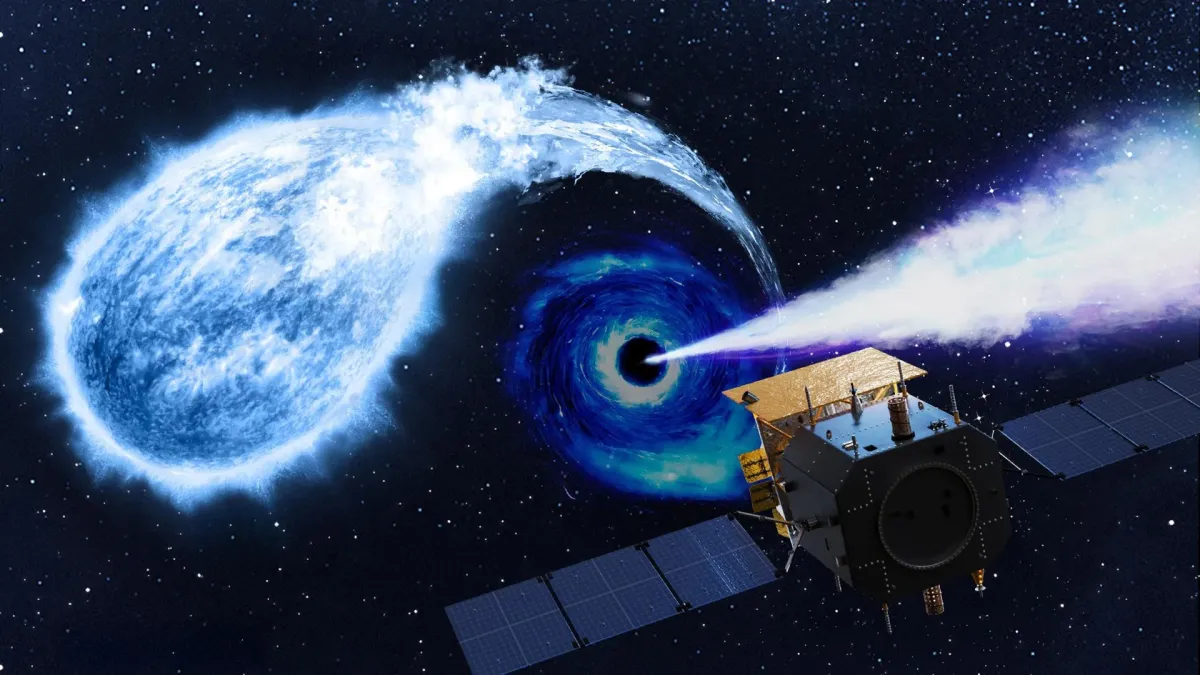
An astonishing deep-space event captured by the China-led Einstein Probe (EP) might be the first direct observation of an intermediate-mass black hole tearing apart and consuming a white dwarf star. The high-energy spectacle, detected on July 2, 2025, triggered a global race among observatories to study this rare cosmic phenomenon.
The Einstein Probe's Wide-field X-ray Telescope (WXT) initially flagged a rapidly fluctuating X-ray source, designated EP250702a. This unusual signal stood out from typical cosmic X-ray sources due to its dramatic brightness changes. Coincidentally, NASA's Fermi Gamma-ray Space Telescope also detected gamma-ray bursts from the same cosmic neighborhood around the same time.
Further analysis of earlier WXT data revealed an even stranger sequence: steady X-ray emissions from the location roughly a day before the gamma-ray bursts, a pattern not usually associated with massive cosmic explosions. This pre-cursor signal, followed by intense X-ray flares peaking at an extraordinary luminosity of 3 × 10^49 erg s-1, hinted at something far more unique than a standard gamma-ray burst.
Following the WXT's precise location data, telescopes worldwide aimed at the source, confirming its position on the outskirts of a distant galaxy. As the EP's Follow-up X-ray Telescope (FXT) monitored the event, its brightness plummeted by over 100,000 times in about 20 days, with a shift from high-energy to low-energy X-rays.
The event's characteristics—early X-ray signals, extreme brightness, rapid evolution, and location away from a galaxy's center—challenged existing models. After exploring various possibilities, researchers concluded that the most compelling explanation is an intermediate-mass black hole ripping into a white dwarf, a process previously unseen in direct observation. The findings were published as the cover story in Science Bulletin.