Astronomers have stumbled upon two of the fluffiest giant planets ever found, so light they’re actually less dense than cotton candy. This rare duo of "super-puff" planets was identified by an international team, with findings published in the Monthly Notices of the Royal Astronomical Society.
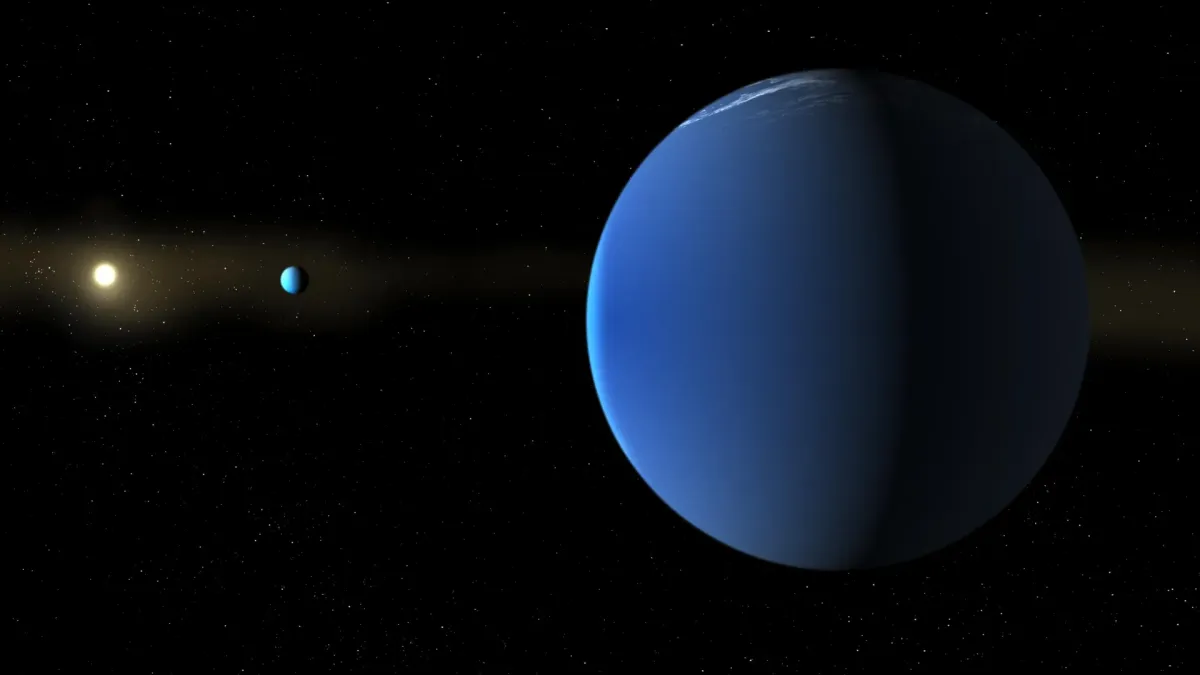
The newly confirmed planets, dubbed TOI-791 b and TOI-791 c, are located about 1,110 light-years away and orbit a star in the southern constellation Volans. While each planet boasts the size of Jupiter, their mass is astonishingly low. TOI-791 b has a density of a mere 0.038 grams per cubic centimeter, and TOI-791 c clocks in at 0.047 grams per cubic centimeter. For context, Jupiter is about 28 to 35 times denser than these cosmic siblings, and even cotton candy, typically around 0.05 grams per cubic centimeter, is denser.
Scientists believe these two planets formed together, essentially "siblings" from the same cosmic nursery. They also share a unique orbital rhythm: for every five laps the inner planet completes, the outer one finishes nearly three. Their gravitational tug-of-war creates subtle but detectable shifts in their transit timings. Finding multiple super-puff planets in a single system is incredibly rare, with only four other known examples, making TOI-791 a prime spot for understanding how these peculiar worlds come to be.
Remarkably, citizen scientists playing a role in the Planet Hunters TESS project first flagged these potential planets back in 2019 and 2023. Researchers then used data from telescopes worldwide to nail down their sizes and masses, revealing their ultra-low densities. The slight timing variations in the planets' transits across their star were key to estimating their mass.
The discovery benefited greatly from eight years of observations, including crucial data from the ASTEP telescope at Concordia Station in Antarctica. The extended winter darkness there provided uninterrupted views of the planets' unusually long transits, lasting over 11 hours – the longest continuous planetary transits ever fully observed from Earth.
The formation of super-puff planets remains a puzzle, but the leading theory suggests they possess massive hydrogen and helium atmospheres that constitute a large portion of their total mass. Future observations, including planned studies with the James Webb Space Telescope, aim to probe these atmospheres for clues about their origins and test different formation theories, offering a unique window into planetary system evolution.