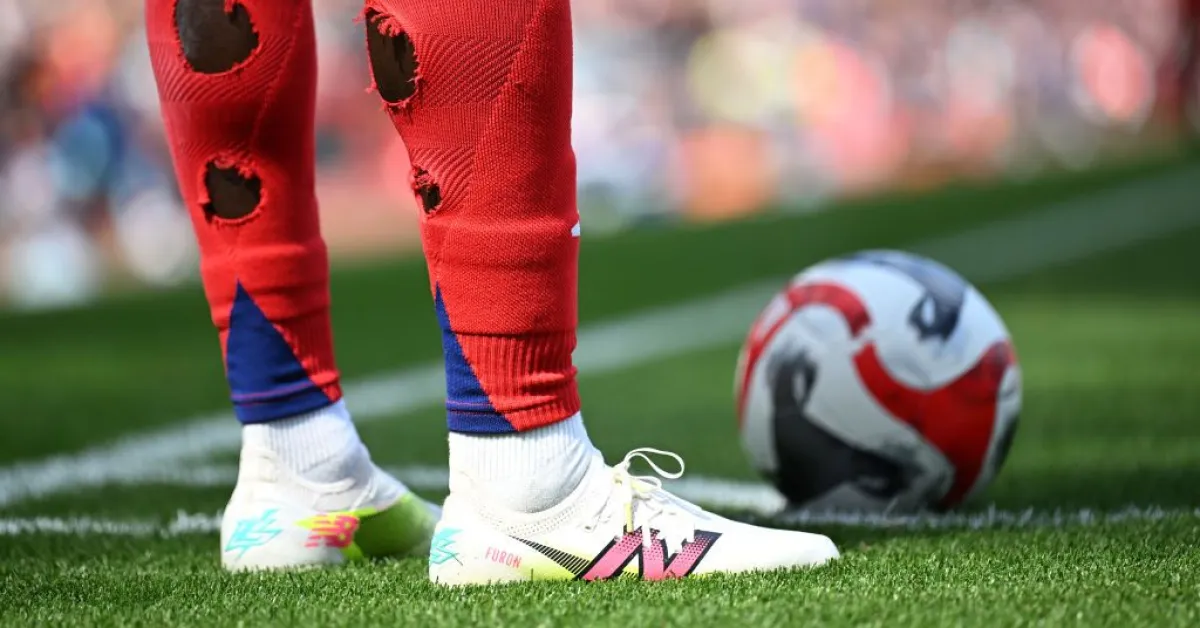
A curious trend is emerging on soccer fields worldwide: players cutting holes in their socks, particularly around the calf area. While social media buzzes with theories about competitive advantages, this practice, seen across major tournaments for years, lacks scientific backing for performance enhancement.
Professional soccer socks are engineered for a snug fit, designed not just to hold shin guards in place but also to support ankles, arches, and calves, while managing moisture and boosting stability by reducing foot slippage. These socks, typically made from synthetic blends like polyester, nylon, and spandex, have followed this design philosophy for decades, with modern materials offering improved lightness and durability.
However, many players report that these form-fitting socks can feel too tight, leading to tingling and numbness in their calves. To combat this discomfort and improve their ability to run freely, some players resort to cutting holes in the sock's calf section to alleviate pressure.
This sensation has a biomechanical root. When a player sprints or changes direction, their calf muscles contract and thicken to generate power. This repeated expansion, occurring thousands of times per game, can create a feeling of pressure for some individuals when the sock consistently compresses the muscle. Players often describe this as letting the muscle "breathe," relieving pressure and potentially preventing pain or cramps.
Despite the players' experiences, sports medicine specialists note a lack of studies proving any benefit from cutting socks. In fact, research on compression garments often suggests they can help reduce post-exertion muscle inflammation when properly fitted. The rules of the game also permit sock modifications, provided shin guards remain covered and the equipment is safe.
Given the absence of physiological proof, experts suggest that comfort perception plays a significant role. In high-stakes sports, feeling comfortable can boost an athlete's confidence. If a player perceives their socks as restrictive, removing that perceived barrier might make them feel more agile and confident, even if objective performance metrics don't change.
It's crucial to understand that there's no evidence cutting socks enhances performance or prevents injuries. However, the discomfort players feel is not imaginary. Individual sensitivity, anatomy, and past experiences all influence how players perceive pressure or restriction. Essentially, the same gear can affect two players very differently.
For now, the sock-cutting phenomenon is likely to persist, driven more by a psychological effect—akin to other sports rituals—than by demonstrable physiological gains. The perceived benefit, while not scientifically validated, seems to be enough for players to continue the practice.